Why Industrial Leaders Are Choosing Solar for Future-Proofing Their Business
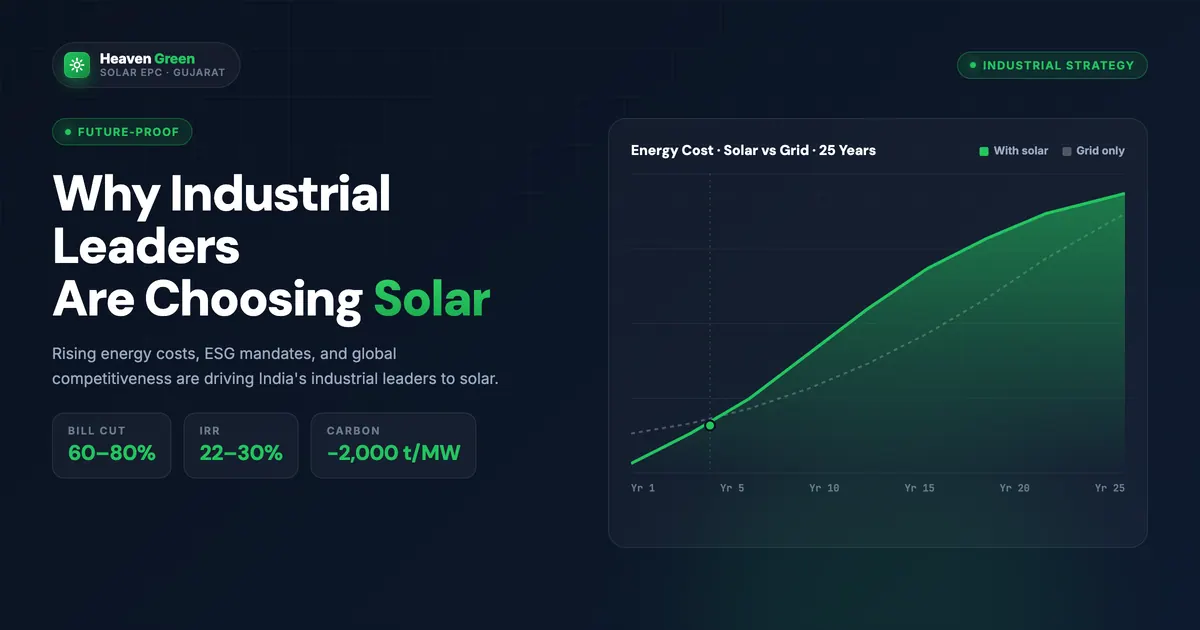
Industries across India are facing a convergence of pressures: rising energy costs, global climate commitments, and increasing demand for sustainable operations. The smartest industrial leaders are not waiting for conditions to worsen further. They are rethinking their power strategy — and solar is at the center of that shift.
This is not just about saving money on electricity bills. It is about future-proofing an entire business against forces that will only grow stronger over the next decade.
Five Reasons Industrial Leaders Are Going Solar Now
1. Locking In Energy Costs for Long-Term Margin Protection
Grid electricity tariffs rise every year. Industries that rely entirely on grid power have no control over one of their largest operating expenses. Solar changes this equation entirely.
By installing solar, businesses lock in their energy costs today and protect against future tariff increases for 20–25 years. In margin-sensitive industries like textiles, chemicals, ceramics, and food processing, this cost certainty translates directly into a strategic competitive advantage.
2. Financial Returns That Match No Other Asset Class
Solar is not a charity investment. The financial returns are hard and measurable.
- ROI in less than 4 years on most industrial solar projects
- 20+ years of near-free electricity after payback
- 25+ years of panel life with minimal maintenance
- Long-term value generation unlike equipment that depreciates
No other capital investment in a manufacturing facility delivers guaranteed returns over such a long time horizon.
3. Accessible Financing That Removes the Upfront Barrier
The perception that solar requires massive upfront capital is outdated. Industrial solar projects today can be financed with:
- Up to 80% loan availability through banking and NBFC partnerships
- Interest subsidies through government energy schemes
- 40% accelerated depreciation in Year 1, reducing effective tax liability
- Structured repayment that can mirror or replace existing electricity bills
For many industries, solar installations can be structured so that EMIs are less than or equal to current monthly power bills — making the switch cash-flow neutral from day one.
4. ESG Credentials That Open Doors in Global Markets
Sustainability is no longer optional for industries with export exposure or international supply chains. Solar adoption directly strengthens:
- ESG scores that investors and lenders increasingly scrutinise
- Supplier credentials for global brands with sustainability requirements
- Brand reputation with customers who prioritise environmental responsibility
- Compliance with evolving green procurement regulations
Industries without credible sustainability programs are finding it harder to win contracts in Europe, North America, and other regulated markets. Solar is the most visible and verifiable step toward those credentials.
5. Long-Term Asset Value That Works for Decades
Unlike machinery or vehicles, solar panels keep generating value for decades. The energy they produce becomes more valuable over time as grid tariffs rise. This means:
- A solar plant installed today is worth more in real terms by Year 10 than it was at commissioning
- It strengthens balance sheets by converting operating expense into asset ownership
- It creates sustainable, predictable cash flows that improve financial standing with banks and investors
Case Studies: Industrial Leaders Who Made the Move
HPCL Panipat, Haryana — 8 MW
One of India’s largest refining facilities installed an 8 MW solar plant, achieving significant reductions in grid reliance and operating expenses while meeting sustainability targets.
Manjalpur GIDC, Vadodara — 1 MW
A Vadodara industrial cluster project delivered energy cost savings and ESG compliance for a manufacturing unit operating in a competitive export environment.
Surat Textile Units — 50 kW to 1 MW
Multiple Surat textile manufacturers achieved financial break-even in under four years. The energy savings now flow directly into more competitive pricing and improved margins on both domestic and export orders.
The Strategic Choice: Grid Dependency vs. Energy Sovereignty
| Factor | Grid-Dependent Industry | Solar-Powered Industry |
|---|---|---|
| Energy cost | Rising, uncontrollable | Fixed, predictable |
| Financial planning | Uncertain | 25-year cost visibility |
| ESG profile | Weak | Strong |
| Global competitiveness | Declining | Improving |
| Balance sheet | Energy as liability | Energy as asset |
Industrial leaders who adopted solar five years ago are now enjoying free electricity, stronger margins, and better ESG ratings. The leaders who act today will have the same advantage over those who continue to wait.
Heaven Green Energy: Empowering India’s Industrial Solar Transition
Heaven Green Energy Ltd has empowered over 200 MW of industrial and commercial solar projects across India, earning recognition among the Top 3 EPC companies in Gujarat. We provide end-to-end solutions including engineering, procurement, construction, financing guidance, and after-sales support.
Our partnerships with Adani Solar, Polycab, and Apollo Structures ensure every project is built to the highest standards of quality and reliability.
Future-proof your business with solar. Contact Heaven Green Energy today: +91 63904 05060