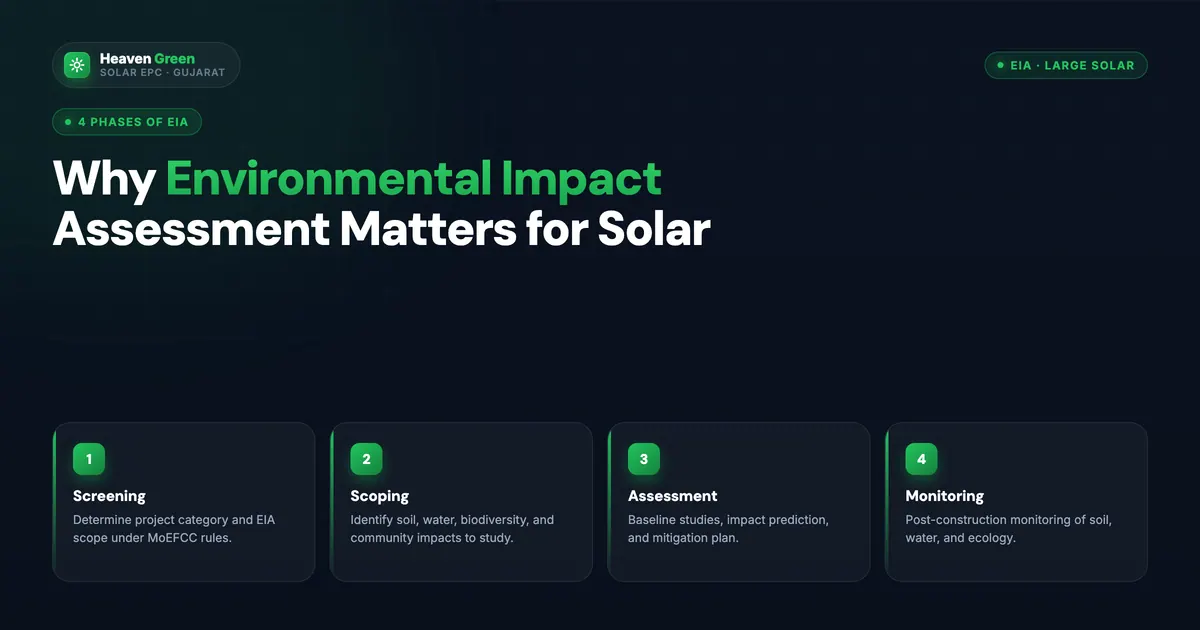
Why Environmental Impact Assessment Matters for Large Solar Power Projects
Solar energy has an image of being entirely clean and consequence-free. And when you compare it to coal or gas, it is. But here is what the industry does not discuss enough: large-scale solar construction is still construction.
Building a utility-scale solar park means moving earth, managing water flows, working near ecosystems, and interacting with local communities. Done carelessly, that can cause real harm. Done with proper planning — specifically, with a well-executed Environmental Impact Assessment (EIA) — it becomes a model for responsible development.
What Is an EIA — and What Is It Not?
“Environmental assessment is not about stopping development. It is about understanding the land, water, ecology, and people around a project site before construction starts.”
An EIA is a structured assessment carried out before a large project breaks ground. It identifies potential environmental risks, proposes mitigation measures, and creates a framework for responsible construction and operation.
It is not red tape. It is not an obstacle. It is a planning tool — and the projects that treat it as one consistently outperform those that do not.
Solar’s Hidden Complexities
The assumption that solar is entirely consequence-free does not hold at scale. Large projects involve:
- Land clearing that can disrupt natural drainage and increase erosion
- Water usage during construction and panel cleaning operations
- Construction activity that generates dust, noise, and traffic
- Physical infrastructure that changes land use and can affect local habitats
None of these are insurmountable — but they all require advance planning, not reactive fixes.
Key Focus Areas in a Solar EIA
Land Assessment
- Identifying and protecting any forested or ecologically sensitive zones within or adjacent to the project boundary
- Maintaining natural drainage channels to prevent waterlogging or erosion
- Planning soil management to minimise disturbance during construction
Water Management
- Mapping groundwater resources and ensuring construction does not compromise local aquifers
- Designing stormwater handling systems to prevent run-off contamination
- Incorporating rainwater harvesting where possible to reduce net water demand
Construction Impact Mitigation
- Dust suppression planning during earthwork phases
- Noise management schedules to minimise disruption to nearby residents
- Traffic management to reduce burden on local roads during equipment transport
Ecological Protection
- Biodiversity surveys before ground clearance begins
- Habitat preservation measures for species identified on or near the site
- Bird and wildlife impact assessments, including glare and collision risk
- Preservation corridors to allow wildlife movement through the project area
Community Engagement
- Transparent dialogue with local populations about the project timeline and expected impacts
- Addressing employment and livelihood concerns — large solar projects can be a source of local jobs
- Grievance mechanisms so communities have a way to raise concerns throughout the project lifecycle
The Business Case for Getting EIA Right
Beyond the ethical argument, there is a very practical one.
Projects with strong environmental foundations consistently deliver:
- Fewer construction delays from regulatory disputes or community opposition
- Lower legal and operational risks over the project’s lifetime
- Easier access to financing — international lenders and green finance institutions increasingly require credible EIA documentation
- Better long-term performance from sites that were properly assessed and prepared
Cutting corners on environmental planning is not a cost saving. It is a deferred cost — one that typically arrives at the worst possible time.
Clean Energy Deserves Clean Planning
The solar industry’s promise is a cleaner world. That promise extends beyond the electricity the panels generate. It includes how the land beneath those panels was treated, how the local community was consulted, and how construction was managed.
Clean energy deserves clean planning.
An EIA is not a bureaucratic hurdle. It is how large solar projects earn — and keep — their social licence to operate.
Heaven Green Energy designs and develops large-scale solar power plants with full environmental due diligence built into every project. If you are planning a utility-scale or commercial solar installation, speak to our team about responsible project development.
Call us: +91 63904 05060 Email: hevaensolarenergy@gmail.com Hours: Monday–Friday, 9 AM–5 PM