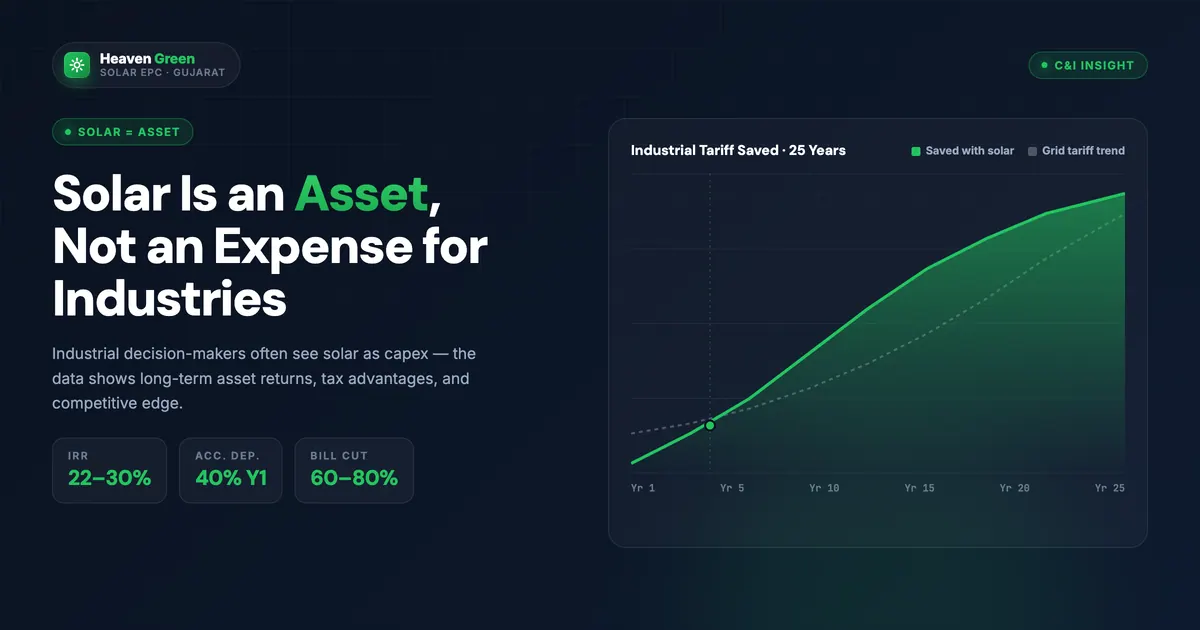
Breaking the Myth: Solar Is Not an Expense, It’s an Asset for Industries
The biggest obstacle to industrial solar adoption is not the technology, the cost, or even the paperwork. It is a mindset problem.
Many industrial decision-makers still treat a solar installation as a capital expense — money going out the door. But the numbers tell a fundamentally different story. Solar is not an expenditure. It is a long-term, revenue-generating asset that starts working for your business from day one.
Why Industries Hesitate
Most industries allocate 20–40% of their operating budget to electricity costs. That figure grows every year as grid tariffs rise. Yet when presented with solar, many leaders ask: “What is the upfront cost?” rather than “What is the return?”
The framing matters. A machine that saves ₹1 crore a year is not an expense — it is an investment. Solar is the same.
The Financial Returns Are Tangible and Measurable
1. Direct Energy Cost Reduction
A well-designed solar system can eliminate 30–80% of grid electricity consumption depending on system size and load profile. For an industry spending ₹20–50 lakh monthly on power, this creates immediate and compounding savings.
2. Break-Even in 3–4 Years
Most industrial solar projects achieve break-even within 3–4 years through optimised design and execution — leaving 20+ years of near-free electricity generation.
3. Accelerated Depreciation and Tax Benefits
The Indian government allows 40% accelerated depreciation on solar assets in the first year. Combined with GST input credits and financing incentives, the effective cost of installation is significantly lower than the headline price.
4. Financing That Replaces Your Power Bill
Financing options cover up to 80% of project costs through subsidised loan programmes. Monthly loan repayments can replace — and eventually become lower than — your existing electricity bills. Once the loan is paid, the electricity is essentially free.
Beyond Savings: Strategic Advantages
Competitive Edge
Lower electricity costs mean lower production costs. This improves competitiveness in both domestic and international markets — especially in energy-intensive sectors like textiles, chemicals, and food processing, where margins are thin and energy is a major cost driver.
Energy Independence
Solar locks in your energy costs today, shielding your business from future grid tariff increases. With electricity prices rising unpredictably, this certainty is itself a strategic asset.
ESG and Brand Value
Global supply chains increasingly require sustainability credentials. Solar adoption:
- Satisfies ESG reporting requirements for investors
- Meets requirements from international buyers and export customers
- Strengthens brand value with environmentally conscious stakeholders
- Qualifies your business for green procurement programmes
Real-World Case Studies
HPCL Panipat, Haryana — 8 MW Installation
An 8 MW solar plant significantly reduced grid reliance and long-term operating expenses for one of India’s largest refineries.
Surat Textile Plants — 50 kW to 1 MW Systems
Multiple textile units across Surat achieved financial payback in under four years while benefiting from substantial tax advantages. The cost savings now flow directly to improved margins and competitiveness.
Gujarat Manufacturing Clusters
Across Gujarat’s industrial zones, Heaven Green Energy has helped businesses convert energy costs into long-term assets through optimised design and EPC execution.
The Asset Analogy
Consider how industrial decision-makers think about other assets:
- A CNC machine costs ₹50 lakh and depreciates. Yet it is bought without hesitation because it produces value.
- A solar plant costs ₹50 lakh and appreciates in relative value as electricity tariffs rise. It generates power for 25+ years with minimal maintenance.
The difference is perception, not reality. Solar is the better investment by almost every financial metric.
Solar Pays Back. Machines Depreciate. The Choice Is Clear.
| Factor | Grid Electricity | Solar Installation |
|---|---|---|
| Cost trajectory | Rising every year | Fixed for 25 years |
| ROI | None (pure expense) | Break-even in 3–4 years |
| Tax benefit | None | 40% accelerated depreciation |
| After payback | Bills continue forever | Near-free electricity |
| Balance sheet impact | Liability | Long-term asset |
Heaven Green Energy: 200+ MW of Industrial Solar Completed
Heaven Green Energy Ltd has delivered more than 200 MW of successful solar projects across India and is recognised among the Top 3 EPC companies in Gujarat. We work with trusted partners including Adani Solar, Polycab, and Apollo Structures to ensure every project is engineered for maximum returns.
We handle everything: engineering, procurement, construction, financing guidance, and documentation — so you can focus on your business while solar handles your energy costs.
The smartest industries in India have already made the switch. The question is not whether solar makes financial sense — the evidence is clear that it does. The question is how much longer you will wait before starting to benefit.
Contact Heaven Green Energy today: +91 63904 05060