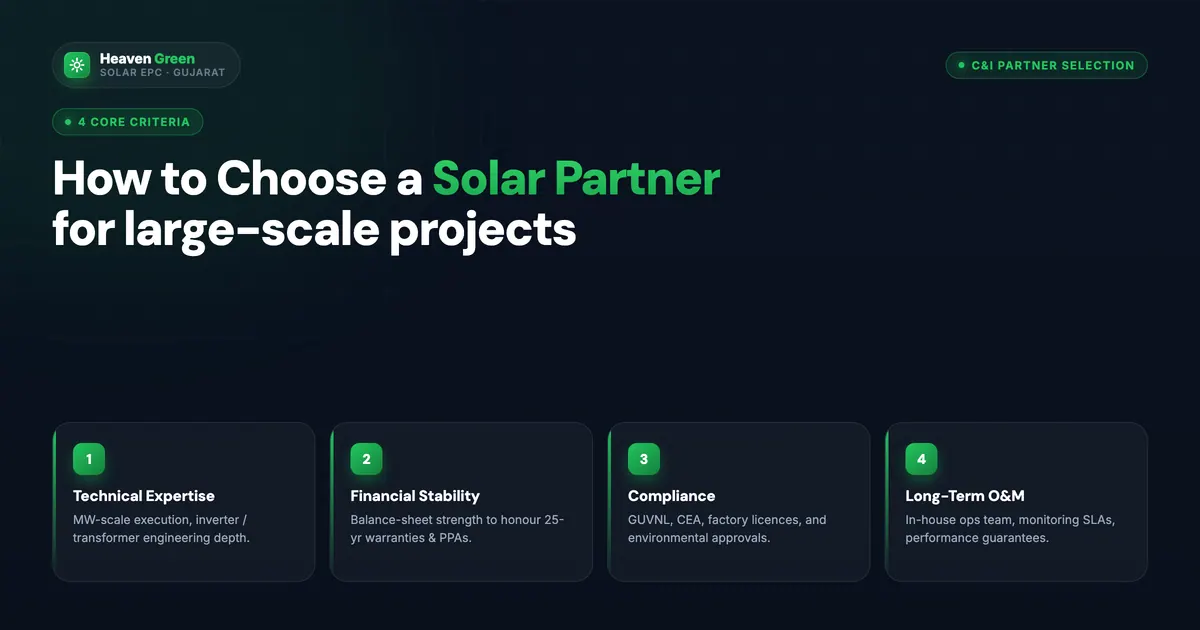
Selecting the right solar partner for your large-scale solar project is one of the most critical decisions stakeholders will make. Multi-megawatt installations represent significant capital investments spanning decades, and the EPC (Engineering, Procurement, and Construction) partner you choose will determine whether that investment delivers its promised returns.
Gujarat has established itself as India’s solar powerhouse, with over 13,000 MW of installed solar capacity as of 2026. The state’s expanding market attracts both reputable players and underqualified entrants — making rigorous partner selection essential.
Eight Core Criteria for Evaluating a Solar EPC Partner
1. Technical Expertise and Engineering Capabilities
A credible solar EPC partner must demonstrate genuine engineering depth, not just project management experience.
What to assess:
- In-house design and engineering qualifications
- Site assessment capabilities including geotechnical surveys and shading analysis
- Proficiency with advanced design software such as PVsyst, AutoCAD, and ETAP
- Experience across multiple system types — rooftop, ground-mounted, carport, floating
Request sample engineering reports from past projects. The quality of documentation reveals the depth of technical competence more accurately than sales presentations.
2. Financial Stability and Business Track Record
Solar systems operate for 25+ years. Your EPC partner must be financially robust enough to honour warranties and provide support across that timeframe.
Due diligence steps:
- Request financial statements and credit ratings
- Verify consistent revenue growth over 3–5 years
- Confirm adequate bonding capacity for project scale
- Assess comprehensive insurance coverage (general liability, professional indemnity, workers’ compensation)
A company that cannot provide audited financials should be treated as a significant risk.
3. Project Portfolio and Past Performance
Past performance is the strongest predictor of future execution quality.
Portfolio evaluation:
- Multi-megawatt ground-mounted installation experience
- Verifiable client references — contact them directly and, where possible, visit completed sites
- Project completion statistics: percentage completed within agreed timelines and budgets
- Experience with utility interconnection and DISCOM coordination
Ask for three to five references of similar project scale and type. A reluctance to provide references is itself a red flag.
4. Execution Capabilities and Resource Availability
The gap between promising delivery and actually executing it separates professional EPC companies from intermediaries.
Assess the following:
- Trained permanent workforce versus reliance on ad hoc subcontractors
- Owned equipment: pile drivers, cranes, testing apparatus, cable laying machinery
- Established supplier relationships ensuring component availability
- Formal project management systems (Gantt charts, milestone tracking, progress reporting)
Ask to see a sample project execution plan from a comparable past installation.
5. Quality Standards and Component Selection
The components your EPC partner specifies determine system longevity and energy yield.
Quality benchmarks:
- Tier-1 solar module brands with bankable performance warranties
- Reputable inverter manufacturers with established India service networks
- Balance-of-system specifications — cables rated for outdoor UV exposure, properly sized AC and DC protection
- Formal quality assurance processes with site inspection checklists
- Clear warranty documentation: typically 2–5 years workmanship, 10–12 years product, 25 years performance for panels
Do not accept vague references to “quality components” — require specific brand names, model numbers, and certification documentation.
6. Post-Installation Support and Maintenance
Operations and maintenance (O&M) quality directly impacts lifetime energy yield and investment returns.
O&M scope to expect:
- Scheduled panel cleaning and inspection
- Electrical connection checks and thermal imaging
- Inverter monitoring and firmware updates
- Performance monitoring with real-time data access
- Regular performance reports comparing actual versus expected generation
Regular performance reports comparing actual vs. expected generation help identify optimization opportunities and detect component degradation before it significantly impacts revenue.
Confirm whether O&M is handled by the same company or outsourced — and obtain references specific to maintenance quality, not just installation.
7. Government Scheme Expertise and Regulatory Compliance
Large-scale projects in Gujarat frequently involve PM-KUSUM, DREBP, or other state and central government schemes. Navigating these programmes requires specific expertise.
What to confirm:
- Demonstrated experience implementing PM-KUSUM and relevant Gujarat state schemes
- Understanding of CEIG (Chief Electrical Inspector to Government) requirements
- Track record of obtaining grid connection approvals from GEBCo, GETCO, and DISCOMs
- Familiarity with net metering and feed-in tariff documentation
An EPC partner unfamiliar with scheme requirements can delay commissioning by months and jeopardise subsidy eligibility.
8. Red Flags That Should End the Conversation
Some indicators should immediately disqualify a potential partner regardless of their pitch quality.
Disqualifying red flags:
- Unrealistic energy generation promises exceeding standard Gujarat irradiation calculations
- Lack of transparency in equipment specifications or pricing breakdowns
- No verifiable completed projects of comparable scale
- High-pressure sales tactics or artificial urgency around pricing
- Unknown or uncertified component brands not available on the MNRE approved list
- Vague warranty terms lacking clear documentation on what is and is not covered
Weighted Evaluation Scorecard
Use this framework to compare multiple proposals systematically:
| Evaluation Criterion | Weighting |
|---|---|
| Technical expertise and engineering | 20% |
| Project portfolio and past performance | 20% |
| Financial stability | 15% |
| Execution capabilities and resources | 15% |
| Component quality and specifications | 15% |
| Post-installation support and O&M | 10% |
| Pricing and total value | 5% |
Score each shortlisted partner against each criterion, then multiply by the weighting to produce a composite score. This prevents a single impressive attribute — such as lowest price or most recognisable brand — from dominating a decision that should be multidimensional.
Systematic Comparison Process
Once you have shortlisted two or three partners, use this process to reach a final decision:
- Normalise proposals — require all partners to quote on identical technical specifications before comparing prices
- Compare warranty terms — assess what is included versus excluded in each warranty
- Calculate total cost of ownership — factor in expected maintenance costs, inverter replacement timelines, and monitoring fees over 25 years
- Conduct site visits — visit at least one completed installation from each shortlisted partner
- Negotiate comprehensive contracts — ensure technical specifications, timelines, payment milestones, performance guarantees, and dispute resolution mechanisms are clearly documented
- Establish collaborative partnership approach — the relationship begins at contract signing and extends for 25+ years
Frequently Asked Questions
What is the difference between an EPC partner and a solar installer? An EPC partner manages the complete project lifecycle — engineering and system design, equipment procurement, and full construction — typically under a single fixed-price contract. An installer may only handle physical installation of components specified and procured by others. For multi-megawatt projects, a full EPC partner provides better accountability and single-point responsibility.
How many years of experience should I require? For projects above 500 kW, prioritise partners with at least 5–7 years of demonstrated operation and a portfolio of comparable-scale projects. Newer entrants may be appropriate for smaller installations where risk can be managed through enhanced contract terms and staged payments.
Which certifications indicate a credible EPC company? Look for ISO 9001 (quality management), ISO 14001 (environmental management), and ISO 45001 (occupational health and safety) certifications. Professional engineering credentials for key personnel and MNRE empanelment status are also important indicators.
How important is local presence? Local presence is directly correlated with post-installation support responsiveness. A partner headquartered hundreds of kilometres away will take longer to respond to performance issues, weather events, or warranty claims. For Gujarat installations, prefer partners with offices and service teams in the state.
What contract elements are non-negotiable? At minimum, your contract should specify: detailed technical specifications for all major components, project timeline with milestone-linked payment terms, equipment and workmanship warranty terms, performance guarantees with defined remedies, and a clear dispute resolution mechanism. For investments exceeding ₹2 crore, engage a solicitor to review contract terms before signing.
Heaven Green Energy is a leading Solar EPC company and an authorized dealer of Adani Solar, with over seven years of experience and offices in Surat, Ahmedabad, and Junagadh across Gujarat. Our team has delivered 10,000+ installations across residential, commercial, and industrial segments, and we bring the same rigour to large-scale project evaluation as we apply to execution. To discuss your project requirements, contact us at +91 63904 05060 or email support@heavengreenenergy.com.