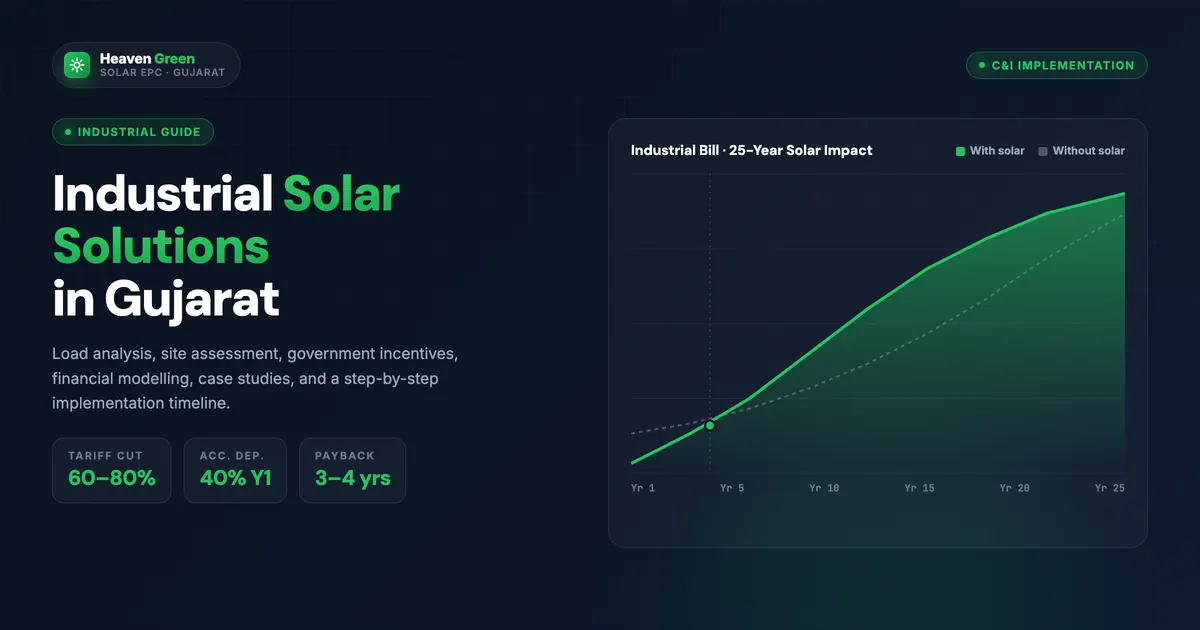
Gujarat’s industrial sector consumes approximately 40% of the state’s total electricity, with manufacturing facilities paying grid tariffs between ₹6–9 per unit. Solar energy offers these facilities the opportunity to generate power at an effective lifetime cost of ₹2.5–3.5 per unit — a reduction of 50–60% in electricity expenses.
With over 12,000 MW of installed solar capacity across the state and a policy environment actively supporting industrial adoption, Gujarat’s manufacturing hubs in Surat, Ahmedabad, Vapi, and Rajkot are at the forefront of India’s industrial solar transition.
Why Industrial Solar Makes Financial Sense in Gujarat
The Energy Cost Equation
| Parameter | Grid Electricity | Solar Energy |
|---|---|---|
| Current tariff (industrial) | ₹6–9 per unit | — |
| Effective lifetime solar cost | — | ₹2.5–3.5 per unit |
| Cost reduction | — | 50–60% |
For a mid-size manufacturing facility consuming 5,00,000 units per year at ₹7/unit, annual electricity costs reach ₹35 lakhs. A well-sized solar installation can offset 60–80% of this cost, delivering ₹21–28 lakhs in annual savings.
Gujarat’s Solar Advantage for Industry
- High solar irradiation: 5.5–6.5 peak sun hours daily, among India’s highest
- Long operating hours: Manufacturing facilities with 8–16 hour shifts align well with solar generation windows
- Daytime peak consumption: Most heavy machinery operates during daylight hours, maximising self-consumption
- Strong policy framework: Gujarat Solar Power Policy 2021 explicitly supports industrial solar
Step 1: Load Analysis and Capacity Planning
Proper system sizing begins with a thorough analysis of your facility’s electricity consumption.
What the Load Analysis Covers
Consumption pattern analysis:
- Monthly electricity bills for the past 12–24 months
- Time-of-day consumption profiles (day shift vs. night shift loads)
- Seasonal variations in consumption
- Sanctioned load and maximum demand
Peak load identification:
- Identifying the highest demand periods
- Understanding which loads run simultaneously
- Assessing motor starting currents and surge demands
Three-phase power system considerations:
- Industrial facilities typically operate on three-phase supply
- Solar system design must ensure balanced loading across all three phases
- Inverter selection must match the facility’s electrical infrastructure
Sanctioned load limitations:
- Solar system capacity is typically limited to the sanctioned load from DISCOM
- Exceeding sanctioned load requires prior approval and may require infrastructure upgrades
- Experienced EPC providers navigate these constraints during design
Recommended System Sizing
| Annual Consumption | Recommended System Size | Expected Generation |
|---|---|---|
| Up to 2,00,000 units | 150–200 kW | 2,10,000–3,00,000 units |
| 2,00,000–5,00,000 units | 350–500 kW | 4,90,000–7,50,000 units |
| 5,00,000–12,00,000 units | 750 kW–1.2 MW | 10,50,000–16,80,000 units |
| Above 12,00,000 units | Above 1.5 MW | Site-specific |
A 500 kW installation typically generates 7,50,000–8,00,000 units annually, offsetting 60–80% of daytime consumption for manufacturing operations.
Step 2: Site Assessment for Industrial Facilities
Structural Integrity Evaluation
Industrial rooftops vary enormously in their load-bearing capacity:
- Truss-type roofs (common in textile units): Typically require lightweight mounting systems and careful load distribution
- RCC (Reinforced Concrete Cement) roofs: Generally high load capacity, suitable for standard mounting
- Metal sheet roofs (pre-engineered buildings): Require specialised clamps; structural engineering review essential
A certified structural engineer must assess the roof before finalising system design. Retrofitting structural reinforcement adds cost but is non-negotiable for safety and insurance compliance.
Space Optimisation
| Roof/Land Area | Approximate Solar Capacity |
|---|---|
| 1,000 sq. m | 100–120 kW |
| 5,000 sq. m | 500–600 kW |
| 10,000 sq. m | 1,000–1,200 kW |
Available ground area adjacent to the facility may supplement rooftop capacity for larger systems.
Shadow Analysis
- Rooftop obstructions — water tanks, HVAC units, exhaust chimneys — create shading that significantly reduces generation
- Shadow analysis using drone surveys or 3D modelling identifies optimal panel placement
- String inverter design or microinverter solutions can mitigate partial shading impact
Electrical Infrastructure Assessment
- Existing switchgear and panel boards must accommodate solar input
- Grid interconnection point selection affects costs and approval timelines
- Metering arrangements for net metering must comply with DISCOM specifications
Government Incentives for Industrial Solar in Gujarat
Accelerated Depreciation (AD)
The most significant financial incentive for industrial solar adopters:
- 40% depreciation in the first year on the installed solar asset
- Applied against taxable income at the company’s applicable tax rate
- For a 30% tax bracket, a ₹2 crore installation generates ₹24 lakh in immediate tax savings in year one
- This effectively reduces the net cost of the system significantly, improving ROI and shortening payback
Net Metering
- Export excess solar generation to the grid during periods of low industrial consumption
- Credits are adjusted against electricity bills in subsequent months
- Particularly valuable for facilities with weekend shutdowns or seasonal production variations
- Net metering approval is processed through DISCOM with EPC provider support
GST Benefits
- Solar panels, inverters, and mounting structures attract 5% GST (reduced rate)
- This compares favourably to the 18% GST applicable to most industrial equipment
Gujarat Solar Power Policy 2021
- Framework supporting grid-connected rooftop solar for industrial consumers
- Provisions for captive solar generation
- Exemptions from certain electricity duties for qualifying solar installations
Financial Analysis: What to Expect
Installation Costs
| System Size | Cost Per kW | Approximate Total Cost |
|---|---|---|
| 100–250 kW | ₹48,000–55,000 | ₹48 lakh–₹1.37 crore |
| 250–500 kW | ₹44,000–52,000 | ₹1.1–2.6 crore |
| 500 kW–1 MW | ₹40,000–48,000 | ₹2.0–4.8 crore |
| Above 1 MW | ₹38,000–45,000 | Site-specific |
Typical 500 kW system: ₹2.0–2.5 crore total installed cost.
Annual Savings
| Parameter | Value |
|---|---|
| Annual generation (500 kW) | 7,50,000 units |
| Average industrial tariff | ₹7/unit |
| Gross annual savings | ₹52.5 lakh |
| Annual maintenance cost | ₹80,000–1,00,000 |
| Net annual savings | ₹51–52 lakh |
Payback Period
| System Size | Net Annual Savings | Payback Period |
|---|---|---|
| 200 kW | ₹20–22 lakh | 4–5 years |
| 500 kW | ₹50–54 lakh | 3.5–4.5 years |
| 1 MW | ₹95–1.05 crore | 3–4 years |
After payback, the system delivers essentially free electricity for the remaining 20+ years of operational life.
Including Accelerated Depreciation
For a ₹2.25 crore, 500 kW system with 30% tax bracket:
- Year 1 tax saving (40% AD): ~₹27 lakh
- Effective net investment: ~₹1.98 crore
- Revised payback period: Approximately 3.5 years
Case Studies: Industrial Solar in Gujarat
Case Study 1: Textile Facility, Surat
System: 750 kW rooftop installation on a fabric manufacturing facility
| Parameter | Result |
|---|---|
| Annual generation | ~10.5 lakh units |
| Annual savings | ₹77 lakh |
| System cost | ₹3.2 crore |
| Payback period | 4.2 years |
| Additional benefit | Reduced peak demand charges |
The facility operates three shifts, with the first two shifts (6am–10pm) largely powered by solar during the day, eliminating peak-hour tariff exposure.
Case Study 2: Chemical Plant, Vapi
System: 800 kW hybrid system (grid-tied with backup capability)
| Parameter | Result |
|---|---|
| Annual savings | ₹84 lakh |
| System uptime | 98.5% |
| Key benefit | Reduced power quality issues from grid fluctuations |
The hybrid configuration provides partial backup capability, critical for processes sensitive to power interruptions.
Case Study 3: Warehouse and Logistics, Ahmedabad
System: 1.2 MW installation across multiple warehouse rooftops
| Parameter | Result |
|---|---|
| Annual generation | ~17 lakh units |
| Daytime energy independence | Near-complete |
| Grid dependency | Night operations only |
The facility now exports surplus solar electricity during warehouse closure periods, generating net metering credits that offset nighttime grid consumption.
Implementation Timeline: 500 kW Industrial Project
| Phase | Duration | Key Activities |
|---|---|---|
| Initial consultation and site visit | Week 1 | Energy audit, initial feasibility, proposal |
| Detailed site assessment | Weeks 2–3 | Structural survey, shadow analysis, electrical audit |
| System design and engineering | Weeks 3–5 | Layout, single-line diagram, structural drawings |
| Utility/DISCOM application | Weeks 4–8 | Net metering application, grid connectivity approval |
| Equipment procurement | Weeks 5–9 | Panel, inverter, structure orders and delivery |
| Civil and structural work | Weeks 9–12 | Foundation, mounting structure installation |
| Module and electrical installation | Weeks 12–15 | Panel mounting, wiring, inverter installation |
| Testing and commissioning | Weeks 15–16 | String testing, inverter startup, performance verification |
| Handover and monitoring setup | Week 17 | Documentation, monitoring dashboard, operator training |
Total duration: 16–17 weeks for a typical 500 kW project from first consultation to commissioning.
Selecting the Right Industrial Solar EPC Partner
Not all EPC providers are equipped to handle industrial-scale projects. Evaluate potential partners on:
Technical capability:
- Experience with three-phase industrial installations
- In-house structural engineering or certified structural engineer partnerships
- Demonstrated track record with projects above 200 kW
Equipment quality:
- Panel brands on ALMM list
- Commercial-grade inverters (not residential-spec inverters on commercial projects)
- Proper industrial-grade cables and protection equipment
Regulatory experience:
- DISCOM application and net metering approval experience in Gujarat
- Accelerated depreciation documentation support
- Familiarity with GST documentation for input credit claims
After-sales support:
- AMC (Annual Maintenance Contract) availability
- Remote monitoring dashboard
- Response time guarantees for breakdown rectification
Frequently Asked Questions About Industrial Solar in Gujarat
Can a factory install solar on a rented building?
Yes, with the building owner’s written consent. The solar system is treated as a movable asset in most cases, and arrangements can be structured to benefit both parties. Legal documentation of the agreement is essential.
What happens during grid outages?
Standard grid-tied systems shut down during grid outages (as required by safety regulations). Hybrid systems with battery storage can provide partial backup. Discuss your uptime requirements with your EPC provider during the design phase.
Does industrial solar require any special insurance?
Most industrial solar installations should be covered under an all-risk property insurance policy. Some insurers offer dedicated solar asset insurance. BIS-certified equipment and professional installation documentation are typically required for coverage.
How does net metering work for industrial consumers?
Excess solar generation is exported to the grid and credited to your account at the applicable net metering tariff. In subsequent billing cycles, exported units are deducted from your consumption charges. DISCOM approval is required before commissioning, and a bi-directional meter is installed.
Planning industrial solar for your Gujarat facility? Heaven Green Energy is a leading solar EPC company with offices in Surat, Ahmedabad, and Junagadh, specialising in turnkey industrial solar projects from 100 kW to multi-megawatt scale.
Call us at +91 63904 05060 to schedule a site assessment and receive a detailed financial proposal for your facility.