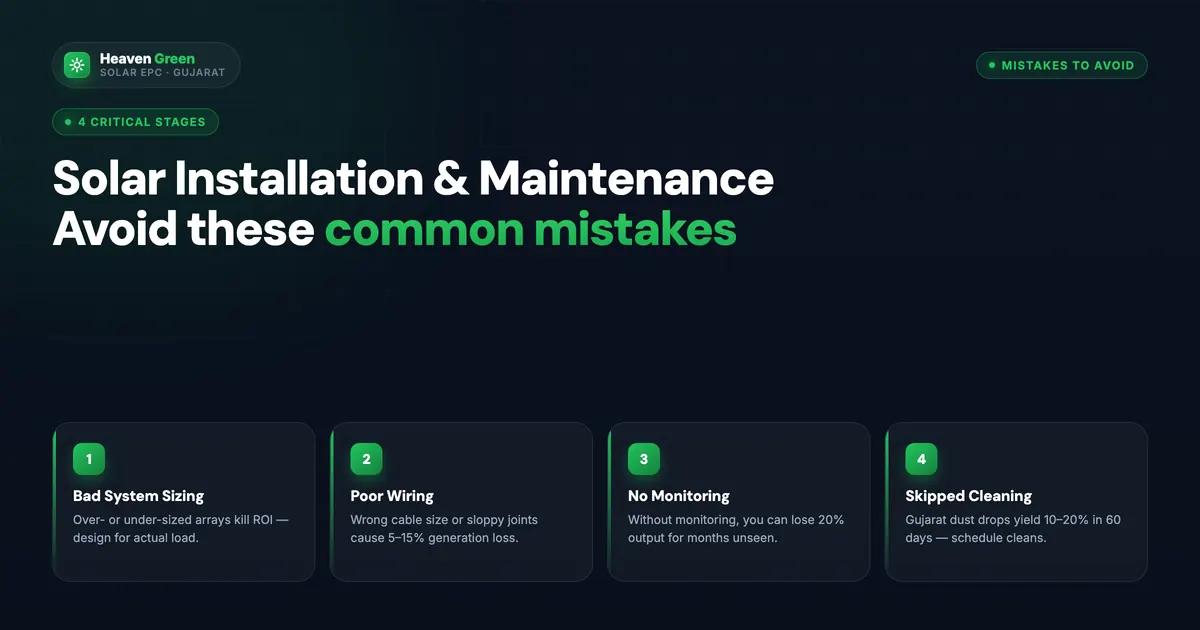
Solar System Installation and Maintenance: Avoid Common Mistakes
Here is something the solar industry does not say often enough: a solar power plant does not perform well just because premium modules or inverters are installed.
Performance hinges on proper design, installation, and ongoing maintenance. Cut corners in any of these three areas, and even the most expensive equipment will underperform — sometimes badly. This guide covers the most common mistakes and how to avoid them.
Why Real Performance Depends More on Execution Than Equipment
The brand on the panel matters less than you think. What matters more:
- Whether shading studies were done before layout was finalised
- Whether cables are properly routed and sealed
- Whether the mounting structure was installed at the right angle
- Whether the system is inspected and cleaned regularly
Get these right, and a mid-range system outperforms a premium one. Get them wrong, and you have wasted money.
1. Solar System Design: The Foundation of Performance
Effective solar design extends beyond capacity calculations — it ensures all modules operate under comparable electrical and environmental conditions.
Uniform Module Selection
All solar modules should share identical technology and electrical ratings. Mixing different types (monocrystalline with polycrystalline) or varying wattages creates mismatch losses, reducing overall system output. Stick to one batch, one manufacturer, one model.
Zero Shading Philosophy
Even partial shading on a single module diminishes the output of the entire string it belongs to. Panels require placement away from:
- Water tanks
- Parapet walls and raised edges
- Trees and poles
- Adjacent buildings and structures
Mandatory shading studies must precede layout finalisation. Never skip this step.
Correct Orientation and Tilt
India’s standard practice positions modules facing south. Tilt angles should approximate your site’s latitude for optimal annual generation. In high-wind zones, lower angles (5–20 degrees) are often used to reduce wind pressure without significantly compromising generation output.
Safe and Accessible Layout
- Panels must avoid unsafe rooftop edges or cramped locations
- Adequate maintenance walkways must be built in from the start
- Tight spacing increases wind uplift risk during storms
2. Installation Quality and Structural Integrity
Solar modules require mechanical care during installation — this directly affects system lifespan.
Proper Module Spacing and Alignment
Neat, uniformly spaced mounting maintains adequate airflow beneath panels, preventing temperature increases that reduce efficiency. Hot modules produce less power.
Roof Load Capacity
Healthy rooftops safely support 25–30 kg per square metre, including modules and the mounting structure. Older or compromised roofs need structural assessment before installation — do not skip this.
Correct Mounting Geometry
Mounting structure legs should maximise load distribution. Improper angles weaken structural strength and increase wind-load failure risk — especially during monsoon season.
Corrosion Resistance
All structures must be rust-free. Use galvanised or corrosion-resistant materials for long-term stability, particularly in coastal and industrial regions like Surat.
Secure Fastening
All clamps and bolts require proper tightening. Loose fittings risk vibration damage or panel loss during storms. Over-tightening can crack mounting brackets.
Well-designed racking systems last 20–25 years. Poorly installed structures may fail within a single monsoon season.
3. Inverter Selection and Placement
The inverter is the brain of your solar system — handle it accordingly.
Protection from Direct Sunlight
Inverters must never be placed in direct sun. Overheating reduces efficiency and dramatically shortens inverter lifespan. Use natural shade, a protective shed, or a purpose-built cover.
Clear Display and Monitoring Access
A visible, readable display allows users and technicians to quickly identify errors, faults, or performance declines. Remote monitoring capability is increasingly important for larger systems.
4. Wiring and Cable Management
Electrical connections are among the most common failure points in poorly executed installations.
Organised Cable Routing
Cables require proper routing paths with securing clamps at regular intervals. Loose cables are vulnerable to:
- Rodent damage
- Water ingress
- Physical disturbance during maintenance
Correct Connection Tightness
Loose connections cause overheating and fire hazards. Over-tightening damages connectors. Balanced tightening is critical — this is not a step for guesswork.
High-Quality Insulation
Cable insulation must remain intact and UV-resistant across years of outdoor exposure. Cheap cables degrade faster and cause faults.
Sealed Conduits
All conduits require proper closure preventing water, insects, or dust from entering the electrical pathways.
Clear Labelling
Every cable should be clearly identified. This is essential for troubleshooting and for future system expansion.
5. Electrical Protection and Grounding
Protection systems safeguard both equipment and personnel.
Effective Earthing
Proper grounding prevents voltage imbalance and shields the system from electrical faults. This step is non-negotiable for safety compliance.
Dedicated Lightning Protection
PV modules should connect to dedicated grounding conductors linked to earth pits. This significantly reduces lightning damage risk — especially important on exposed rooftops.
6. Maintenance: Sustaining Performance Over Years
Solar plants are not maintenance-free systems. Ignore maintenance and output will decline every year.
Regular Cleaning
Dust and dirt substantially reduce output. In Gujarat’s climate, periodic cleaning — at minimum after summer dust storms and before peak generation months — maintains stable generation.
Physical Inspection
Modules require checking for:
- Cracks and micro-cracks
- Moisture ingress or delamination
- Corrosion on frames and connectors
- Discolouration (indicates cell damage)
Replace damaged modules immediately — one bad module affects the whole string.
Hotspot Monitoring
Hotspots from defective cells or shading present fire and performance risks. Bypass diodes reduce danger, but persistent hotspots require professional attention.
Safe Installation and Maintenance Practices
Whether installing or servicing, follow safety protocols at all times:
- Helmets and gloves
- Safety harnesses at height
- Insulated tools
- Never work on live systems alone
Final Thought
“Solar system performance is not defined only by brand or specifications. Design accuracy, installation discipline, and regular maintenance decide how much energy your system will actually deliver over its lifetime.”
Experienced professionals ensure solar plants are engineered for reliable, decades-long performance — not built to cut corners and hope for the best.
Want a solar system designed, installed, and maintained to the highest standards? Heaven Green Energy brings engineering integrity to every project in Surat and Gujarat.
Call us: +91 63904 05060 Email: hevaensolarenergy@gmail.com Hours: Monday–Friday, 9 AM–5 PM