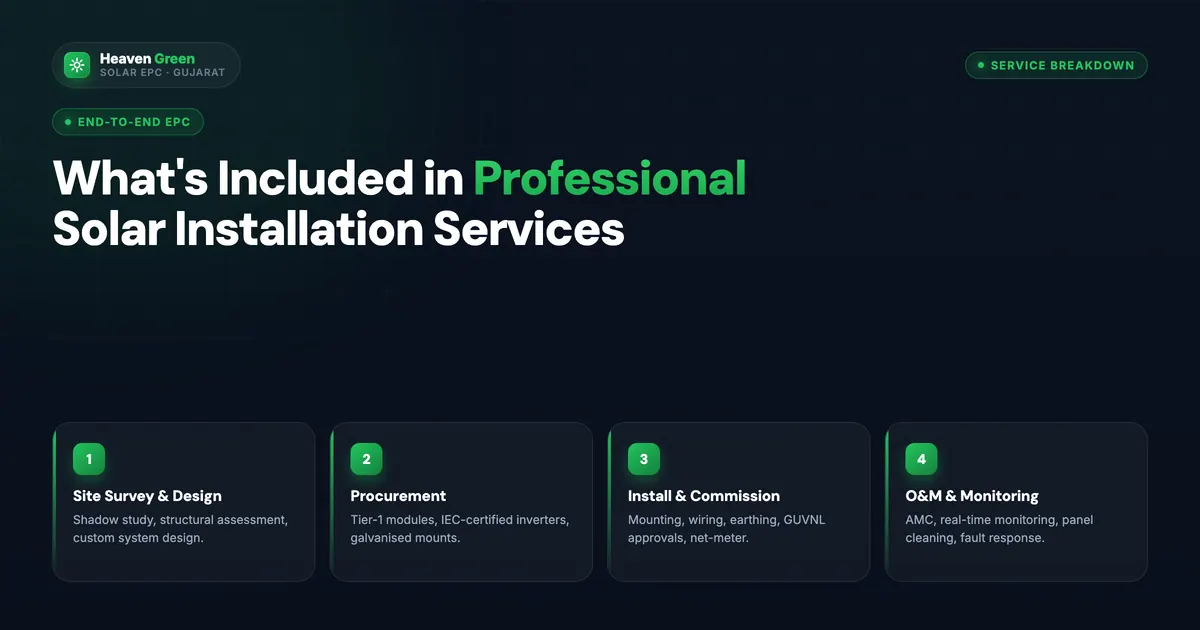
When investing in solar energy for your home or business in Gujarat, you’re acquiring more than just panels and an inverter. You’re acquiring a comprehensive service package that transforms your property into a clean energy generator. Understanding what each service component includes helps you make informed decisions and ensures you receive full value for your investment.
Gujarat leads India’s solar adoption with abundant sunshine, progressive policies, and PM-KUSUM scheme support—making it one of the best states in the country to go solar.
1. Understanding Solar Installation Services in Gujarat
Professional installation extends beyond panel mounting. It represents a complete turnkey solution that encompasses engineering, procurement, construction, regulatory compliance, and ongoing support. The seven major components are:
- Initial consultation and site assessment
- Custom system design and engineering
- Equipment procurement and quality assurance
- Professional solar installation work
- Grid connection and net metering setup
- Government subsidy and financing assistance
- Post-installation support and maintenance
Gujarat’s solar irradiation levels of 5.5–6.0 kWh per square metre daily, combined with supportive GUVNL policies, enable faster payback and higher ROI compared to most Indian states.
2. Initial Consultation and Site Assessment
Consultations are typically free of charge. During this stage, experts:
- Analyze 12 months of utility bills to understand consumption patterns, peak demand, and seasonal variations
- Conduct physical inspections evaluating roof condition, structural integrity, space availability, orientation, and shading obstacles
- Employ drone surveys and 3D modeling (for advanced assessments) to achieve precision
- Expand to full infrastructure evaluation and expansion planning analysis for commercial properties
The outcome is a feasibility report outlining:
- Recommended system size
- Expected energy production
- Project costs and savings potential
- Payback timelines
3. Custom System Design and Engineering
System design transforms concepts into precise technical blueprints. Gujarat residential systems typically range 3–10 kW; commercial and industrial projects span 50 kW to megawatts.
Engineers create:
- Electrical drawings: Panel layout, string configurations, inverter placement, and complete wiring diagrams
- Structural designs: Mounting systems and wind resistance specifications (up to 150 km/h for monsoon conditions)
Inverter selection accounts for shading patterns and system expandability. All designs comply with:
- Central Electricity Authority (CEA) regulations
- Bureau of Indian Standards (BIS)
- GUVNL technical requirements
Design deliverables include:
- Layout drawings
- Electrical schematics
- Equipment specifications
- Energy production estimates
- Project timeline
4. Equipment Procurement and Quality Assurance
Equipment quality directly impacts performance and longevity. Professional providers source from established manufacturers with certified, authentic equipment.
Solar Modules
Monocrystalline panels are popular in Gujarat for their higher efficiency and superior high-temperature performance. Requirements:
- Minimum 25-year performance warranties
- IEC and BIS certifications
Inverters
Convert DC to AC electricity. Quality units carry 5–10 year warranties and must comply with GUVNL technical specifications.
Mounting Structures
- Aluminum or galvanized steel with 120-micron coating minimum
- Coastal areas require marine-grade stainless steel hardware
Electrical Components
- ISI-marked cables with UV-resistant insulation
- Rated for 60°C+ summer temperatures
Complete procurement documentation includes manufacturer warranties, test certificates, certifications, and product datasheets. Procurement timelines span 2–4 weeks for residential projects.
5. Professional Solar Installation Work
Installation requires skilled technicians, proper tools, and strict adherence to safety protocols.
Installation Process Steps
- Roof preparation and mounting structure assembly
- Chemical anchors/expansion bolts installation
- Waterproofing at all penetration points
- Rail installation with laser leveling
- Panel positioning and securing with mid/end clamps
- Electrical connections with color-coding standards
- Inverter installation in shaded, ventilated areas
- AC isolator switch installation
- Cable management with UV-resistant ties
Gujarat-Specific Installation Considerations
- Temperature-resistant cables for 45°C+ heat
- Enhanced waterproofing for the monsoon season (June–September)
- Coastal corrosion protection using stainless steel hardware
- Spacing for air circulation and cooling to maintain inverter performance
Professional teams follow strict safety protocols including fall protection equipment, barriers, and electrical safety procedures. Residential installation typically requires 2–4 days.
6. Grid Connection and Net Metering Setup
Grid-connected systems require GUVNL or local distribution company net metering approval. Professional installation services handle the complete application process, including documentation submission and site inspections.
Approval Timeline
Grid connection and net metering approval typically takes 2–6 weeks.
What Happens at Connection
- GUVNL installs a bi-directional meter replacing your existing unit
- Testing verifies inverter synchronization, safety disconnects, and proper energy flow recording
- Net metering commissioning documentation enables subsidy disbursement
7. Government Subsidy and Financing Assistance
Rooftop Solar Subsidy
Residential installations up to 10 kW qualify for government support (structure varies by capacity tier).
PM-KUSUM Scheme
Supports agricultural solar and water pumping systems with significant central and state subsidies.
Subsidy Application Requirements
- Aadhaar card
- Electricity bills
- Property ownership proof
- Bank account details
- Technical specifications
Professional installation services compile documentation, ensure format compliance, and submit applications on your behalf.
Financing Support
Service providers facilitate connections with financial institutions offering solar loans at competitive rates, with monthly installments often lower than your current electricity bill savings.
Detailed ROI calculations factor in subsidies, financing costs, electricity savings, and system lifespan to demonstrate your true return.
Subsidy Timeline: 3–6 months post-commissioning after document submission. Installing without proper permits disqualifies you from subsidies.
8. System Testing, Commissioning, and Handover
Testing Phases
Before commissioning, technicians conduct:
- Electrical safety checks (insulation resistance, earthing, polarity, voltage)
- Performance testing on clear sunny days
- Baseline performance documentation
Commissioning Includes
- Official documentation (reports, certificates, as-built drawings)
- Customer training on monitoring and operation
- Monitoring system setup with cloud-based platforms
- Mobile app configuration for remote access
- Formal handover with manuals, warranties, and support information
9. Post-Installation Support and Maintenance
Remote Monitoring
Continuous performance tracking with automated alerts for faults—allowing proactive issue resolution before generation is significantly impacted.
Preventive Maintenance
Periodic inspections and cleaning are essential. Dust reduces solar output by 15–25% in Gujarat’s dusty environment, making regular panel cleaning non-negotiable.
Annual Inspections Cover
- Electrical connections and cables
- Inverter performance
- Mounting structure integrity
- Panel condition assessment
Repair Support
Quick troubleshooting for common issues such as inverter faults, cable damage, and loose connections, minimizing system downtime.
Warranty Support
- 25-year panel warranties and 5–10 year inverter warranties with full manufacturer coordination
- Documentation and claim support throughout the warranty period
System Expansion
Services accommodate growing energy needs and technology upgrades, so your solar investment remains relevant as your business scales.
Support Channels
Phone, email, and service request systems ensuring continuous access to expert help.
10. Cost Components of Solar Installation Services
Equipment costs represent 60–70% of total project expense—solar panels, inverters, mounting, cables, and electrical components.
Service costs account for 25–35%, covering:
- Assessment and design
- Installation labor
- Structural work
- Safety systems
- Approvals and permits
- Commissioning
- Warranty support
Key Cost Factors
- System size: Larger systems achieve economies of scale
- Roof complexity: Complex or high-pitch roofs increase labor time
- Site accessibility: Difficult-to-reach locations add cost
Typical Costs
₹50,000–₹70,000 per kW for quality installations. Government subsidies reduce net costs by 30–40% for eligible residential projects.
Professional services deliver proper sizing, quality equipment, expert installation, complete documentation, and ongoing support—resulting in higher energy production and reliability despite a premium over DIY or budget installers.
11. Choosing the Right Solar Installation Partner in Gujarat
Selection Criteria
| Criterion | What to Look For |
|---|---|
| Regional Experience | Gujarat-specific project history, GUVNL familiarity, local authority relationships |
| Certifications | MNRE credentials, NSEFI membership, manufacturer authorizations |
| Project Portfolio | Verifiable references and customer testimonials |
| Service Offerings | Complete design-to-maintenance packages |
| Transparent Pricing | Itemized quotations with clear terms |
| After-Sales Support | Warranty processes, response times, technical support availability |
| Financial Stability | Established reputation and solid business foundation |
12. Frequently Asked Questions
What is the total timeline for solar installation in Gujarat?
6–12 weeks total:
- Assessment and design: 1–2 weeks
- Equipment procurement: 2–4 weeks
- Installation: 2–4 days
- Net metering approval: 2–6 weeks
What approvals are required?
Net metering approval from GUVNL is the primary requirement. Systems above certain capacity thresholds may require Electrical Inspector approval. Subsidy applications require registration on the national portal.
Do I need to be present during installation?
Optional throughout, but beneficial at three key moments: initial site assessment, the first day of installation, and commissioning/handover.
Can the system handle Gujarat’s monsoon season?
Systems are designed to withstand heavy rainfall and 150+ km/h winds. Waterproofing and corrosion-resistant hardware ensure safe monsoon operation. Monsoon rains also naturally clean your panels. Installation avoids peak monsoon months when possible, but existing systems operate normally throughout the season.
When will I start seeing bill savings?
Electricity generation begins immediately upon grid connection. Full benefits appear after the first billing cycle. Residential customers typically see 50–90% bill reduction, with savings beginning immediately.
Understanding what’s included in comprehensive solar installation services empowers you to make informed decisions and ensures your investment delivers maximum value. Heaven Green Energy offers complete turnkey solar solutions with 10,000+ successful installations across Gujarat since 2017. For a free site assessment and detailed proposal, call +91 63904 05060 today.