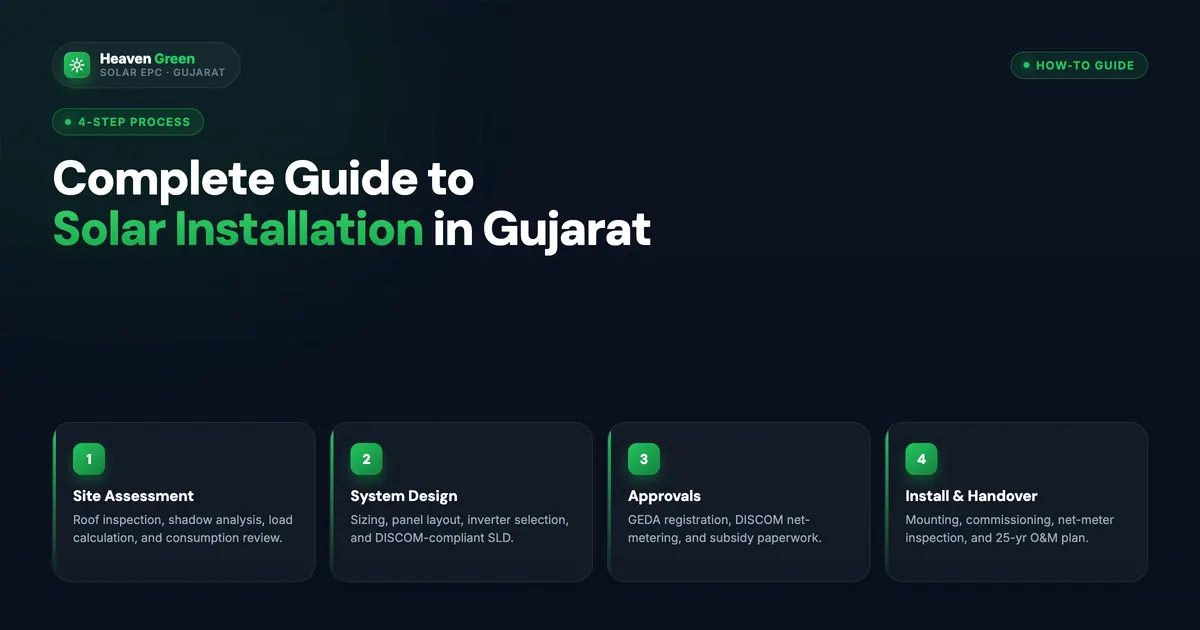
Gujarat receives an average of 300 sunny days per year, positioning it as India’s solar powerhouse. The state maintains its leadership in installed solar capacity with thousands of residential, commercial, and industrial installations across Surat, Ahmedabad, Vadodara, Rajkot, and Junagadh.
Whether you’re a homeowner looking to eliminate electricity bills, a factory owner cutting operational costs, or an investor planning a solar park — this guide walks you through every stage of the solar installation process in Gujarat for 2026.
Step 1: Initial Consultation and Site Assessment
What Happens During the Initial Consultation
The process begins by understanding your situation:
- Current electricity consumption and monthly bills
- Goals — whether targeting 100% offset or partial coverage
- Available roof or land space
- Budget and financing preferences
- Timeline expectations
Comprehensive Site Assessment
Technical evaluation covers five key areas:
Roof Condition and Structural Analysis — Engineers assess load-bearing capacity, roof age, and material compatibility for panel and mounting structure support.
Orientation and Tilt Analysis — South-facing orientation is ideal in Gujarat. Assessment determines optimal tilt angles to maximise year-round generation.
Shading Analysis — The most critical factor. Evaluation of obstructions from buildings, trees, and water tanks that affect performance.
Energy Consumption Analysis — Twelve months of electricity bills analysed to understand consumption patterns, peak periods, and seasonal variations.
Electrical Infrastructure Review — Assessment of the main distribution board, inverter installation space, and cable routing possibilities.
Site assessments typically require 2–4 hours for residential installations. Larger projects may need multiple visits.
Step 2: System Design and Equipment Selection
Custom System Design
Engineering work includes:
- 3D roof modelling with precise panel placement
- Electrical single-line diagrams showing all components
- String configuration optimising performance and minimising losses
- Cable sizing and routing plans
- Earthing and lightning protection design
- Shading analysis using specialised software
Choosing Solar Modules (Panels)
Panel Type Considerations:
| Type | Efficiency | Best For |
|---|---|---|
| Monocrystalline | 18–22% | Homes with limited space |
| Polycrystalline | Slightly lower | Larger, cost-effective installations |
Modern panels range from 330W to 550W capacity. Temperature coefficients are especially important for Gujarat’s hot climate, and manufacturers typically offer 25-year performance warranties.
Inverter Selection
- String Inverters — Most common for residential and commercial use; cost-effective and reliable
- Micro Inverters — Individual panel installation, ideal for partially shaded conditions; higher cost
- Hybrid Inverters — Accommodate battery backup for power security during outages
Quality inverters carry 5–10 year warranties with extension options.
Mounting Structures and Balance of System
Structures must withstand Gujarat’s monsoon winds and extreme heat. Quality materials include hot-dip galvanised iron and aluminium designs rated for 25+ years.
Balance of system components:
- DC and AC cables rated for outdoor solar applications
- MC4 connectors for panel interconnections
- DC isolators and AC distribution boards
- Earthing materials and lightning arrestors
- Monitoring systems for performance tracking
Step 3: Government Approvals and Documentation in Gujarat
Net Metering Application
Essential for all grid-connected systems. Applications go to your relevant DISCOM based on location:
- DGVCL — South Gujarat (including Surat)
- MGVCL — Central Gujarat
- PGVCL — Paschim (West) Gujarat
- UGVCL — North Gujarat
- Torrent Power — Ahmedabad areas
Feasibility approval for systems up to 100 kW typically arrives within 15–30 days.
Required Documents
- Electricity bill copy and consumer number
- Property ownership documents or NOC from owner
- Identity proof (Aadhaar, PAN card)
- System design and technical specifications
- Electrical single-line diagram
- Structural stability certificate (rooftop installations)
- Site photographs
Subsidy Applications (PM-KUSUM and State Schemes)
- Subsidies cover 20–40% of installation costs for residential systems
- Available only through empanelled vendors
- Processing time: 2–6 months
- Subsidy directly adjusted in final invoice
Approval Timelines
| Stage | Timeline |
|---|---|
| Net metering feasibility | 15–30 days |
| Subsidy application | 30–90 days |
| DISCOM inspection post-installation | 7–15 days |
| Net meter installation | 7–15 days post-inspection |
Step 4: Installation Process and Timeline
Pre-Installation Preparations
Before installation teams arrive:
- Equipment delivery and on-site verification
- Site clearing and roof access preparation
- Tool and scaffolding arrangement for multi-storey buildings
- Safety briefing and site setup
Day-by-Day Installation
Day 1–2: Mounting Structure Installation
Mark precise panel locations per approved design, install base supports with waterproofing on RCC roofs, assemble aluminium or GI mounting rails, verify alignment and structural integrity.
Day 2–3: Solar Panel Installation
Lift panels to roof using safety equipment, secure panels to mounting rails using clamps, maintain proper thermal expansion spacing, connect panels into strings, install weatherproof MC4 connectors.
Day 3–4: Electrical Work and Inverter Installation
Position inverter in a shaded, well-ventilated location, run DC cables through conduits, install DC isolators, surge protection, and earthing, connect AC wiring to the main distribution board, configure the monitoring system.
Day 4–5: Testing and Quality Checks
Insulation resistance testing, polarity verification, string voltage and current measurements, inverter configuration, system startup and performance verification, full safety checks.
Installation Timeline by System Size
| System Size | Installation Time |
|---|---|
| Residential (1–10 kW) | 2–5 days |
| Commercial (10–100 kW) | 5–15 days |
| Industrial (100 kW – 1 MW) | 3–8 weeks |
| Ground-mounted Parks (1 MW+) | 2–6 months |
Monsoon season (July–September) can affect schedules. Plan installations in the pre-monsoon window for best timelines.
Step 5: Testing, Commissioning and Grid Connection
DISCOM Inspection Process
- Submit commissioning request with installation completion certificate
- DISCOM schedules inspection (typically 7–15 days)
- Inspector verifies installation matches approved design
- Safety measures, earthing, and protection devices inspected
- Any deficiencies must be corrected before approval
Net Meter Installation
Following inspection approval, the DISCOM installs a bidirectional net meter within 7–15 days. Under Gujarat’s net metering policy, excess generation credits carry forward for up to 12 months.
Final Commissioning and Handover
A quality EPC company provides:
- Complete system documentation and electrical diagrams
- Equipment manuals and warranty certificates
- Monitoring system training
- Maintenance guidelines and schedules
- Emergency support contact information
Solar Installation Costs in Gujarat (2026)
Residential System Costs
Per-kW costs decrease as system size increases due to economies of scale.
- Small (1–3 kW): Suits homes with moderate consumption; significant bill offset
- Medium (3–5 kW): Most popular household size; meets substantial daytime needs
- Large (5–10 kW): For higher-consumption homes; maximises solar adoption
Commercial and Industrial Costs
- Systems above 10 kW benefit from bulk equipment pricing
- Industrial (100 kW+) achieves the most competitive rates
- Ground-mounted systems may have additional civil costs
Factors Affecting Installation Costs
Equipment Quality — Tier-1 manufacturers cost more but deliver better performance, longer warranties, and greater reliability over 25 years.
Roof Complexity — Simple, accessible roofs cost less. Complex multi-level roofs requiring structural modifications add cost.
System Type — Grid-connected systems are most cost-effective. Battery backup significantly increases upfront investment.
Subsidies Available — Central government subsidies reduce upfront costs by 20–40% for residential systems under PM Surya Ghar Muft Bijli Yojana.
Return on Investment
- Payback period: 4–6 years for residential; 3–5 years for commercial/industrial
- Annual ROI: 15–20%
- Lifetime savings: Several times the initial investment over 25+ years
Financing Options
- Bank Loans — Dedicated solar loans, tenures up to 10 years
- NBFC Financing — Quick approval and flexible repayment
- CAPEX Model — Upfront investment with full system ownership
- OPEX/PPA Model — Developer installs; you purchase power at agreed rates
Post-Installation Support and Maintenance
Monitoring System Performance
Modern systems provide:
- Daily, monthly, and yearly energy statistics
- Real-time power output and system status
- Performance issue alerts and fault notifications
- Historical data for long-term tracking
- Mobile app access
Regular Maintenance Requirements
Panel Cleaning — Gujarat’s dusty conditions require cleaning 3–4 times per year. Clean early morning or evening with water and soft brushes. Never use abrasive materials.
Visual Inspections — Periodic checks for physical damage, loose connections, or debris.
Electrical Checks — Annual inspections of connections, cables, and protection devices.
Inverter Maintenance — Occasional ventilation cleaning and operational verification.
Warranty Coverage
| Component | Product Warranty | Performance Warranty |
|---|---|---|
| Solar Panels | 10–12 years | 25 years (min. 80% output) |
| Inverters | 5–10 years | — |
| Installation/Workmanship | 5–10 years | — |
Troubleshooting Common Issues
- Reduced Output — Usually soiling, shading, or inverter issues. Monitoring systems identify causes quickly.
- Inverter Errors — Error codes diagnose problems; many issues resolve remotely.
- Grid Synchronisation — Occasional disconnections due to voltage fluctuations; usually self-resolving.
- Physical Damage — Comprehensive insurance covers storm or impact damage.
Choosing the Right Solar Installation Partner in Gujarat
What to Look For
Experience and Track Record — Companies with hundreds or thousands of successful installations understand local conditions, regulations, and challenges.
Local Presence — Multiple branch offices indicate commitment, better support, and faster response times.
Comprehensive Services — End-to-end solutions from assessment through after-sales support ensure accountability.
Quality Equipment — Tier-1 manufacturer components cost more but deliver better performance and longer warranties.
Technical Expertise — Qualified engineers and certified installers understand the nuances of Gujarat-specific installations.
Essential Certifications
- DISCOM empanelment for subsidy-eligible installations
- ISO certifications for quality management
- GSIA (Gujarat Solar Industries Association) membership
- Government recognition or awards
- Certified engineers and installers
Questions to Ask Before Signing
- How many similar installations have you completed in Gujarat?
- Can you provide references from recent installations?
- What panel and inverter brands do you recommend, and why?
- What do the warranties cover, and who services them?
- How do you handle government approvals and subsidies?
- What is the complete timeline from contract to commissioning?
- What after-sales support and maintenance do you offer?
- What performance monitoring system is included?
Frequently Asked Questions
How long does the entire process take from start to finish?
Complete timeline from consultation to a commissioned system typically ranges 2–4 months for residential installations. This includes site assessment (1 week), system design and approvals (4–8 weeks), equipment procurement (2–4 weeks), installation (3–7 days), and DISCOM inspection plus net meter installation (2–4 weeks). Approval phases consume most of the time.
What is the lifespan of a solar system?
Solar panels are designed to last 25–30+ years with performance warranties guaranteeing at least 80% output after 25 years. Inverters typically last 10–15 years and may require one replacement. Properly installed mounting structures with quality materials last as long as the panels.
Do solar panels work during Gujarat’s monsoon season?
Yes. Panels generate 10–25% of rated capacity on overcast days using both direct and diffuse sunlight. Monsoon season (July–September) is only 3 months; the remaining 9 months of excellent irradiance compensate. Annual energy calculations account for seasonal variation.
Can I expand my solar system later?
Yes — though considerations include available roof space, inverter capacity (may require upgrade), and a DISCOM net metering modification application. Planning potential future expansion during initial design makes later additions easier.
What happens during power cuts?
Standard grid-connected systems automatically shut down during power cuts — a safety feature preventing electricity feed into lines where workers may be present. For power during outages, you need a hybrid system with battery backup. These cost more but provide energy security for critical applications.
How much maintenance does a solar system require?
Minimal. Primary maintenance involves panel cleaning 3–4 times per year, visual damage inspections, and one annual professional electrical checkup. Most systems run reliably with just this basic care. Quality EPC companies offer Annual Maintenance Contracts (AMC) that handle all servicing.
Start Your Solar Journey in Gujarat Today
Gujarat’s abundant sunshine, supportive policies, and mature solar ecosystem create ideal conditions for adoption. Whether you’re a homeowner reducing electricity bills, a business cutting operational costs, or an industrial facility planning a large-scale solar park, understanding the complete installation process lets you make informed decisions and set realistic expectations.
Heaven Green Energy brings the necessary expertise and local knowledge — with established offices across Surat, Ahmedabad, and Junagadh, 10,000+ completed installations, and recognition as one of Gujarat’s top 3 EPC companies in 2024.
Contact us for a free site assessment: +91 63904 05060