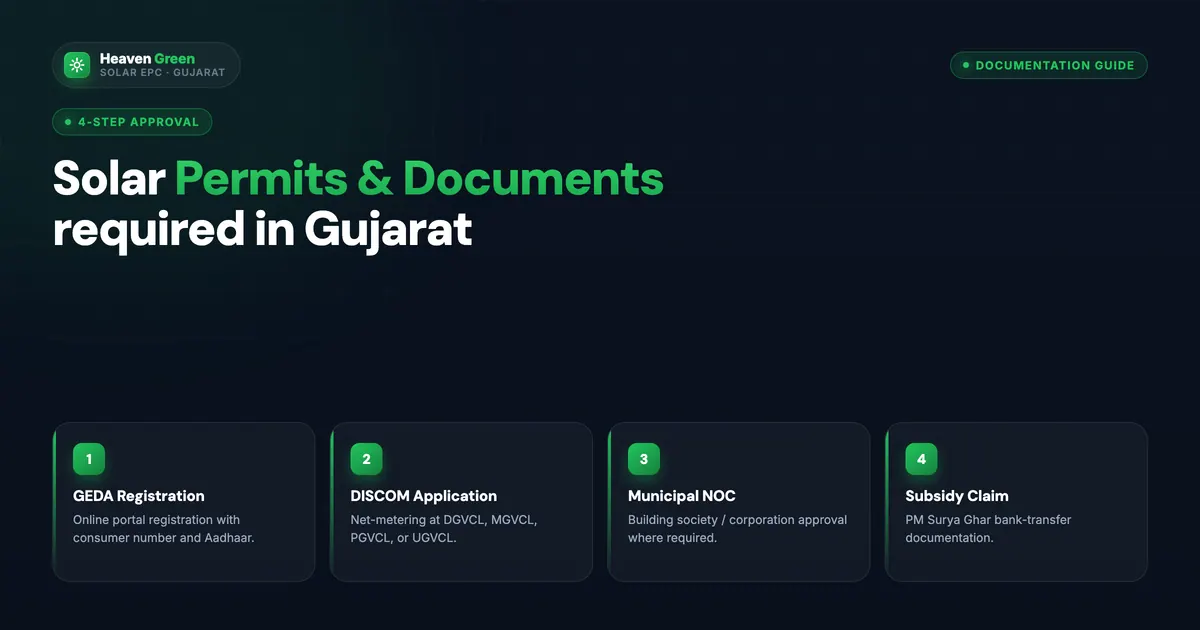
Installing a solar energy system in Gujarat is an excellent investment—but getting it right means navigating a multi-step documentation and approval process. Understanding solar permits Gujarat requirements upfront prevents costly delays, ensures subsidy eligibility, and keeps your system grid-compliant from day one.
The regulatory framework involves three key bodies:
- GEDA (Gujarat Energy Development Agency): oversees renewable energy project registration
- GUVNL and distribution companies: handle grid connectivity and net metering
- Municipal corporations: manage building permissions and structural safety
1. Understanding Solar Permits Gujarat: Why Documentation Matters
Proper permits and documentation serve several critical purposes:
- Structural safety: Ensures rooftop installations meet load-bearing and wind-resistance standards
- Legal grid connectivity: Enables net metering registration and credit billing
- Subsidy eligibility: Installing without proper permits disqualifies you from government subsidies
- Regulatory compliance: Required under GEDA, GUVNL, and municipal corporation frameworks
Critical Point: Installing without proper permits disqualifies you from subsidies—and can result in forced disconnection from the grid.
2. GEDA Registration and Approval Process
Process Steps
- Visit the GEDA portal and create an account
- Submit online application with your electricity consumer number
- Provide property ownership documents
- Include sanctioned load information
Required Documents
- Copy of electricity bill
- Proof of property ownership (property tax receipt or title deed)
- Recent passport-size photograph
- Aadhaar card
Timeline
- Residential applications: 7–15 days
- Commercial/Industrial projects: 3–4 weeks
GEDA Empanelment for Installers
For solar EPC companies and installers, GEDA empanelment is crucial to appear on approved vendor lists—a requirement for projects under government subsidy schemes. Always verify that your chosen installer is GEDA-empaneled.
3. Net Metering Application for Solar Permits Gujarat
Net metering allows excess solar electricity to be fed back to the grid, running your meter backward and generating valuable billing credits.
Distribution Companies by Region
| Discom | Coverage Area |
|---|---|
| DGVCL | Southern Gujarat — Surat, Navsari, Valsad, Dang, Tapi |
| MGVCL | Central Gujarat — Vadodara, Anand, Kheda, Chhota Udaipur |
| UGVCL | Northern Gujarat — Ahmedabad, Gandhinagar, Mehsana, Sabarkantha |
| PGVCL | Western Gujarat — Rajkot, Junagadh, Jamnagar, Porbandar |
Application Requirements
- Electricity consumer number
- System capacity in kilowatts
- Technical specifications of panels and inverters
- Single-line diagram of the installation
Key Documents for Net Metering Application
- Latest electricity bill
- Proof of property ownership
- Technical proposal from installer
- Manufacturer datasheets for panels and inverters
- Inverter test certificate
Capacity Limits
- Residential: Cannot exceed sanctioned load or 10 kW (whichever is lower)
- Commercial/Industrial: Higher limits based on contract demand
Processing Time
15–30 days for net metering approval after complete document submission.
4. Municipal Corporation Permissions Across Gujarat
Surat Municipal Corporation
- Requires building permission for rooftop installations
- Needs architectural drawings and current property tax receipt
- Requires a structural stability certificate from a licensed engineer
Ahmedabad Municipal Corporation
- Similar requirements plus fire safety compliance
- May require a No Objection Certificate from the fire department
- Emphasizes setback compliance for panel placement
Junagadh and Smaller Municipalities
- Generally more straightforward for residential installations
- Still requires application with property documents and layout plan
Structural Safety Certificate: Universal Requirement
A structural safety certificate is required across all Gujarat municipalities. Issued by a licensed structural engineer, it:
- Confirms the roof can safely bear panel weight (panels + mounting hardware + accumulated dust)
- Assesses roof age, construction type, and structural integrity
- Is valid for the duration of the installation
Heritage Zones: Properties in historic areas require additional clearances and may face restrictions on visible installations.
5. Electricity Board Procedures and Grid Connectivity
Technical Feasibility Study
Before approving your connection, the distribution company assesses:
- Local grid capacity and transformer rating
- Existing solar installations on the same feeder
- Whether grid upgrades are needed
This study typically takes 2–4 weeks.
Grid Connectivity Agreement
A formal contract between the consumer and distribution company covering:
- Net metering methodology and billing
- Export/import measurement procedures
- Maintenance responsibilities
Inspection and Commissioning
An authorized engineer verifies your installation meets standards, checking:
- Earthing quality and resistance
- Protection devices (anti-islanding, surge protection, isolation)
- Overall compliance with CEA and GUVNL technical requirements
A commissioning certificate is issued upon approval—required for subsidy disbursement.
6. Documentation Checklist for Solar Permits Gujarat
Residential Solar Installation Documents
Core Documents:
- Electricity bill (6 months history)
- Property ownership documents (property tax receipt, title deed, or sale deed)
- Aadhaar card
- PAN card
- Recent passport-size photograph
Technical Documents:
- Single-line diagram
- Manufacturer datasheets (panels and inverter)
- Inverter test certificates
- Structural stability certificate from licensed engineer
Tenants: Additionally require a No Objection Certificate from the property owner.
Commercial and Industrial Projects
Additional Documents:
- GST registration certificate
- Company incorporation documents
- Detailed electrical drawings
- Layout plans and cable routing diagrams
- Environmental clearance (if applicable)
Vendor and Installer Certifications
- GEDA empanelment certificate
- Technical qualifications proof
- Past project experience documentation
- ISO certifications (if applicable)
- Equipment warranties
- Commissioning reports
7. Timeline Expectations: From Application to Commissioning
Residential Without Subsidy
Total: 4–8 weeks
| Stage | Duration |
|---|---|
| GEDA registration | 7–15 days |
| Net metering application | 15–30 days |
| Municipal permission | 10–20 days (often runs in parallel) |
| Final inspection post-installation | 7–10 days |
Residential With Subsidy
Total: 6–12 weeks (add 2–4 weeks for subsidy processing)
Commercial and Industrial
Total: 8–16 weeks
Factors Affecting Timeline
- Documentation completeness (the most controllable factor)
- Geographic location within Gujarat
- Peak application periods (post-budget announcement periods see spikes)
- Local administrative capacity
Acceleration Tips
- Work with a GEDA-empaneled installer who knows the process
- Ensure all documents are complete and accurate before submission
- Respond promptly to requests from authorities
- Consider a dedicated project coordinator for large commercial projects
8. Common Challenges and How to Overcome Them
1. Incomplete Documentation
Problem: Applications rejected or delayed due to missing or incorrect documents.
Solution: Create a comprehensive checklist before applying. Keep organized digital and physical copies. Submit everything at once rather than piecemeal.
2. Technical Specification Mismatches
Problem: Equipment changes after application submission require resubmission.
Solution: Finalize all equipment selections before applying. Submit revised specifications immediately if changes are unavoidable.
3. Coordination Between Multiple Authorities
Problem: GEDA, distribution company, and municipal corporation each have separate timelines and requirements.
Solution: Maintain a tracking spreadsheet with all pending items and deadlines. Set calendar reminders for follow-ups. Running GEDA and municipal applications in parallel saves 1–2 weeks.
4. Rejections and Resubmissions
Problem: Applications rejected without clear reason.
Solution: Systematically address each rejection point. Request written clarification if rejection reasons are unclear. A GEDA-empaneled installer can often resolve these issues faster.
5. Structural Concerns
Problem: Engineer finds roof cannot support panels in its current condition.
Solution: Engage a qualified engineer early in the process. Propose reinforcement solutions or relocate panels to a structurally sound area.
6. Grid Capacity Limitations
Problem: Local transformer is at capacity, causing distribution company to delay or refuse connection.
Solution: Ask about the upgrade timeline. Consider a smaller initial system or an alternative connection point.
Partner Benefits: Working with an experienced EPC partner like Heaven Green Energy significantly reduces all of the above challenges. An experienced installer has navigated these situations dozens of times and knows how to resolve them efficiently.
9. Subsidy and Incentive Documentation
PM-KUSUM Scheme Components
- Component A: Large-scale ground-mounted projects by farmers/cooperatives
- Component B: Individual farmer solar pumps (off-grid)
- Component C: Solarization of existing grid-connected agricultural pumps
PM-KUSUM Requirements:
- Land ownership documents
- Agricultural electricity connection (for Component C)
- Bank account details (Aadhaar-linked)
- Aadhaar-linked documentation
Residential Rooftop Subsidy (2026)
- Covers systems up to 3 kW (higher subsidy) with partial support up to 10 kW
- Must apply before installation begins
- Available for homeowners in 2026 through the national portal
Required Subsidy Documents
- Standard solar permits documentation (all items from the residential checklist above)
- Subsidy application approval proof
- Installation stage photographs
- Commissioning report from distribution company
- Bank account linked to Aadhaar
Final Commissioning Documents Required for Subsidy Disbursement
- Distribution company commissioning certificate
- Bi-directional meter installation certificate
- Performance test report
Subsidy Timeline: 3–6 months after commissioning, following complete document submission. Patience is required, but the financial benefit is worth the wait.
10. Your Path to Hassle-Free Solar Installation in Gujarat
The solar permits process in Gujarat is complex but manageable with proper preparation. Each documentation requirement serves an important safety or financial purpose—ensuring your system is structurally sound, legally connected, and eligible for maximum financial benefits.
Key Takeaways:
- Start the GEDA registration and municipal permission applications in parallel to save time
- Never install before receiving at least initial approval—it risks subsidy disqualification
- Insist on a GEDA-empaneled installer who handles documentation as part of their service
- Budget 6–12 weeks for the full residential approval and commissioning process if claiming subsidies
Heaven Green Energy handles the entire documentation and approval process for our customers—coordinating with GEDA, distribution companies, and municipalities from start to finish. Based in Surat with offices in Ahmedabad and Junagadh, we have managed hundreds of Gujarat solar permit applications since 2017. Call +91 63904 05060 to get started with a free site assessment and a clear documentation roadmap for your project.