A Complete Guide to Net Metering in India
Net metering is the billing mechanism that makes rooftop solar financially compelling for Indian households and businesses. Instead of letting surplus solar power go to waste, net metering lets you export it to the grid and earn credits that offset your future electricity bills.
Nearly 95% of rooftop solar systems in India now use net metering — and for good reason. It effectively allows the grid to act as a free battery, storing your daytime solar surplus and returning it at night.
Here is everything you need to know to get net metering approved for your rooftop solar system.
How Net Metering Works
A bi-directional meter (also called a net meter) is installed at your premises. This meter measures:
- Units consumed from the grid
- Units exported to the grid from your solar system
At billing time, your consumption units are offset against your exported units. If you export more than you consume in a billing cycle, the surplus rolls over as credit for the next month (subject to state-specific rules on annual reconciliation and caps).
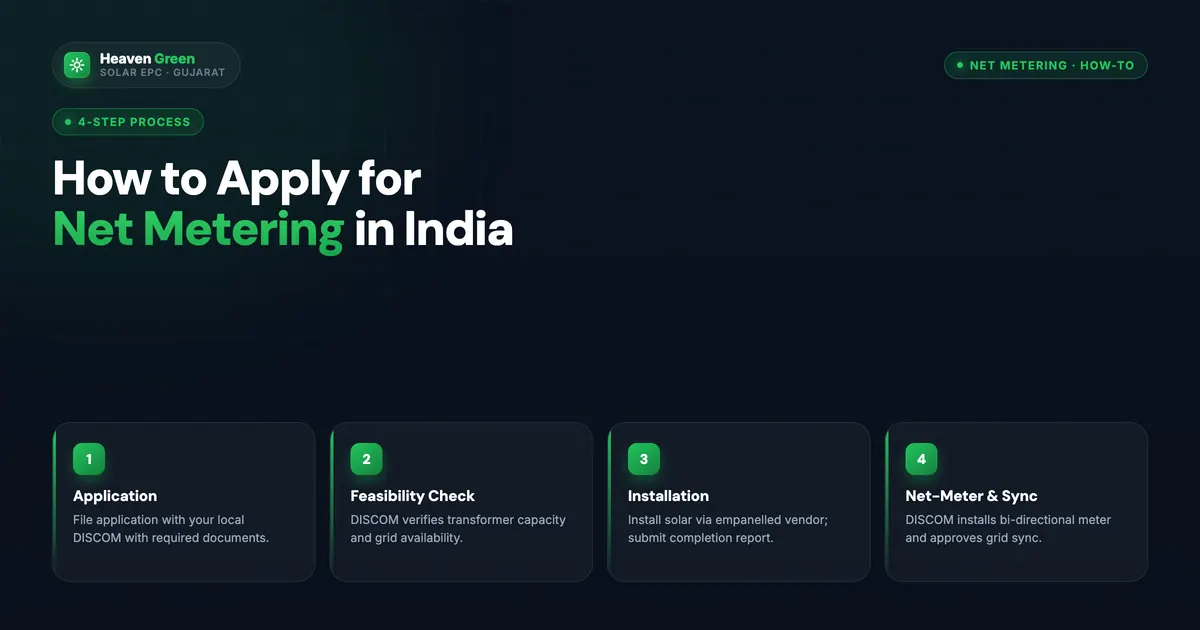
The Step-by-Step Application Process
Step 1: Apply Online
Register on the National Rooftop Solar Portal (solarrooftop.gov.in) or your state DISCOM’s portal. Provide:
- Customer account details
- Proposed system specifications (capacity, inverter type, panel brand)
- Installation address
Step 2: Feasibility Check (Up to 30 Days)
The power utility assesses whether the local grid infrastructure can accommodate your solar system. Most residential rooftop systems below 10 kW pass this check without issues.
Step 3: Approval and Registration (10–15 Days)
Upon document verification, the DISCOM issues a registration number or sanction letter approving your system for grid connection.
Step 4: System Installation
Engage an MNRE-empanelled vendor to install the panels, inverter, DCDB/ACDB, earthing, and all wiring. Obtain a Commissioning Certificate confirming the system is correctly installed.
Step 5: DISCOM Inspection
The utility inspects your installation and installs the bi-directional net meter. This replaces your existing single-direction meter.
Step 6: Synchronisation and Activation
Once the net meter is installed and verified, surplus solar power exported to the grid begins earning bill credits. Your system is live.
Documents Required for Net Metering Application
Organise these before starting the process to avoid delays:
Identity and Address Proof
- Aadhaar card, PAN card, voter ID, or passport
- Recent electricity bill (as address proof)
Property Documentation
- Ownership documents or lease agreement
- No-Objection Certificate (if applicable — e.g., rented premises)
Technical Documents
- One-line electrical diagram of the proposed solar system
- Equipment specifications (panel wattage, inverter rating)
- IEC certification certificates for panels and inverter
- MNRE empanelment proof from your installer
- Commissioning certificate (after installation)
How Long Does Net Metering Take?
Regulatory timelines:
- Feasibility check: 30 days
- Meter installation after commissioning: 45 days
Real-world timelines: Most applicants find the complete process takes 1–2 months (50–60 days) from application to meter installation. Urban areas with well-staffed DISCOMs tend to be faster; rural or smaller town DISCOMs may take longer.
The national portal processes subsidy claims in approximately 15 working days once all documents are complete.
Common Challenges and How to Handle Them
DISCOM Processing Delays
DISCOMs in smaller towns sometimes have limited staff for solar approvals. Follow up proactively at regular intervals. Keep a record of all correspondence.
Paperwork Errors or Omissions
Missing a single document can reset the clock. Prepare a complete dossier before submitting anything. Your MNRE-empanelled installer should know exactly what is required in your state.
Bi-Directional Meter Supply Shortages
Some DISCOMs face meter supply issues, causing delays even after approval. Escalate through the grievance portal if the delay exceeds the regulatory timeline.
Technical Specification Mismatches
If your system specifications do not match the documents submitted, the DISCOM may reject the application. Ensure your installer submits accurate, verified specs.
Consumer Awareness Gaps
Many applicants are unfamiliar with the portal or process. A good installer handles all of this on your behalf — choose one with a proven track record on subsidy and net metering applications.
State-Specific Rules to Verify
Net metering rules vary by state. Before installation, confirm your state’s specific rules on:
- Monthly vs. annual credit settlement — some states reconcile credits annually; others monthly
- Maximum system size for net metering eligibility (often capped at 90–100% of sanctioned load)
- Carry-forward limits on unused export credits
- Gross vs. net metering — some states have switched to gross metering for certain categories
Your DISCOM or an experienced local installer can clarify the applicable rules for your state and category.
Tips for a Smooth Net Metering Process
- Choose an MNRE-empanelled installer who handles all subsidy and net metering paperwork as part of their service
- Organise all documents before applying — do not submit an incomplete application
- Follow up with the DISCOM at 10–15 day intervals after submission
- Track your application status on the national portal
- Use the grievance system if any step exceeds its regulatory timeline — DISCOMs are required to respond
- Keep copies of all documents submitted and all correspondence exchanged
Net Metering and Your Electricity Bill
Once net metering is active, your electricity bill will show:
- Units consumed from the grid during the billing period
- Units exported to the grid from your solar system
- Net units (consumed minus exported)
- Billing only on net units consumed (if positive)
- Credit carried forward if exported units exceed consumed units
Over time, well-sized solar systems with net metering can bring many months’ bills close to zero — with only fixed charges and taxes remaining.
Get Net Metering Sorted with Heaven Green Energy
Heaven Green Energy handles the complete net metering application process for every solar system we install — from portal registration and document preparation to DISCOM follow-up and meter commissioning. We have guided hundreds of customers through the process across Gujarat.
Ready to install rooftop solar and start earning grid credits? Contact us today: +91 63904 05060
Surat: +91 63904 05060 | Ahmedabad: +91 87996 96345