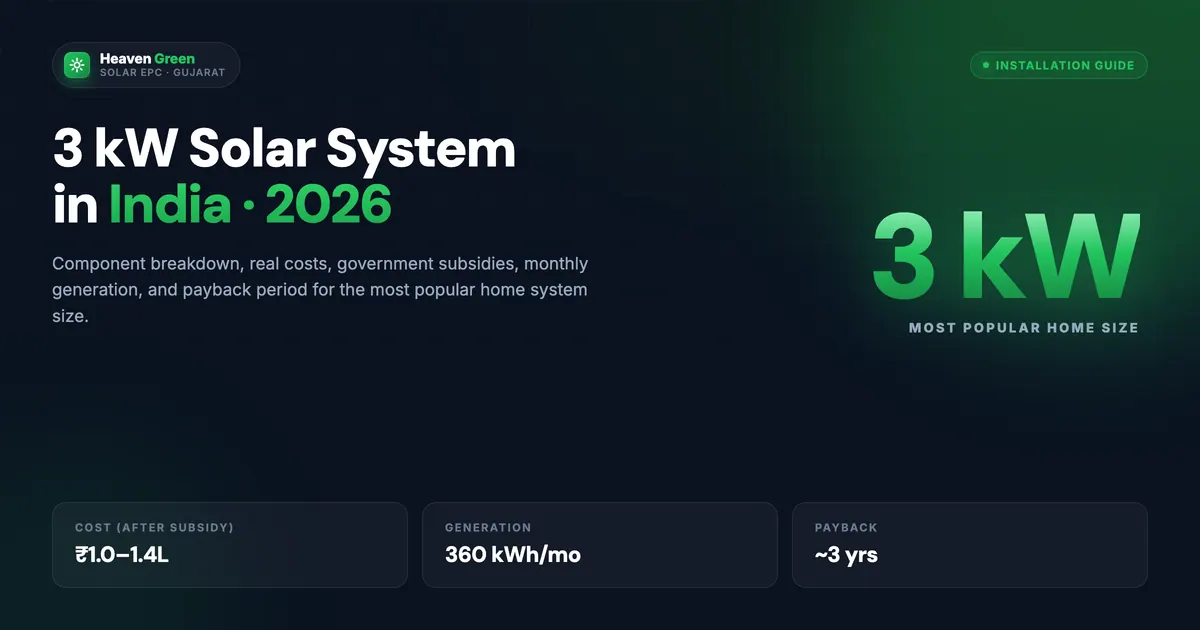
3 kW Solar System in India: Cost, Subsidy, Generation & Installation Guide (2025)
A 3 kW rooftop solar system is the most popular choice for medium-to-large Indian households — and for good reason. It qualifies for maximum government subsidy, generates enough power to offset most daytime consumption, and typically pays for itself in 6–8 years, after which electricity is essentially free for another 15–20 years.
This guide covers everything you need to know before investing.
What Is in a 3 kW Rooftop Solar System?
A standard 3–3.24 kW system produces 3,000–3,240 watts during peak sun hours. A typical installation includes:
- Solar panels (PV modules): Modern panels range from 535–585 watts each, requiring approximately 6–9 panels for 3–3.24 kW total capacity
- Inverter: A 3–4 kW inverter converts DC power to AC for household use or grid export (e.g., Qbits Inverter)
- Mounting structure: Metal rails securing panels to the roof at optimal tilt angle
- Wiring and protection: DC and AC cables, DCDB/ACDB fuse boxes, MC4 connectors, earthing, and lightning arrestor
- Net meter: Bi-directional meter enabling power export to the grid and credit against your bill
What Does a 3 kW Solar System Cost in India?
As of 2025, a turnkey 3 kW installation in India typically costs ₹1.9–2.2 lakh before subsidies. This translates to approximately ₹75–85 per watt installed, covering panels, inverter, structure, wiring, and labour.
Government Subsidies Available in 2025
Central Subsidy (MNRE Residential Rooftop Scheme)
- ₹14,588 per kW for the first 3 kW — approximately ₹43,764 subsidy for a 3 kW system
- For capacity above 3 kW up to 10 kW, the subsidy reduces to ₹7,294 per kW
- Above 10 kW, a fixed ₹94,822 subsidy applies
PM Surya Ghar: Muft Bijli Yojana (Launched January 2024)
| Monthly Consumption | System Size | Subsidy |
|---|---|---|
| Over 300 units/month | Over 3 kW | Flat ₹78,000 |
| 150–300 units/month | 2–3 kW | ₹60,000–₹78,000 |
Zero-Cost Financing Support
Collateral-free loans up to ₹2 lakh at approximately 7% interest are available for systems up to 3 kW through the national scheme.
As of March 2025, approximately 10 lakh homes have been powered through the Surya Ghar scheme, with a target of 1 crore homes by 2026–27.
How Much Electricity Will a 3 kW System Generate?
A 3.24 kW system generates approximately 300–350 units (kWh) per month on average, assuming 4–5 hours of daily peak sunlight.
Annual generation estimate: 3.24 kW × 4.5 hours/day × 365 days ≈ 4,300 kWh/year
What This Means in Rupees
At ₹7–8 per kWh retail rate:
- Annual savings: ₹30,000–₹35,000
- Monthly savings: ₹2,500–₹3,000
- 25-year generation: Over 1,00,000 kWh
Payback Period and ROI
With ₹30,000 in annual savings on a ₹2 lakh system (after subsidies), break-even is achieved in under 7 years. After payback, the system generates near-free electricity for the remaining 15–20 years of panel life.
How Does Installation Work? Step by Step
- Site Inspection — Vendor assesses roof area, tilt, direction, and shading to finalise panel layout and inverter sizing
- System Design — Proposal with specifications and detailed quote
- Applications — Apply for net metering through your DISCOM or state portal; vendor submits technical details (typically takes several days to one week)
- Procurement — Components ordered once permissions are secured
- Installation — Mounting rails and panels fixed; inverter and wiring installed; utility installs bi-directional net meter
- Commissioning — System checked for voltage, earthing, and safety before activation; DISCOM inspector may verify
- Subsidy and Final Payment — Remaining balance paid after commissioning; subsidy transfers directly to vendor
Typical timeline: From initial survey to power-on takes 2–4 weeks in urban areas, assuming smooth paperwork.
3 kW vs. Other System Sizes
| System Size | Ideal For | Monthly Generation |
|---|---|---|
| 1 kW | Very light usage | ~100–120 units |
| 2 kW | Small households | ~200–240 units |
| 3.24 kW | Medium-to-large families (3–5 members) | ~300–350 units |
| 5 kW | Large families with heavy loads | 500+ units |
The 3.24 kW size hits the sweet spot: it offsets most daytime consumption for a typical Indian household while qualifying for maximum government subsidy. Systems above 3 kW still get subsidy, but at a lower per-kW rate.
Common Mistakes and Misconceptions
Price-Only Selection
The cheapest quotes often use inferior components with poor performance or early failure rates. Compare panel brands, inverter certifications, and warranty terms — not just cost per watt.
Ignoring Roof Conditions
Shading, steep angles, and flat surfaces all reduce generation. Proper site surveys are essential. South-facing orientation at 15°–20° tilt is optimal for most of India.
Overestimating Output
Sales claims of “500 units/month from a 3 kW system” exceed realistic expectations based on India’s ~4–5 peak sun hours daily. Be sceptical of inflated projections.
Neglecting Net Metering Rules
State policies vary on monthly credits, annual reconciliations, and system size caps. Verify your state’s rules before installation.
Skipping Maintenance
While minimal, panels require occasional cleaning — especially in dusty areas. Neglect can reduce output by 10% or more over time.
No Written Warranties
Always document warranty terms in the supply and installation contract. Verbal promises are unenforceable.
How to Choose the Right Installer
What to Look For
- Accreditation: MNRE-empanelled installers or those listed on the national portal
- Component quality: Reputable panel brands (Adani, Waaree, Tata) and inverters (Qbits, ABB, Schneider, Luminous)
- Warranties: Standard is 25 years for panel performance and 5–10 years for inverters — confirm in writing
- Service: Reliable vendors offer annual maintenance visits or rapid-response support
- Subsidy handling: Quality installers manage all subsidy applications, net meter registration, DISCOM liaison, and commissioning paperwork
Final Tips Before You Go Solar
- Consult neighbours or local solar users for real-world experience with specific installers
- Analyse 12 months of electricity bills to right-size your system precisely
- Monitor your bill credits monthly once the system is live
- Remember that solar increases home value — it is both a financial and an environmental investment
Get Your 3 kW Solar System Installed by Professionals
Heaven Green Energy installs rooftop solar systems across Surat, Ahmedabad, and Gujarat with professional design, quality components, and full subsidy support. We handle everything from site survey to commissioning — so you can focus on enjoying lower electricity bills.
Contact us today: +91 63904 05060
Address: 201, Anupam Square, SAT Swaminarayan Temple Rd, Mota Varachha, Surat, Gujarat 394101