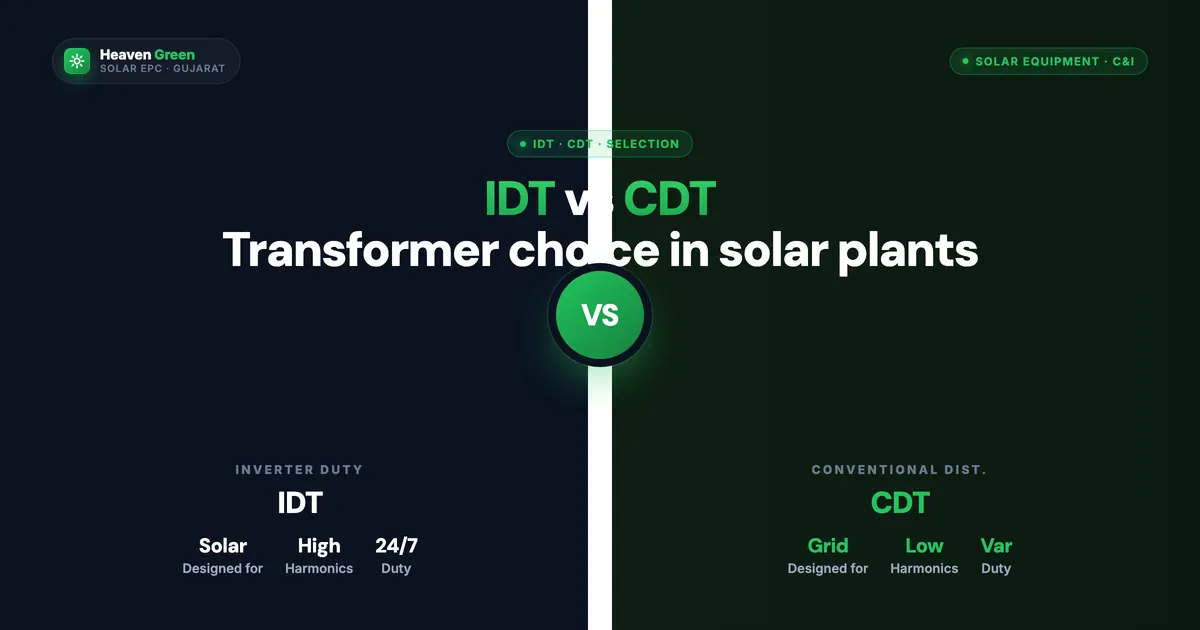
Transformer Selection in Solar Power Plants: IDT vs CDT Explained
When we started designing solar power plants, transformer selection seemed straightforward. Match the voltage levels. Check the MVA rating. Finalise the spec. Done.
That assumption was wrong — and learning why cost us a hard lesson.
Transformers in solar applications operate under fundamentally different electrical conditions than conventional utility or industrial systems. Getting this wrong means overheating, premature failure, and a plant that never delivers its promised output.
Why Solar Transformers Are Different
In conventional electrical systems, rotating machines generate power with relatively clean, near-sinusoidal waveforms at steady frequency. Solar power plants use power electronic inverters as their power source — and that changes everything.
Key differences introduced by inverters:
- Inverter output current is non-sinusoidal and rich in harmonics
- Fast switching introduces high dv/dt stress on transformer insulation
- Transformer loading is dynamic, varying continuously throughout the day in both magnitude and waveform quality
These factors collectively introduce additional thermal stress, dielectric stress, and mechanical stress that conventional transformers are not originally designed to handle.
IDT vs CDT: Not Just a Rating Difference
An Inverter Duty Transformer (IDT) differs fundamentally from a Conventional Distribution Transformer (CDT). It is not simply a higher-rated CDT — it is purpose-built for inverter-fed applications.
| Feature | IDT (Inverter Duty Transformer) | CDT (Conventional Distribution Transformer) |
|---|---|---|
| Insulation system | Reinforced for high dv/dt stress | Standard insulation |
| Winding design | Optimised for harmonic-rich currents | Designed for sinusoidal currents |
| Stray losses | Controlled to avoid localised overheating | Not designed for harmonic loading |
| Thermal margins | Higher, for fluctuating and partial loading | Designed for steady-state loading |
| Suitable for | Solar PV, Battery Energy Storage (BESS) | Conventional distribution, linear industrial loads |
A CDT may initially appear to operate when connected to inverter output — but over time it risks overheating, increased losses, insulation degradation, and premature failure.
Application Suitability
Use IDTs for:
- Solar PV power plants
- Battery Energy Storage Systems (BESS)
Use CDTs for:
- Conventional distribution networks
- Linear industrial and utility loads
Using the correct transformer type is fundamental to plant reliability and long-term performance. This is not a place to value-engineer.
MVA Selection: There Is No Fixed Rulebook
One of the most common errors in solar plant design is treating MVA selection as a simple calculation. In practice, “there is wide variation in IDT MVA ratings used across different solar plants” — and no single rule determines the right choice.
The final transformer rating depends on:
- Total AC capacity and inverter loading philosophy
- Inverter grouping and power evacuation design
- Redundancy and reliability requirements
- Permissible overloading limits
- Ambient temperature and site conditions
- Selected cooling method (ONAN vs ONAF)
- Provision for future plant expansion
Transformer selection is a system design decision, not a component-level choice.
Typical Solar IDT Design Parameters
Real-world solar projects commonly specify:
| Parameter | Typical Value |
|---|---|
| LV voltage | 800 V or 690 V |
| HV voltage | 11 kV or 33 kV |
| Vector group | Dyn11 or Ynd11 |
| Cooling method | ONAN or ONAF |
| Impedance | Coordinated with fault levels and inverter current limits |
Each parameter directly influences electrical stability, protection coordination, and long-term reliability.
Learning from a Real GTP
Studying actual Guaranteed Technical Particulars (GTP) reveals how design choices on paper translate into site performance. Key GTP parameters to evaluate carefully:
- No load and load losses
- Percentage impedance
- Temperature rise limits
- Insulation class
- Cooling arrangement
- Compliance with IEC and IS standards
Never accept a transformer specification without reviewing the GTP in detail. The numbers on that document define how your plant will actually perform over 25 years.
Final Takeaway
Transformer selection in solar power plants extends far beyond matching voltage levels and MVA ratings. It requires:
- Understanding inverter behaviour and the electrical stresses it creates
- Specifying IDTs — not conventional distribution transformers — for solar and BESS applications
- Designing for long-term efficiency, reliability, thermal stability, and future expansion
“One of the most important lessons learned the hard way: treat transformer selection as a system design decision, not an equipment purchasing decision.”
Planning a commercial or industrial solar power plant? Heaven Green Energy brings the technical depth to get every component — including transformer selection — right from the start.
Call us: +91 63904 05060 Email: hevaensolarenergy@gmail.com Hours: Monday–Friday, 9 AM–5 PM