A solar system is a 25-year investment — and your warranty is the only thing standing between you and an expensive replacement bill. Most homeowners in Gujarat don’t realise there are four distinct warranty types stacked onto every installation, each with different coverage, duration, and claim rules.
This guide breaks down everything you need to know before you sign an EPC contract.
The Four Types of Solar Warranty
1. Product Warranty
Covers manufacturing defects and material failures in the solar panels themselves — delamination, cell cracking, junction box failure, or frame defects.
- Duration: 10–12 years typically
- Remedy: Free replacement of defective panels
- Covers: Factory defects, material failures
2. Performance Warranty
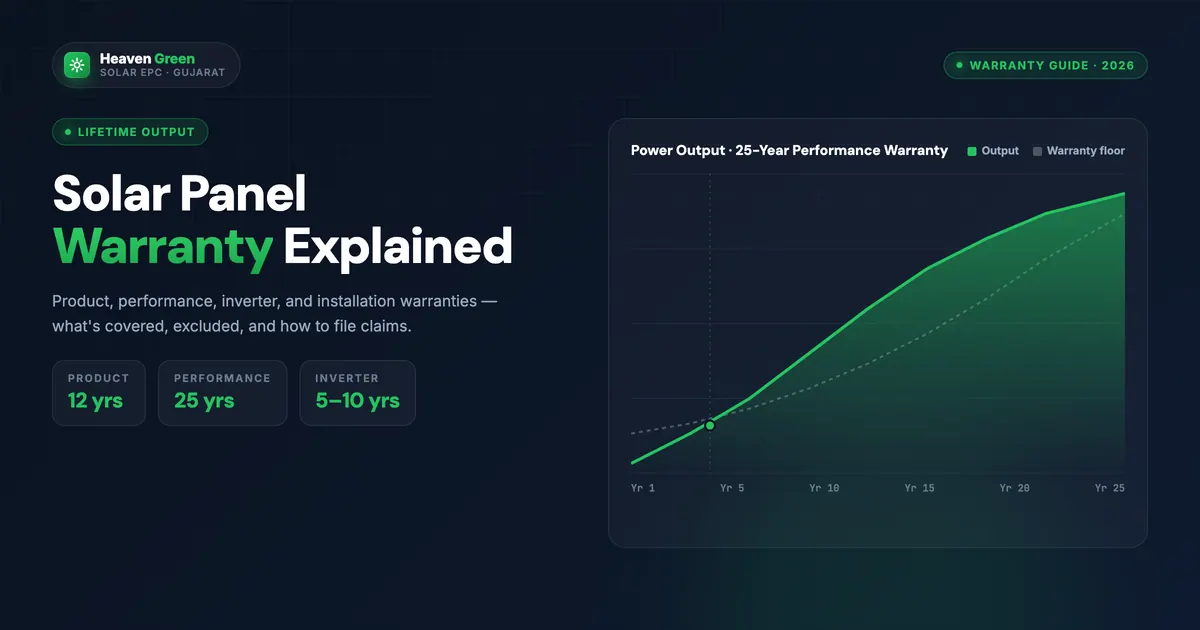
Guarantees the panel will still produce a minimum percentage of its rated output after a specified number of years.
- Duration: 25 years (industry standard)
- Typical terms: ≥ 90% output after 10 years, ≥ 80% output after 25 years
- Remedy: Additional panels or cash compensation if output falls below threshold
3. Inverter Warranty
Covers the inverter — the component most likely to need replacement within the system’s 25-year life.
- Duration: 5–10 years standard (extendable to 25 years on some models)
- Replacement cost without warranty: ₹15,000–25,000 per kW
4. Installation Warranty
Covers the workmanship — mounting, wiring, waterproofing, grid connection. Provided by your EPC partner, not the manufacturer.
- Duration: 5–10 years
- Covers: Faulty installation, loose connections, water ingress, structural issues
What’s Covered vs. What’s Excluded
Typically covered:
- Defects in materials and manufacturing
- Power output falling below warranted levels
- Premature degradation beyond 0.5–0.7% per year
- Failure under normal operating conditions
Typically excluded:
- Physical damage from external causes (vandalism, accidents)
- Hail damage, extreme weather, lightning strikes
- Improper installation by unauthorised installers
- Unauthorised modifications or repairs
- Maintenance-related failures (e.g., dirty panels)
- Normal wear and cosmetic issues
Many of the “excluded” risks — hail, lightning, storms — can be covered separately under your homeowner’s insurance policy. Ask your insurer specifically about solar coverage.
Understanding Performance Degradation
All solar panels degrade gradually. Modern panels typically degrade at 0.5% to 0.7% per year, which translates to:
| Year | Expected Output |
|---|---|
| Year 1 | 100% |
| Year 10 | ≥ 90% |
| Year 25 | ≥ 80% |
If your panel degrades faster than this — say, 2% per year — you have a valid performance warranty claim.
How to File a Warranty Claim
Step-by-Step Process
- Document the issue — Performance data from your monitoring system, photographs, error codes
- Contact your EPC partner first — They coordinate with the manufacturer on your behalf
- Submit required paperwork:
- Original purchase invoice
- Warranty certificate
- Installation records and commissioning report
- Photographic evidence of the defect
- Performance data / monitoring logs
- Site inspection — Manufacturer or authorised technician visits
- Resolution — Replacement, repair, or compensation
Typical Timeline
- Claim acknowledgement: 1–2 weeks
- Site inspection: 2–4 weeks
- Resolution: 4–12 weeks total
How to Protect Your Warranty
Use certified, experienced installers. Panel manufacturers only honour warranties if the installation was done by an approved EPC partner. An unauthorised installer can void your entire warranty on day one.
Keep all original documentation. Invoice, warranty certificate, commissioning report, DISCOM inspection report — store them digitally and physically.
Register your system with the manufacturer. Most manufacturers require product registration within 90 days of installation to activate the full warranty.
Follow manufacturer maintenance guidelines. Annual cleaning, avoiding pressure washers, using only approved cleaning agents — skipping these can void performance warranties.
Keep your monitoring system running. Performance data is the evidence you’ll need for any future claim.
Why Your EPC Partner’s Warranty Matters Most
The panel manufacturer is a distant company. When something goes wrong on your roof, you call your local EPC — and a good partner handles the entire warranty coordination with the manufacturer on your behalf.
Look for an EPC with:
- Local service teams — physical presence in Gujarat
- Strong manufacturer relationships — authorised dealer status with Adani, Polycab, Havells, Vikram, Waaree
- Track record of honouring workmanship warranties — ask for references
Heaven Green Energy is an authorised Adani Solar distributor and Polycab inverter dealer, with dedicated local service teams in Surat, Ahmedabad, and Junagadh. Over 10,000 installations back our warranty commitments.
Frequently Asked Questions
Does the warranty transfer if I sell my home? Most manufacturer warranties transfer with the system. Installation warranties may or may not, depending on the EPC contract. Confirm in writing before purchase.
What happens if my inverter brand goes out of business? This is a real risk with unknown brands. Stick to established manufacturers (Adani, Polycab, Havells, Delta, SMA, Fronius, ABB) that have been operating for decades.
Can I extend my inverter warranty? Yes — most manufacturers offer 2-year, 5-year, or 10-year extensions for a fee. Buy the extension at purchase; it’s much cheaper than after the standard warranty expires.
What if the manufacturer rejects my claim? A reputable EPC partner will escalate on your behalf. Keep all documentation and consumer court escalation is an option for valid claims.
Bottom Line
Your solar warranty is only as good as the EPC partner who installs it and coordinates claims. Don’t compare quotes on price alone — compare warranty terms, installer credentials, and track record.
Want a clear breakdown of warranty terms before you sign? Heaven Green Energy provides a full warranty comparison as part of every proposal.
Call +91 63904 05060 for a free consultation and detailed warranty walkthrough.