Solar cables are among the most underappreciated components in a photovoltaic system. While panels and inverters attract most of the attention during procurement, the cables carrying current between them operate continuously for 25+ years in harsh outdoor conditions — UV radiation, monsoon moisture, temperature swings from 10°C to 50°C, and in coastal regions, salt-laden air. Selecting, sizing, and installing them correctly is not optional: it directly determines how much energy your system delivers over its lifetime.
This guide addresses every common question about solar cables for Gujarat installations, from connector types and sizing methodology to safety certifications and long-term maintenance.
What Are Solar Cables?
Solar cables are specialised electrical conductors engineered for photovoltaic systems. Unlike standard building wiring, they are designed to withstand extreme outdoor conditions for the full 25-year system lifespan without significant degradation.
The two primary categories are:
DC Cables (PV Wire)
DC cables connect solar panels to each other and to the inverter. They operate outdoors, continuously exposed to UV radiation, rain, dust, and heat. Quality DC cables feature:
- Tinned copper conductors — corrosion resistance superior to bare copper in outdoor environments
- XLPE (cross-linked polyethylene) insulation — UV-resistant and thermally stable up to 120°C
- Halogen-free outer jacket — reduces toxic gas emission in the event of fire
- Double insulation — provides protection even if the outer jacket is damaged
AC Cables
AC cables connect the inverter output to the main electrical panel or distribution board. These are typically installed indoors or routed through conduit, and while they require less UV resistance than DC cables, they must still be correctly sized for the inverter’s output current rating.
Single-Core vs. Multi-Core
Single-core cables are the industry standard for rooftop DC wiring. They allow individual string routing without grouping conductors, simplifying fault isolation and minimising induced losses. Multi-core cables are used in specific applications such as AC connection runs in conduit.
Why Correct Cable Sizing Matters
Undersized cables are one of the most common — and costly — installation errors. The consequences are not immediately obvious but compound over years.
The problem with undersized cables:
- Cables with insufficient cross-sectional area create resistance, which generates heat and wastes energy as heat rather than electricity
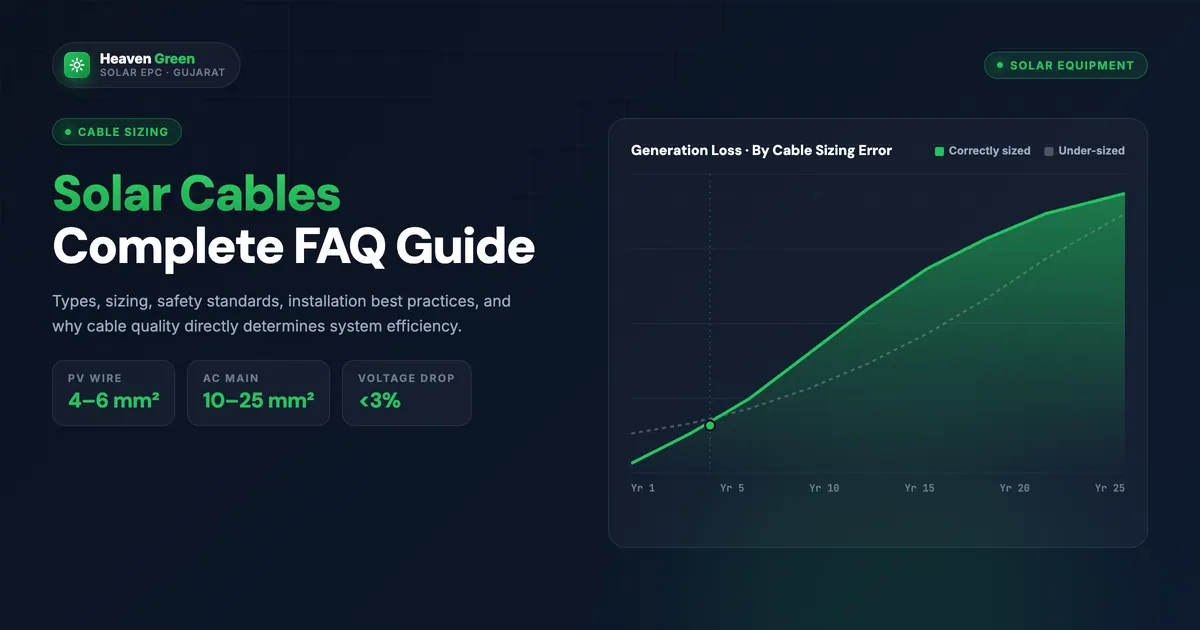
- A voltage drop exceeding 3% in the DC circuit reduces system efficiency by 3–5% annually
- For a 5 kW system in Gujarat, a 5% annual efficiency loss translates to approximately ₹3,150 per year in lost generation at ₹6/unit
- Over 25 years, this compounds to ₹15,000–₹20,000 in lost returns — far exceeding the cost of correctly sized cables at installation
Professional sizing methodology: Cable cross-section is selected based on the maximum short-circuit current of the string, the cable run length, and the acceptable voltage drop threshold. Standard practice in India requires DC voltage drop to remain below 3% for the full string run. Professional EPC companies calculate this for every string, not just the longest one.
Common cable sizes used in Gujarat rooftop installations:
- 4 mm² — standard for residential string connections up to approximately 10 m runs
- 6 mm² — longer runs or higher-current strings
- 10 mm² and above — commercial and industrial installations with longer distances to the inverter
Safety Standards and Certifications
Not all cables sold as “solar cables” meet the standards required for safe, long-term outdoor installation. Verify that cables carry one or more of the following certifications before accepting delivery:
| Certification | Issued By | Significance |
|---|---|---|
| IS 694:1990 | Bureau of Indian Standards | Indian standard for PVC insulated cables |
| IS 1554 | Bureau of Indian Standards | Indian standard for PVC sheathed cables |
| IEC 62930 | International Electrotechnical Commission | Specific standard for PV system DC cables |
| EN 50618 | European standard | Widely adopted internationally for PV cables |
| TUV Rheinland | Third-party testing body | Common international certification |
| UL 4703 | UL (USA) | Required for some export/finance applications |
Why certifications matter for Gujarat specifically:
Gujarat’s climate creates exceptional stress on cable materials:
- Intense UV radiation year-round degrades uncertified cable jackets within 3–5 years
- Temperatures exceeding 45°C accelerate insulation degradation in substandard materials
- Monsoon moisture infiltrates compromised insulation and promotes corrosion at connections
- Coastal installations near Surat, Junagadh, and along the Gulf of Khambhat face salt spray corrosion
Certified cables are tested specifically for these conditions. Non-certified cables may appear identical but fail early, creating safety hazards and requiring expensive replacement.
Quality Indicators: How to Identify a Good Solar Cable
When evaluating cables during procurement or incoming inspection, look for these physical indicators of quality:
- Clear manufacturer markings every metre — including cable type, voltage rating, current capacity, certification marks, and manufacturing date
- Uniform, smooth outer jacket — no bubbles, pits, or surface irregularities indicating inconsistent insulation
- Flexibility in cold conditions — quality cables remain flexible at low temperatures; substandard cables stiffen and crack
- Tinned copper conductors — visible as a silver appearance rather than the orange of bare copper; confirms corrosion resistance
- Proper documentation — each cable reel should be accompanied by a test certificate from the manufacturer and certification body
MC4 Connectors: The Critical Junction
DC cables in rooftop solar systems are connected using MC4 connectors — the industry-standard weatherproof connector for photovoltaic systems. Poor connector quality or incorrect crimping is responsible for a significant proportion of solar system failures.
Common MC4 connector faults:
- Improper crimping — the pin is not fully seated or crimped at incorrect torque, creating a high-resistance joint that heats up and can cause arcing
- Mismatched brands — mixing MC4-compatible connectors from different manufacturers can compromise the weatherproof seal
- Insufficient tightening — connectors that are not fully locked allow moisture infiltration
- Damaged locking clips — reused connectors with worn locking mechanisms are a fire risk
Professional EPC installers use calibrated crimping tools and perform pull-force tests on each connector to verify correct assembly. Requesting evidence of this testing is reasonable due diligence.
Common Installation Mistakes and How to Avoid Them
Undersizing Cables
The most prevalent error. Always require the installer to provide voltage drop calculations for each string run before installation begins.
Inadequate UV Protection
DC cables on rooftop runs should be routed in UV-stabilised cable trays or conduit wherever they are not self-supporting with UV-rated insulation. Cables lying directly on a hot metal roof surface experience accelerated thermal degradation.
Poor Cable Routing
Cables should be:
- Secured at intervals not exceeding 500 mm to prevent wind-induced abrasion
- Kept away from sharp edges that could damage insulation over time
- Routed to minimise induced shading on panels beneath
- Clearly labelled at both ends for maintenance identification
Incorrect Polarity
DC polarity reversal during stringing is a serious fault. Every string should be polarity-checked before connecting to the combiner box or inverter. Polarity errors can damage inverter input stages.
Environmental Considerations for Gujarat Installations
Gujarat presents some of India’s most demanding environmental conditions for cable materials:
UV intensity: Gujarat’s proximity to the Tropic of Cancer means exceptionally high UV index levels year-round. Only cables with documented UV resistance — tested to IEC 62930 or equivalent — should be used for outdoor DC runs.
Temperature range: Cable insulation must maintain integrity from winter lows of approximately 10°C (which can cause brittleness in substandard materials) to summer highs where cable surface temperatures on dark rooftops can exceed 70°C.
Monsoon moisture: Cable glands, junction box entries, and MC4 connectors must be rated to IP67 or IP68 to prevent moisture infiltration during heavy monsoon rainfall.
Coastal environments: Installations within approximately 5 km of the coastline — including parts of Surat, Hazira, and the Saurashtra coast — require tinned copper conductors and connector contacts with enhanced corrosion resistance. Standard bare copper corrodes rapidly in salt air.
Cost-Benefit Analysis: Quality vs. Economy Cables
The incremental cost of premium-grade solar cables in a typical 5 kW residential installation is approximately ₹3,000–₹5,000 over economy alternatives. The returns on that investment are substantial:
| Factor | Premium Cable | Economy Cable |
|---|---|---|
| Expected lifespan | 25+ years | 8–15 years |
| Annual energy loss from resistance | < 1% | 3–5% |
| Replacement cost if premature failure | N/A | ₹8,000–₹15,000 + labour |
| Fire risk from overheating | Low (certified materials) | Higher |
| 25-year energy savings from lower resistance | ₹15,000–₹20,000+ | Baseline |
Quality cables representing 2–3% of total system cost deliver a 3–5% improvement in energy production over the system lifetime — making them one of the highest-return component upgrades available.
Long-Term Maintenance and Inspection
Premium cables installed correctly require minimal maintenance, but periodic inspection protects against gradual degradation:
Annual visual inspection:
- Check for UV-induced jacket cracking, especially at bends and where cables exit conduit
- Inspect MC4 connectors for moisture ingress indicators (discolouration, corrosion)
- Confirm all cable securing clips remain in place and cables are not chafing against edges
Thermal imaging (every 2–3 years): Infrared thermal imaging identifies hotspots at connectors or junction points — areas where resistance has increased due to corrosion or loose crimping. Thermal imaging should be part of any professional O&M contract for systems above 10 kW.
After major weather events: Following severe monsoon storms, visually inspect cable routing for displaced securing clips or physical damage from debris.
Heaven Green Energy’s installation teams use certified solar cables on every project, with voltage drop calculations provided as part of the system design documentation. Our O&M service includes annual cable and connector inspections to protect your system’s performance over its full 25-year lifespan. For technical advice on cable selection or to discuss your installation requirements, contact us at +91 63904 05060 or email support@heavengreenenergy.com. We operate from Surat, Ahmedabad, and Junagadh across Gujarat.