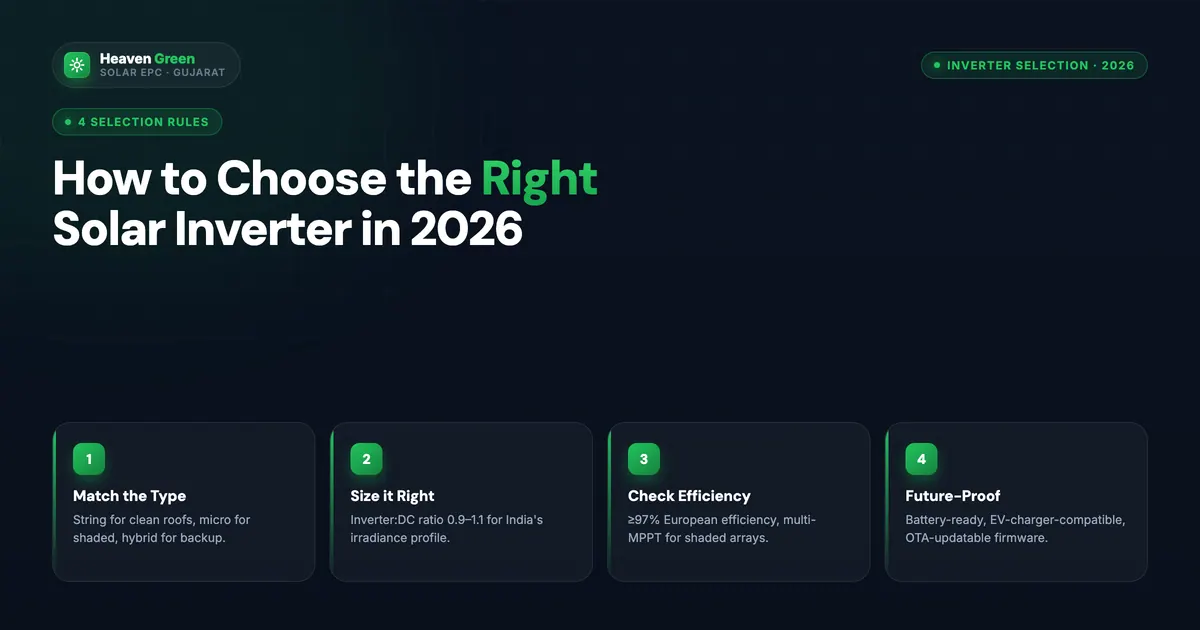
How to Choose the Right Solar Inverter: 2026 Buyer’s Guide & Selection Criteria
A solar inverter converts DC electricity from your panels into AC electricity your home or business can actually use. Beyond simple conversion, modern inverters optimize energy production through Maximum Power Point Tracking (MPPT), monitor system performance in real-time, ensure safety during grid outages, and provide actionable operational data.
Inverter selection has a direct and lasting impact on your ROI. A high-quality inverter at 98% efficiency versus 95% delivers substantially more usable electricity over 25+ years. For Gujarat homeowners and businesses, that efficiency difference translates to thousands — and for commercial systems, lakhs — of rupees over the system’s lifetime.
Types of Solar Inverters: Which One Fits Your Needs?
String Inverters: The Traditional Choice
Multiple solar panels connect in series to a single centralized inverter. Best for rooftop installations with minimal shading and uniform orientation.
Advantages:
- Lower upfront cost
- Simple installation and maintenance
- Proven reliability with an extensive track record
- Easy monitoring and troubleshooting
- Suitable for most residential and small commercial applications
Limitations:
- System performance is limited by the weakest panel in the string
- Shading on one panel reduces the entire string’s output
- Less flexible for complex roof layouts
- No panel-level monitoring
Microinverters: Panel-Level Optimization
Each solar panel gets its own small inverter. Optimal for installations with partial shading, multiple roof orientations, or complex layouts.
Advantages:
- Maximum energy harvest from each individual panel
- Shading on one panel does not affect others
- Panel-level monitoring and diagnostics
- Easier future system expansion
- Better performance in partially shaded conditions
- Longer warranty periods (20–25 years)
Limitations:
- Higher initial investment (15–30% more expensive than string inverters)
- More components that can potentially fail
- More complex installation process
- Roof-level maintenance if a unit fails
Hybrid Inverters: Battery-Ready Solutions
Combines solar inverter functionality with battery inverter capability for energy storage. Valuable for homeowners planning to add batteries or seeking backup power during grid outages.
Advantages:
- Single integrated unit manages both solar and battery
- Backup power capability during grid outages
- Time-of-use optimization (charge cheap, discharge expensive)
- Future-proof for battery additions
- Advanced energy management features
- Maximizes self-consumption
Limitations:
- Higher upfront cost than string inverters
- More complex installation and configuration
- Battery costs add significantly to total investment
- Requires careful sizing for both solar input and battery
Central Inverters: For Large-Scale Projects
High-capacity units for large commercial, industrial, and utility-scale installations. Suitable for solar parks and PM-KUSUM projects.
Advantages:
- Lowest cost per watt for large installations
- High efficiency at scale
- Centralized monitoring and maintenance
- Proven technology for utility-scale projects
Limitations:
- Single point of failure can affect large portions of the array
- Requires a dedicated equipment room
- Not suitable for residential or small commercial applications
Key Specifications to Evaluate When Selecting a Solar Inverter
Power Rating and Capacity
Power rating indicates maximum AC output, measured in kilowatts (kW). Residential systems typically range from 3 kW to 10 kW; commercial and industrial may require 10 kW to 100 kW+.
Efficiency Ratings: The Performance Indicator
Modern solar inverters achieve 95–98.5% efficiency. Two types matter:
- Peak efficiency: maximum conversion efficiency under ideal conditions — often reaches 98%+
- Weighted efficiency: calculates efficiency across varying power levels representing real daily operation
Always prioritize weighted efficiency ratings when comparing inverters, as they better reflect real-world performance.
For Gujarat’s climate, look for weighted efficiency of 96% or higher. A difference between 96% and 98% on a 5 kW system yields approximately 100–150 additional units annually — thousands of rupees in savings over 25 years.
Maximum Power Point Tracking (MPPT)
MPPT technology continuously adjusts the inverter’s operating point to extract maximum power under varying irradiance and temperature conditions. Multiple MPPT channels provide flexibility for installations with panels at different orientations or with partial shading patterns.
Input Voltage Range and DC/AC Ratio
The DC/AC ratio compares total DC panel capacity to the inverter’s AC rating. Modern systems use 1.1 to 1.3 ratios, allowing oversizing that maximizes energy production during morning and evening low-irradiance hours.
Operating Temperature Range
Gujarat experiences temperatures exceeding 40°C in summer. Inverters should be rated for -25°C to +60°C or higher, with clearly specified derating behavior at high temperatures.
IP Rating for Environmental Protection
Ingress Protection (IP) rating indicates resistance to dust and moisture:
- Outdoor installations: IP65 or IP66 recommended for Gujarat’s dusty conditions
- Indoor installations: IP54 or IP55 acceptable
Matching Inverter Capacity to Your Solar Panel System
Understanding the DC to AC Ratio
DC/AC ratio = Total solar panel capacity (DC watts) ÷ Inverter’s AC rating
A 6 kW solar array with a 5 kW inverter yields a 1.2 ratio.
Industry best practices recommend ratios between 1.1 and 1.3 because:
- Real-world conditions prevent panels from operating at rated nameplate capacity
- Panel degradation (0.5–0.8% annually) is offset by initial oversizing
- Extended production during morning and evening benefits from oversizing
- Modern inverters handle brief midday clipping without significant energy losses
Sizing Guidelines by Application
| Application | DC/AC Ratio | Example |
|---|---|---|
| Residential (1–10 kW) | 1.15–1.25 | 5 kW array → 4–4.5 kW inverter |
| Commercial (10–100 kW) | 1.2–1.3 | 50 kW array → 40 kW inverter |
| Industrial/Ground-mounted (100 kW+) | 1.2–1.25 | Detailed engineering analysis required |
Accounting for Real-World System Losses
| Loss Type | Typical Magnitude |
|---|---|
| Temperature losses (Gujarat heat) | 10–15% |
| Soiling losses (dust between cleanings) | 3–5% |
| Wiring losses (cable resistance) | 2–3% |
| Mismatch losses (panel variations) | 1–2% |
| Annual degradation | 0.5–0.8% per year |
Panels typically deliver 75–85% of rated capacity under real-world Gujarat conditions, which is why oversizing is standard practice.
Practical Sizing Examples
Example 1 – Residential: 20 panels × 540 W = 10.8 kW DC. Appropriate inverter: 9 kW AC (DC/AC ratio ≈ 1.2).
Example 2 – Commercial: 100 kW DC installation. Using 1.25 ratio → 80 kW inverter or four 20 kW inverters for redundancy and uptime protection.
Efficiency Ratings: What the Numbers Really Mean
Quantified Impact on Your ROI
5 kW residential system in Gujarat — annual savings comparison:
| Inverter | Weighted Efficiency | Annual Generation | Annual Savings |
|---|---|---|---|
| Inverter A | 96% | 7,200 kWh | ₹57,600 |
| Inverter B | 98% | 7,350 kWh | ₹58,800 |
The 2% efficiency difference yields 150 kWh additional electricity — ₹1,200 saved annually. Over 25 years: ₹30,000+, often more than the price gap between the two inverters. For commercial systems, this multiplies proportionally.
Warranty Considerations and Long-Term Reliability
Standard Warranty Periods in 2026
| Inverter Type | Standard Warranty |
|---|---|
| String inverters | 5–10 years; extendable to 15–20 years |
| Microinverters | 15–25 years |
| Hybrid inverters | 5–10 years (battery components separate) |
| Central inverters | 5–10 years + service agreements |
Plan for at least one inverter replacement during your solar system’s 25–30 year lifespan, or choose extended warranty coverage upfront.
What Warranties Typically Cover and Exclude
Covered:
- Manufacturing defects and component failures
- Performance degradation below specified levels
- Replacement or repair of defective units
- Some warranties include labor costs
Excluded:
- Improper installation or maintenance damage
- Lightning strikes and electrical surges (unless specified)
- Physical damage from accidents or vandalism
- Operating outside specified parameters
- Normal wear beyond the warranty period
Evaluating Manufacturer Reputation
A warranty is only as good as the company behind it. Evaluate:
- Company longevity: 10+ year established presence
- Financial stability: Research company health
- Gujarat service network: Local authorized technicians and service centers in Ahmedabad, Surat, Vadodara, and Rajkot
- Spare parts availability: Stocked within India, not requiring import
- Customer reviews: Look specifically at warranty claim experience
Brand Comparisons: Trusted Solar Inverter Manufacturers
Leading International Brands
SMA Solar Technology (Germany): 40+ years of experience. Known for exceptional reliability, 97–98.5% weighted efficiency, and robust performance in harsh conditions. Premium pricing reflects quality.
Fronius (Austria): Renowned for innovative technology and superior build quality. Excellent efficiency (97–98%), advanced monitoring, and attractive design. Popular for residential and commercial installations.
SolarEdge (Israel): Pioneered power optimizer technology combining string inverter and microinverter benefits. Excellent for shaded or complex-layout installations. Strong India presence.
Huawei (China): Rapidly gained market share with competitive pricing and advanced AI-powered features. FusionSolar platform offers comprehensive monitoring. Strong value for commercial and utility-scale projects.
Reputable Indian Manufacturers
Delta Electronics India: Established Indian presence with local manufacturing. Good efficiency, reliability, and competitive pricing. Well-suited for commercial and industrial applications.
Sungrow India: Comprehensive portfolio from residential to utility-scale. Competitive pricing with decent performance and an expanding Indian service infrastructure.
Growatt: Popular for residential and small commercial systems. Budget-friendly with improving service support across India.
Real-World Performance Data
| Quality Tier | Failure Rate (First 10 Years) |
|---|---|
| Premium (SMA, Fronius) | Under 2% |
| Budget brands | 5–8% or higher |
Red Flags to Avoid When Purchasing a Solar Inverter
Unusually Low Prices
Beware of inverters priced 30–40% below market rates. Extremely low prices indicate inferior components, poor quality control, or counterfeits. Purchase savings erode quickly through poor performance and early replacement.
Lack of Proper Certifications
Essential certifications every legitimate inverter must carry:
- IEC 62109 — International safety standard for PV power converters
- IEC 61683 — Efficiency measurement standard
- CE marking — European safety and electromagnetic conformity
- BIS certification — Bureau of Indian Standards approval for Indian sale
- UL certification — Additional quality mark from Underwriters Laboratories
Uncertified inverters may not be eligible for government subsidies, could void your insurance, and may not meet grid connection requirements.
Limited or Unclear Warranty Terms
Warning signs to avoid:
- Warranty periods shorter than 5 years
- Vague language without clear coverage details
- Warranties from companies with no verifiable presence
- No clear claim process defined
- Warranties excluding labor, shipping, or other essential costs
No Local Service Support
Verify before purchasing that your chosen brand has:
- Authorized service centers in Gujarat
- Trained technicians familiar with the specific model
- Spare parts stocked within India
- Technical support hotlines with knowledgeable staff
Missing Safety Features
Modern inverters must include:
- Anti-islanding protection — disconnects automatically during grid outages
- Ground fault detection
- Overvoltage/undervoltage protection
- Overtemperature protection
- Arc fault detection
- Surge protection
Future-Proofing Your Solar Investment
Battery Compatibility for Future Storage
Even without immediate battery plans, choosing a battery-compatible hybrid inverter keeps this option open. Consider:
- Can it manage both solar and battery systems?
- Does it support standard communication protocols (CAN bus, Modbus)?
- Can batteries be added later with AC coupling if using a standard inverter?
Smart Monitoring and Connectivity Features
Look for:
- Wi-Fi and cellular connectivity for remote smartphone monitoring
- Real-time performance data (generation, consumption, system health)
- Predictive maintenance alerts
- Cloud-based analytics with historical data
- Remote troubleshooting capability for technicians
Grid Integration and Net Metering Compatibility
Ensure inverter compliance with:
- Gujarat Electricity Regulatory Commission (GERC) grid connection requirements
- Net metering bi-directional metering support
- Reactive power control for commercial systems
- Proper frequency and voltage response
Software Updates and Longevity
- Firmware update capabilities that add features and fix vulnerabilities
- Manufacturer track record supporting older products with updates
- Open communication protocols vs proprietary lock-in
Frequently Asked Questions About Solar Inverters
How long do solar inverters last? String inverters typically last 10–15 years with proper maintenance; premium units may exceed 20 years. Microinverters generally last 15–25 years. In Gujarat’s hot climate, adequate ventilation extends operational life significantly.
Can I replace my inverter without changing panels? Yes. Solar panels and inverters are separate, independently replaceable components. This is common practice since panels typically outlast inverters by 10–15 years.
What size inverter do I need for my home? Use a 1.15–1.25 DC/AC ratio. A 5 kW panel system → 4–4.5 kW inverter; a 10 kW array → 8–9 kW inverter. Always consult an experienced provider for exact sizing based on your specific roof, orientation, and consumption pattern.
Are microinverters better than string inverters? Neither is universally superior. Choose microinverters for shading issues, complex roofs, or multiple orientations. Choose string inverters for uniform, unshaded rooftops with simpler layouts. For most Gujarat residential installations, string inverters offer excellent value.
How do I maintain my solar inverter?
- Clean air vents and filters regularly (critical in Gujarat’s dusty conditions)
- Monitor performance data for efficiency drops
- Check for error messages or warning lights
- Schedule annual professional inspection including electrical connection testing and firmware updates
Making Your Solar Inverter Decision with Confidence
Key takeaways:
- Match inverter type to your installation — string for straightforward layouts, microinverters for complex situations, hybrid for battery readiness
- Prioritize weighted efficiency — 2–3% differences between budget and premium inverters pay for themselves many times over
- Size properly — use 1.15–1.25 DC/AC ratios for optimal real-world performance
- Choose reputable brands — established manufacturers with strong local service networks ensure long-term support
- Verify certifications and warranties — these protect your investment legally and financially
- Plan for the future — battery compatibility, smart monitoring, and scalability preserve your options
- Avoid red flags — suspiciously low prices, missing certifications, and absent local service are serious warning signs
For Gujarat homeowners and businesses, expert guidance matched to regional conditions makes all the difference. Heaven Green Energy brings extensive experience from thousands of installations across Surat, Ahmedabad, Junagadh, and throughout Gujarat — ensuring optimal inverter technology selection for every project type.
Ready to find the right inverter for your system? Contact Heaven Green Energy at +91 63904 05060 to discuss your requirements and receive expert, site-specific recommendations.