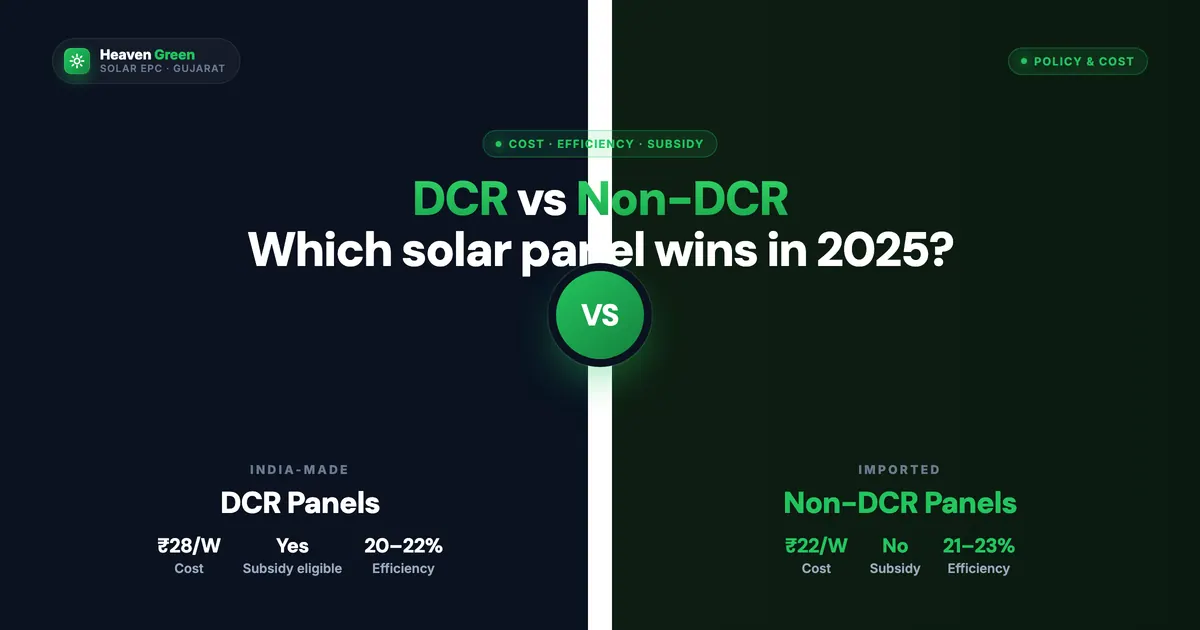
DCR vs Non-DCR Solar Panels: 2025 Guide — Cost, Efficiency & Policy Explained
India is racing toward 500 GW of solar capacity by 2030. At the heart of this ambition lies a critical policy divide: DCR vs Non-DCR solar panels. Whether you are a homeowner, farmer, or industrial buyer, choosing the right panel type determines your subsidy eligibility, return on investment, and long-term performance.
What Are DCR and Non-DCR Solar Panels?
DCR (Domestic Content Requirement) Solar Panels are entirely manufactured in India — both the solar cells and the modules are produced domestically through the wafer-to-cell-to-module process. As of 2025, India has 110 GW of module manufacturing capacity and 9.6 GW of cell capacity.
Non-DCR Solar Panels use imported cells or fully assembled modules from countries including China, Vietnam, Malaysia, and Taiwan. They often feature advanced technologies such as TOPCon, HJT, and bifacial designs.
Head-to-Head Comparison
| Aspect | DCR | Non-DCR |
|---|---|---|
| Origin | India (cells + modules) | Imported sources |
| Efficiency | 19–21% (PERC) | 21–26% (TOPCon/HJT) |
| Cost | ₹23–28/Wp | ₹8–15/Wp |
| Warranty | 25 years (80% output) | 25–30 years (85–90%) |
| Policy Alignment | Government tenders & schemes | Private/C&I projects |
| Payback (50 kW system) | 10.2 years | 7 years |
Efficiency Data: 2025 Field Performance
| Technology | Efficiency | Gain vs PERC | Annual Degradation |
|---|---|---|---|
| Mono-PERC (DCR) | 20% | Baseline | 0.55% |
| TOPCon (Non-DCR) | 22–23% | +8–10% | 0.45% |
| HJT (Non-DCR) | 24–26% | +15–20% | 0.35% |
Cost and ROI Analysis
Utility-Scale (1 MW+)
- DCR PERC: ₹7.75 Cr CAPEX — 14.2% IRR (government tender eligible)
- Non-DCR TOPCon: ₹5.52 Cr CAPEX — 16.8% IRR (open-access preferred)
Rooftop (50 kW)
- DCR: 10.2-year payback, ₹90 lakh in lifetime savings
- Non-DCR: 7-year payback, ₹1.08 Cr in lifetime savings (₹18 lakh additional benefit)
Government Subsidy Programs (2025)
PM Surya Ghar Scheme (Residential)
- 40–60% cost subsidy for rooftop systems up to 3 kW
- Requires DCR-compliant panels for eligibility
PM-KUSUM Scheme (Agricultural)
| Component | Subsidy |
|---|---|
| Component A (Decentralized ≤2 MW) | 50–70% |
| Component B (Standalone pumps) | 60% |
| Component C (Grid-connected pumps) | 50% |
CPSU Phase II
- Targets 12 GW of DCR-only projects
- Requires minimum 40% domestic value addition
Key rule: If you want government subsidy, you need DCR panels. If you want maximum ROI on a private project, Non-DCR usually wins.
Market Trends in 2025
- ALMM (Approved List of Models and Manufacturers) reinstated in April 2025
- Import duty: 40% on modules, 25% on cells (through FY 2026)
- DCR pricing rising due to domestic cell shortages
- Non-DCR pricing declining post duty revision
- PLI Phase II boosting 10 GW of new domestic manufacturing capacity
- Employment: 75,000 solar manufacturing jobs in 2025, projected 120,000 by 2027
Leading Manufacturers
DCR: Waaree Energies (14% market share), Adani Solar (10 GW expansion), Premier, Emmvee
Non-DCR: Trina Solar, JA Solar, LONGi, Risen Energy
Which Panel Should You Choose?
| Segment | Recommended | Reason |
|---|---|---|
| Residential | DCR | Subsidy eligibility under PM Surya Ghar |
| C&I Rooftop | Non-DCR TOPCon/HJT | Superior efficiency and faster ROI |
| Utility-Scale | Hybrid (70% Non-DCR + 30% DCR) | Balance policy compliance with returns |
| Agricultural (KUSUM) | DCR | 60–70% subsidy + rural support |
Environmental Impact
Each megawatt of solar capacity installed displaces approximately 1,200 tons of annual CO₂ emissions and conserves 3 million liters of water compared to coal-based thermal power plants.
The Bottom Line
DCR and Non-DCR panels are complementary pillars of India’s solar strategy — not competitors. DCR panels strengthen energy security and domestic manufacturing. Non-DCR panels drive innovation and reduce system costs for private buyers. The smartest approach depends on your project type, subsidy eligibility, and ROI priorities.
A balanced approach that integrates both domestic capacity and global technology will accelerate India’s path to 500 GW by 2030.
Not Sure Which Is Right for You?
Heaven Green Energy will assess your project requirements, subsidy eligibility, and long-term ROI to recommend the best panel technology for your specific situation.
Call our solar experts today: +91 63904 05060