Why AI Is the Future of Solar Operations and Maintenance
Artificial intelligence is fundamentally transforming solar operations and maintenance. The industry is shifting away from reactive, manual processes toward intelligent, predictive, and autonomous systems. As solar capacity expands globally, AI has become essential for enhancing efficiency, reducing costs, and ensuring long-term asset sustainability.
The Financial Case for AI in Solar
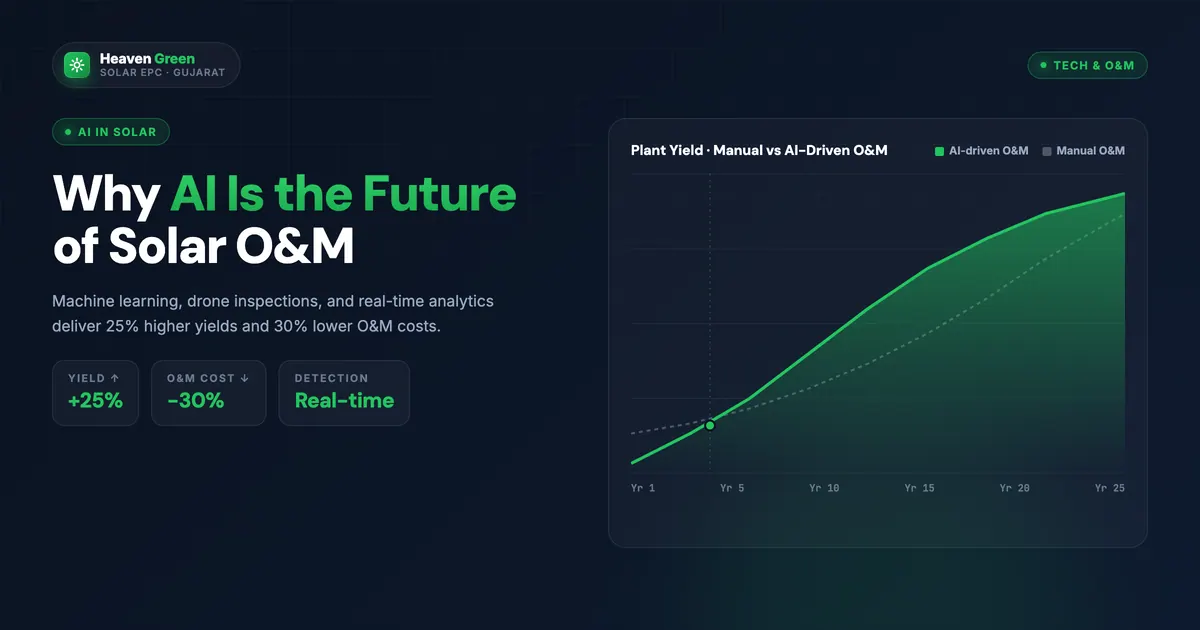
The numbers make a compelling argument. AI-driven solar energy management systems deliver:
- Up to 25% boost in energy yields
- 30% reduction in operational costs
- 30% decrease in overall maintenance costs
- 40% cut in inspection costs
- 25% increase in system availability
These are not theoretical projections — they represent measured outcomes across real solar portfolios.
Predictive Maintenance: From Reactive to Proactive
Traditional solar maintenance is reactive — problems are addressed only after equipment fails. AI transforms this through predictive maintenance that identifies failures before they disrupt operations.
Advanced machine learning algorithms achieve:
- 95% accuracy in fault prediction
- 6–7 days advance notice of inverter or transformer failures
- 30–45% reduction in unplanned downtime
- 20–25% extension of equipment lifespans
Advanced Neural Network Applications
Long Short-Term Memory (LSTM) Networks:
- Achieve 94.2% accuracy in forecasting solar panel energy output
- Analyze patterns in operational data to predict future performance degradation
Convolutional Neural Networks (CNNs):
- Deliver 92.10% training accuracy in detecting visual defects
- Process thermal and RGB imagery to identify problems invisible to the human eye
- Enable early intervention before minor issues become major failures
Drone-Based Thermal Inspection and Computer Vision
AI-powered drone technology is revolutionizing how solar farms are inspected.
Key advantages over traditional inspection methods:
- Up to 70% reduction in inspection time
- Significant labour cost savings
- Detection of invisible anomalies including:
- Micro-cracks in panel cells
- Hot spots from cell damage or soiling
- Surface degradation patterns
- Electrical faults in wiring
Computer vision algorithms using deep learning achieve 99% defect detection accuracy. The Mask-RCNN framework combined with transfer learning enables accurate defect localization and classification in complex environments. Drones can scan vast installations in minutes — work that previously required days of manual inspection.
Real-Time Performance Optimization
IoT sensors integrated with AI analytics provide continuous monitoring of:
- Temperature changes across the array
- Voltage readings at string and panel level
- Irradiance patterns throughout the day
- Thermal imaging data from embedded sensors
These systems quickly detect anomalies and suggest corrective measures. AI algorithms analyse over 10,000 data points per minute from sensors across installations, identifying underperforming components and proposing optimal operating conditions.
Machine learning models simultaneously optimize:
- Panel angle and orientation adjustments
- Energy storage charge and discharge schedules
- Grid integration timing for maximum tariff benefit
This dynamic adjustment ensures peak efficiency as environmental conditions change throughout each day.
Scalability: Managing Growth Without Proportional Cost Increases
One of AI’s greatest strengths is scalability. Agentic AI solutions enable seamless growth across multiple sites without proportional increases in operational costs.
Portfolio Growth Example
When expanding from 500 MW to 2,000 MW, operational complexity increases exponentially. AI addresses this through:
- Smart resource allocation across sites
- Focused deployment of maintenance teams and spare parts
- Cross-site optimization identifying opportunities invisible at individual site level
- Coordinated maintenance scheduling to minimize downtime
- Weather-based production forecasting for accurate energy accounting
- Market participation strategies for grid-scale assets
AI systems make thousands of operational decisions daily, optimised for local conditions while considering broader portfolio objectives.
AI in Practice: What It Means for Your Solar Plant
| Traditional O&M | AI-Powered O&M |
|---|---|
| Scheduled maintenance visits | Predictive, condition-based servicing |
| Manual panel inspections | Drone-based thermal imaging |
| Reactive fault response | 6–7 day advance fault warning |
| Periodic performance reports | Real-time 10,000+ data points/minute |
| Site-by-site management | Cross-portfolio optimisation |
The Future Is Intelligent
AI represents more than an upgrade to solar operations and maintenance — it is becoming the foundation of modern solar asset management. The combination of predictive maintenance, drone-based inspections, real-time performance analytics, and multi-site optimization delivers:
- Higher energy output per installed megawatt
- Lower operational costs per kWh generated
- Longer equipment life across the portfolio
- Consistent efficiency and reliability for investors and off-takers
As solar portfolios grow in complexity, AI ensures sustainable performance without increasing workforce requirements proportionally. This technology transforms solar operations from reactive processes into proactive, intelligent systems — making AI the key driver for solar growth over the next decade.
Future-Proof Your Solar Plant with Heaven Green Energy
Heaven Green Energy designs and installs solar systems built for intelligent, long-term performance. Whether you are managing a rooftop installation or a large commercial plant, we help you leverage monitoring, maintenance, and modern technology to protect your investment.
Talk to our team today: +91 63904 05060