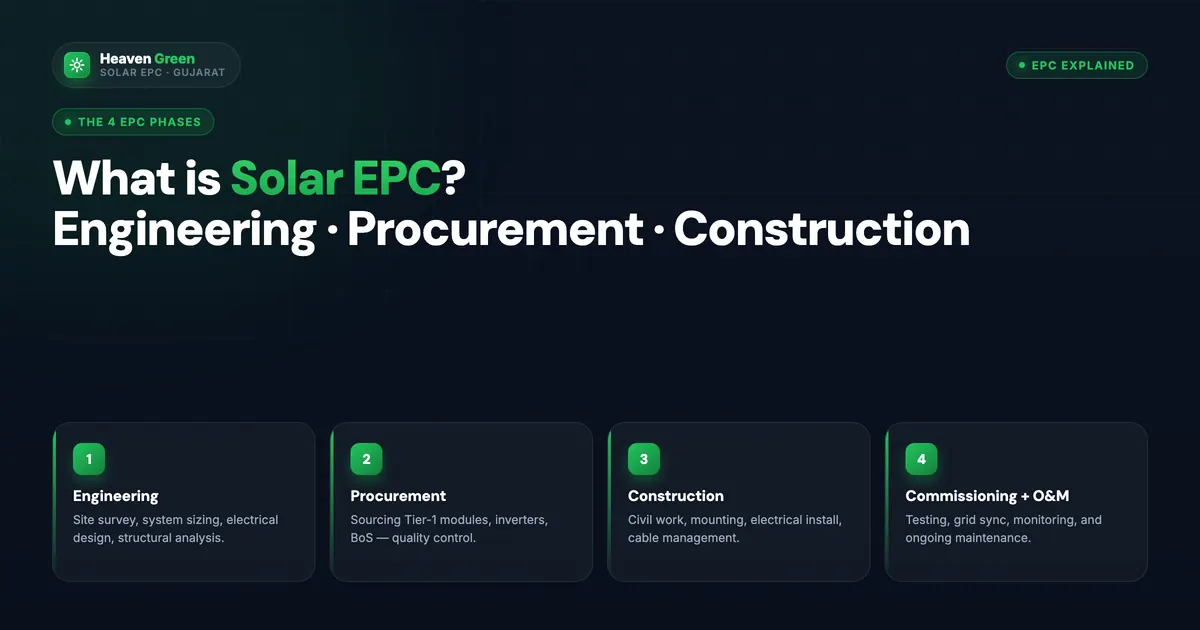
Solar EPC stands for Engineering, Procurement, and Construction — a comprehensive, single-responsibility approach to solar project implementation.
Your EPC partner handles everything: site surveys, engineering calculations, government approvals, equipment procurement, installation work, grid connectivity, testing, and final commissioning. Instead of coordinating multiple vendors and contractors yourself, one experienced team takes full accountability for delivering a working, optimised solar system.
What Does Solar EPC Mean?
The EPC model breaks a solar project into three integrated phases, each managed by the same contractor:
Engineering Phase
The engineering phase lays the technical foundation for the entire project:
- Site assessment — evaluating your roof or land for solar potential, structural integrity, and orientation
- Shadow analysis — identifying obstructions that could reduce generation at any time of day or year
- Electrical load analysis — matching system capacity to your actual consumption patterns
- Technical documentation — producing drawings, single-line diagrams, and calculations required for government and utility approvals
Procurement Phase
Once the engineering design is approved, the procurement phase sources all equipment and materials:
- Solar modules (panels) from verified manufacturers
- Inverters — string inverters, central inverters, or microinverters as per design
- Mounting structures — roof-mounted, ground-mounted, or elevated racking
- DC and AC cables, connectors, and protection equipment
- Balance of System (BOS) components — junction boxes, earthing, surge protection, monitoring systems
Experienced EPC companies leverage bulk procurement relationships to secure better pricing and guaranteed lead times.
Construction Phase
The construction phase delivers the physical installation:
- Site preparation and civil work (for ground-mounted projects)
- Mounting structure installation
- Solar module mounting and wiring
- Inverter installation and electrical connections
- Grid interconnection and metering
- System testing and commissioning
- Handover with full documentation and operator training
What Is Included in an EPC Package?
A complete solar EPC package typically covers:
| Component | Included |
|---|---|
| System design and engineering | Yes |
| Equipment (panels, inverters, structures, cables) | Yes |
| All BOS components | Yes |
| Installation and construction labour | Yes |
| Government permit applications | Yes |
| DISCOM/utility approvals | Yes |
| Grid connection and net metering setup | Yes |
| System testing and commissioning | Yes |
| Handover documentation | Yes |
| Workmanship warranty | Yes (typically 2–5 years) |
| Panel performance warranty facilitation | Yes (25 years via manufacturer) |
Solar EPC Project Timelines
Project timelines depend on system size and complexity:
| Project Type | Typical Duration |
|---|---|
| Residential (1–10 kW) | 4–8 weeks |
| Commercial / Industrial (10–500 kW) | 8–16 weeks |
| Large solar parks (1–50 MW) | 6–12 months |
Timelines include site assessment, engineering, equipment procurement, installation, utility approvals, and commissioning.
Benefits of the Solar EPC Model
Single-Point Accountability
One contractor is responsible for every aspect of your project. If something goes wrong — whether it is a design issue, an equipment defect, or an installation problem — you have one point of contact rather than finger-pointing between multiple vendors.
Faster Project Completion
Integrated management eliminates handover delays between engineering, procurement, and construction teams. EPC providers also have established relationships with utilities and government bodies that streamline approvals.
Cost Efficiency Through Bulk Procurement
EPC companies purchase equipment in volume across multiple projects, passing savings on to clients. This bulk procurement advantage is difficult to replicate when buying equipment independently.
Quality Assurance
Professional EPC providers follow established quality control processes at every stage — from verifying equipment certifications on delivery to testing each panel string before commissioning.
Comprehensive Warranties
EPC contracts typically include:
- 2–5 years workmanship warranty on installation
- 25 years performance warranty on panels (via manufacturer)
- 5–10 years warranty on inverters (via manufacturer)
Technical Expertise
System design matters as much as equipment quality. Proper tilt angles, string configurations, cable sizing, and grounding directly affect energy generation and safety. EPC engineers apply this expertise to every project.
Solar EPC Cost Structure
Solar modules represent 40–50% of total project cost. The remaining budget covers:
| Cost Component | Proportion |
|---|---|
| Solar modules | 40–50% |
| Inverters | 10–15% |
| Mounting structures | 8–12% |
| BOS components (cables, earthing, protection) | 5–8% |
| Installation labour and project management | 15–20% |
| Engineering, permits, approvals | 3–5% |
Overall system costs in Gujarat typically range from ₹40,000–70,000 per kW depending on project size, equipment quality, and site conditions. Larger systems benefit from economies of scale.
ROI of Solar EPC Projects in Gujarat
Gujarat’s solar resource — averaging 5–6 peak sun hours daily — delivers strong investment returns:
| Project Type | Typical Payback Period |
|---|---|
| Residential (rooftop) | 5–7 years |
| Commercial / Industrial | 3–5 years |
| Ground-mounted solar parks | 3–4 years |
After payback, the system generates essentially free electricity for the remaining 18–22 years of its operational life.
How to Choose the Right Solar EPC Partner in Gujarat
When evaluating EPC providers, assess the following:
Experience and Track Record
- Number of projects completed in your segment (residential/commercial/industrial)
- Years of operation in the Gujarat market
- Portfolio of completed installations you can verify
Equipment Partnerships
- Which panel and inverter brands does the company work with?
- Are those brands on the ALMM (Approved List of Models and Manufacturers)?
- Do they use BIS-certified equipment?
Subsidy and Regulatory Expertise
- Can they handle PM Surya Ghar, PM-KUSUM, or DREBP applications?
- Do they manage DISCOM approvals and net metering connections?
- Are they registered with MNRE or state nodal agencies?
Warranty and After-Sales Support
- What workmanship warranty is offered?
- Do they provide performance monitoring?
- What is their process for handling warranty claims?
Transparency
- Is the proposal itemised by component?
- Are all inclusions and exclusions clearly stated?
- Do they provide detailed generation estimates?
Frequently Asked Questions About Solar EPC
What is the difference between solar EPC and supply-only?
A supply-only provider sells you equipment but leaves installation, approvals, and commissioning to you. An EPC contractor handles everything, delivering a fully operational system. EPC is strongly recommended for any project above 1 kW.
Can I manage my own procurement and hire a separate installer?
Yes, but this creates coordination risk. If panels underperform, the installer may blame the equipment supplier and vice versa. EPC single-point accountability eliminates this problem.
What certifications should my EPC provider have?
Look for MNRE empanelment, valid electrical contractor licences, ISO 9001 quality certification, and experience with your state’s DISCOM application process.
How long does the EPC process take for a 10 kW commercial installation?
A 10 kW commercial installation typically completes in 8–12 weeks, including site assessment, equipment procurement, installation, and DISCOM approval for net metering.
Does EPC pricing include government subsidies?
EPC providers quote the gross system cost. Subsidies (such as PM Surya Ghar residential subsidies) are applied separately — typically either deducted from your payment or reimbursed after installation. An experienced EPC partner handles the subsidy application process on your behalf.
Have questions about solar EPC for your project? Heaven Green Energy has completed over 10,000 solar installations across Gujarat since 2017, from residential rooftops to multi-megawatt industrial systems. We manage every aspect of your project — engineering, procurement, construction, approvals, and after-sales support.
Call us at +91 63904 05060 to discuss your requirements and get a detailed EPC proposal.