Gujarat has established itself as India’s solar powerhouse with over 13,000 MW of installed solar capacity as of 2026. The state’s favourable policies, abundant sunshine averaging 5.5–6.0 kWh/m²/day, and progressive government schemes have created a thriving solar ecosystem — and a market crowded with providers ranging from well-established local specialists to large national conglomerates.
Choosing between a local Gujarat-based solar EPC company and a national player is one of the most consequential decisions in any solar project. Both options have genuine strengths, and the right choice depends on your project scale, priorities, and the specific characteristics of your installation.
Understanding the Solar EPC Landscape in Gujarat
Local solar EPC companies are regional players with deep roots in Gujarat’s market, focusing exclusively on serving customers within the state. Companies like Heaven Green Energy operate from Surat with offices in Ahmedabad and Junagadh, building their reputation project by project within the communities they serve.
National solar EPC companies operate across multiple states with standardised processes, larger teams, and extensive resource networks. Examples include Tata Power Solar and Waaree Energies — companies with pan-India presence and corporate-scale operations.
Neither model is inherently superior. The relevant question is which model aligns better with your specific project requirements.
Local Solar EPC Companies in Gujarat: Key Advantages
Regional Expertise and Local Knowledge
Gujarat’s climate varies considerably — from the corrosive coastal environment of the Gulf of Khambhat to the industrial heartland of Surat and Ahmedabad’s urban density. Local companies possess intimate knowledge of these microclimatic differences and how they affect solar system performance.
What local expertise delivers:
- Coastal areas require corrosion-resistant mounting structures due to salt-laden air — local installers specify this automatically
- Inland industrial zones need systems designed for higher dust accumulation and cleaning frequency
- Deep familiarity with Gujarat’s electricity distribution infrastructure and utility-specific procedures
- Knowledge of state-specific net metering regulations and incentive programmes
- Established relationships with Gujarat’s DISCOMs (DGVCL, MGVCL, UGVCL, PGVCl) that streamline approvals
Heaven Green Energy has completed over 10,000 installations across Gujarat since 2017, providing insights into district-specific challenges and opportunities that no standardised playbook can replace.
Service Quality and Response Time
Local companies offer significant advantages in responsiveness:
- Same-day or next-day site visits for troubleshooting and emergency repairs
- Direct communication with decision-makers, not call centre representatives
- Personalised project management with consistent team from consultation through commissioning
- Flexible scheduling accommodating customer-specific timelines
- Local language support in Gujarati, Hindi, and English
National Solar EPC Companies: What They Bring to the Table
Brand Recognition and Financial Stability
Companies like Tata Power Solar and Waaree Energies provide:
- Long-term financial stability providing assurance for 25-year warranty obligations
- Easier access to capital markets and financing partnerships
- Preferential solar loan terms through established bank relationships
- Strong corporate backing with publicly available financial information
Procurement Power and Standardised Processes
National players benefit from scale:
- Large-volume purchasing directly from manufacturers yields better pricing on components
- Standardised processes and quality control systems refined across thousands of installations
- Dedicated specialised teams for each project phase — design, engineering, procurement, installation, commissioning
- Unified project management methodology across multiple states
Technology Access and Innovation
National companies often have distinct technological advantages:
- Dedicated research and development teams with technology partnerships
- Early access to latest solar panel technologies and efficiency improvements
- Partnerships with international technology providers
- Access to cutting-edge monitoring systems and innovative mounting solutions
Head-to-Head Comparison: 8 Critical Factors
1. Pricing and Cost Structure
Local companies:
- Competitive pricing due to lower overhead costs
- More flexible and negotiable pricing structures
- Better value for small to medium-sized projects under 100 kW
- May not match bulk procurement discounts on very large installations
National companies:
- Economies of scale on equipment procurement benefit large orders
- Lower per-watt costs achievable on projects above 500 kW
- Premiums built in for brand value and corporate overhead
- Less flexible pricing following established corporate matrices
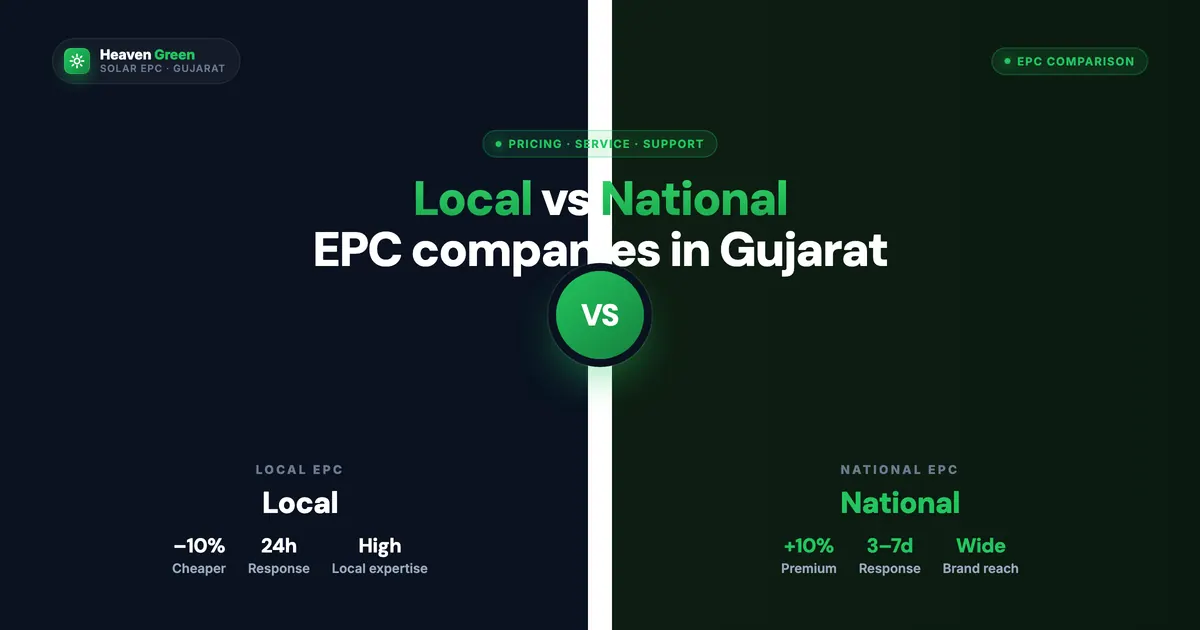
Verdict: Local companies typically provide better value for residential and small commercial projects. National companies’ procurement advantages primarily benefit large industrial or ground-mounted installations above 500 kW.
2. Service Quality and Customer Support
Local companies:
- Personalised attention and relationship-based service throughout project life
- Consistent team across the entire project lifecycle
- Direct access to technical decision-makers
- Service approach tailored to site-specific needs
- Strong motivation to maintain quality — community reputation is the primary marketing channel
National companies:
- Standardised service protocols with defined escalation procedures
- Formal service level agreements with documented terms
- Different teams may be involved at different project stages
- Systematic quality checks at each phase
- Clear documentation and audit trails
Verdict: Local companies excel in personalised attention and direct communication. National companies provide formal process structure and systematic documentation.
3. Response Time and Accessibility
Local companies:
- Hours-long response times through geographical proximity
- Quick site visits without logistical coordination challenges
- Critical advantage during monsoon season when weather-related issues demand immediate attention
- Particularly beneficial for customers in tier-2 and tier-3 cities across Gujarat
National companies:
- Regional service centres in major metros provide reasonable coverage
- Response times range from same-day in major cities to several days in smaller towns
- Larger technician pools reduce individual availability delays
- Centralised customer service systems can slow initial response
Verdict: Local companies clearly win on response time and accessibility, especially outside major cities.
4. Local Expertise and Customisation
Local companies:
- Deep understanding of Gujarat-specific climatic challenges
- Knowledge of optimal mounting specifications for different regions
- Experience maximising Gujarat government schemes and subsidies
- Willingness to customise for unique site challenges
- Strong motivation to secure every available state incentive for customers
National companies:
- Standardised design templates developed for pan-India deployment
- Broader experience drawing on solutions validated in other states
- Customisation typically requires special approvals and additional costs
- Less emphasis on state-specific optimisation
Verdict: Local expertise provides significant value for unique site challenges or maximising Gujarat-specific incentives including PM-KUSUM and DREBP.
5. Warranty Support and After-Sales Service
Local companies:
- Direct warranty claim handling — one point of contact
- Faster resolution without corporate escalation procedures
- Strong incentive to maintain customer relationships in local market
- Risk: dependent on company business continuity
National companies:
- Established service networks with corporate financial backing
- Formal warranty procedures with documented processes and timelines
- Greater long-term viability assurance through corporate structure
- Financial stability for honouring 25-year performance commitments
Verdict: National companies have an edge in long-term warranty security. Local companies provide better day-to-day responsiveness when issues arise.
6. Project Timeline and Execution Speed
Local companies:
- Faster execution through proximity and operational flexibility
- Streamlined decision-making without multiple corporate approval layers
- Quick adaptation to site conditions discovered during installation
- Fast procurement through established local supplier relationships
- Clear advantage for time-sensitive projects
National companies:
- Established timelines based on standardised processes
- Reliable, well-documented schedules with defined milestones
- Less flexibility for acceleration or schedule adjustments
- Advantages on very large installations requiring substantial resource deployment
- Superior project documentation quality
Verdict: Local companies generally execute faster for small to medium projects. National companies have resource advantages on very large installations.
7. Technology and Equipment Quality
Local companies:
- Source from the same tier-1 manufacturers as national players
- Comparable technology quality when correctly specified
- Greater flexibility in equipment selection to match project requirements
- Limited early access to very latest technologies
National companies:
- Exclusive partnerships with equipment manufacturers
- Earlier access to new technologies
- More limited equipment choices within approved vendor lists
- More formalised quality control and testing documentation
Verdict: Equipment quality is comparable when tier-1 manufacturers are specified. National companies offer earlier technology access; local companies offer greater equipment flexibility.
8. Financial Stability and Long-Term Viability
Local companies:
- Stability varies significantly based on company age and portfolio scale
- Established players with years of operation and thousands of projects offer reasonable viability
- Newer or smaller companies carry higher risk of discontinuation
- Due diligence on financial health is essential — request business registration documents
National companies:
- Backed by large corporate groups or publicly traded entities
- Greater financial security and diversity of revenue streams
- Access to capital markets reducing liquidity risk
- Greater confidence in honouring 25-year warranty commitments
Verdict: National companies have a clear advantage in long-term stability. Well-established local companies with proven track records and strong project portfolios can provide reliable partnerships.
Which Option Is Right for Your Project?
For Residential Solar Projects
Homeowners typically benefit most from local solar EPC companies.
Choose local if:
- System size is under 10 kW
- You value direct communication and personalised attention
- Quick service response for maintenance matters to you
- You want flexibility in system design and equipment selection
- Cost optimisation is a primary concern
- You are applying for state-level subsidies or PM-KUSUM schemes
Choose national if:
- Brand recognition provides significant peace of mind
- You have multiple properties across different states
- Formal documented procedures are preferred
- You are willing to pay a premium for an established corporate brand
For most Gujarat homeowners, local providers like Heaven Green Energy offer the appropriate balance of quality, service, and value.
For Commercial and Industrial Projects
Commercial and industrial installations (50–500 kW) present more nuanced decisions.
Choose local if:
- You have a single Gujarat location
- You need customised solutions for unique rooftop or ground conditions
- Quick service response is critical to operational continuity
- You want a dedicated team managing the project from start to finish
- You are implementing government schemes like PM-KUSUM or DREBP
- Cost competitiveness is a key decision factor
Choose national if:
- You have multiple facility locations across different states requiring consistent service
- The project exceeds 500 kW
- Corporate procurement policies favour established national brands
- You need specialised financing arrangements
- Formal project documentation and compliance are critical requirements
For Large-Scale Ground-Mounted Solar Parks
Large-scale solar parks above 1 MW demand careful evaluation of both options.
Choose local if:
- The company has a proven track record with similar-scale projects in Gujarat
- Strong financial stability is demonstrable
- Local expertise in land acquisition and DISCOM approvals provides advantages
- Competitive pricing comes with quality equipment specifications
- Local authority relationships are valuable for site-specific approvals
Choose national if:
- Project scale exceeds the local company’s demonstrated capacity
- Specialised financing or EPC-plus-financing packages are required
- Complex technical requirements or innovative technologies are involved
- Corporate governance and compliance frameworks favour established brands
- Substantial financial guarantees and performance bonds are required
Red Flags to Watch Out For
General warning signs — applicable to all providers:
- Unrealistic performance promises exceeding standard Gujarat irradiation calculations
- High-pressure sales tactics or artificial urgency around pricing
- Vague warranty terms lacking clear documentation of coverage and exclusions
- Inability to provide verifiable customer references
- Unusually low pricing — often indicates substandard equipment or hidden costs
- Poor communication during the sales process
- No verifiable physical office or showroom
- Incomplete proposals lacking equipment specifications, timeline, or warranty details
Specific concerns for local companies:
- Less than 2–3 years of operational history without a substantial project portfolio
- Inability to provide financial statements or business registration documentation
- Absence of professional certifications or industry affiliations
- Reluctance to provide detailed equipment specifications
Specific concerns for national companies:
- Installation outsourced to unknown subcontractors without documented quality oversight
- Rigid contracts with unfavourable terms and limited flexibility for site conditions
- Customer service representatives unable to answer basic technical questions
- Significant gaps between what was promised in the sales process and what appears in the contract
Making Your Final Decision: A Practical Checklist
Company Credentials and Track Record
- Years in business and operational history
- Number and scale of completed similar projects
- Verifiable customer references available for direct contact
- Professional certifications and industry memberships
- Financial stability evidence
- Awards, recognition, or industry rankings
Technical Capabilities
- In-house engineering and design expertise
- Equipment quality from tier-1 manufacturers
- System design optimised for specific site conditions
- Technical team qualifications and project experience
- Installation quality standards and inspection processes
- Performance monitoring and tracking systems
Service and Support
- Service team proximity to your location
- Guaranteed response times for service requests
- Warranty terms — coverage, duration, and exclusions
- After-sales support structure and communication channels
- Maintenance package options
Pricing and Value
- Total project cost breakdown — equipment, installation, commissioning
- Cost per watt compared to market benchmarks
- Payment terms and financing options
- All included services clearly itemised
- Warranty coverage duration and scope
Contract Terms
- Contract clarity and completeness
- Performance guarantees with defined remedies
- Payment milestones tied to completion stages
- Dispute resolution mechanism
- Exit clauses and cancellation terms
Conclusion
The solar energy landscape in Gujarat offers excellent options among both local and national EPC companies. The right choice aligns your specific project requirements with the provider’s genuine strengths — not just their marketing position.
Whether you select a local Gujarat specialist offering regional expertise and personalised service, or a national player with established brand recognition and pan-India resources, your solar system will generate clean energy for 25+ years — making this one of the most important long-term investment decisions you will make.
Heaven Green Energy brings over seven years of Gujarat-specific experience, 10,000+ completed installations, and offices in Surat, Ahmedabad, and Junagadh to every project we take on. To discuss which approach fits your project, speak with our solar experts at +91 63904 05060 or email hevaensolarenergy@gmail.com.