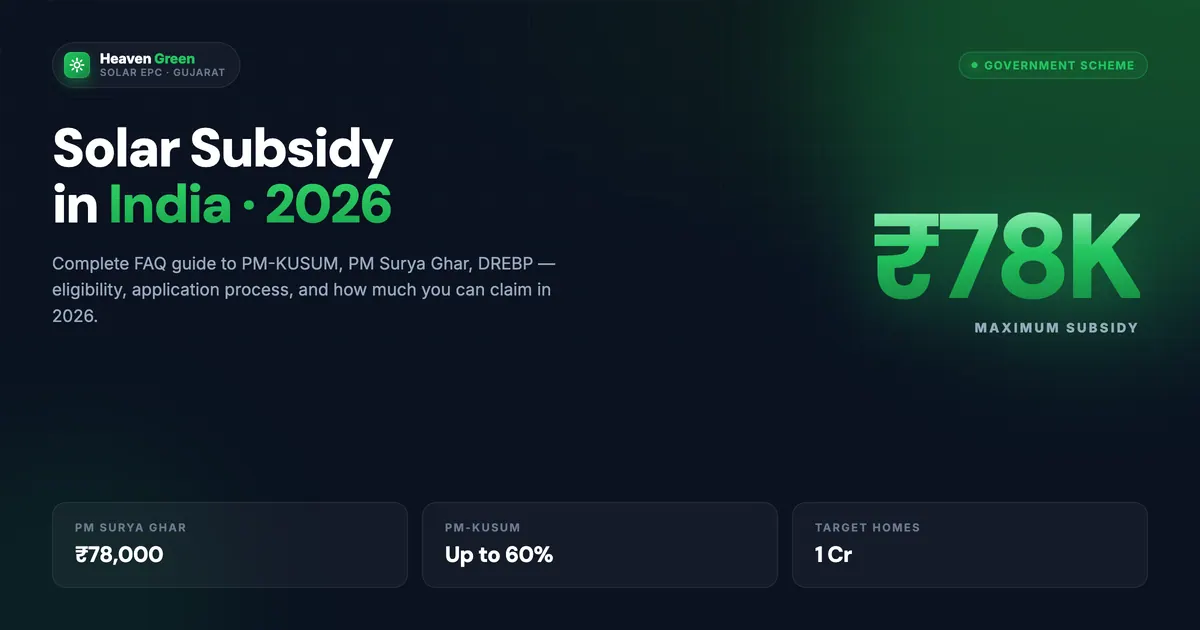
India targets 500 GW of renewable energy capacity by 2030. Solar subsidies are the government’s primary tool to reduce the initial investment barrier — typically covering 30–40% of installation costs for residential systems. In Gujarat alone, with 5.5–6.5 kWh/m²/day of solar irradiation, the financial case is compelling even before subsidies are factored in.
This guide answers every question you have about solar subsidies in India for 2026.
What is a Solar Subsidy and How Does It Work?
Solar subsidies are financial assistance programs that reduce installation costs through Direct Benefit Transfer (DBT). The process:
- Installation by a government-approved empanelled vendor
- Subsidy application submission with documentation
- System installation and DISCOM inspection
- Subsidy disbursement directly to your bank account
Only grid-connected systems installed through approved channels qualify for government subsidies.
Major Government Solar Subsidy Schemes in 2026
Rooftop Solar Programme (Phase III)
- For residential consumers
- Systems up to 10 kW capacity
- Higher subsidies for smaller systems
- Net metering facility for surplus electricity
PM-KUSUM (Pradhan Mantri Kisan Urja Suraksha evam Utthaan Mahabhiyaan)
Three components targeting different beneficiaries:
| Component | Description |
|---|---|
| Component A | Grid-connected renewable plants (500 kW to 2 MW) |
| Component B | Standalone solar-powered agriculture pumps |
| Component C | Solarisation of existing grid-connected pumps |
Gujarat State Solar Initiatives
- Expedited approvals and simplified net metering
- Support for commercial and industrial projects
- Banking facility for surplus generation
Who is Eligible for Solar Subsidy in India?
Residential Rooftop Solar
- You own the property (house, apartment, or housing society)
- You have an active electricity connection
- Adequate rooftop space available
- System installed through an empanelled vendor
- No previous subsidy availed at the same premises
PM-KUSUM (Farmers)
- Individual farmers, groups, cooperatives, panchayats
- Component B: Off-grid or grid-connected irrigation needs
- Component C: Existing grid-connected pump owners
Commercial and Industrial
- Accelerated depreciation benefits
- State-specific incentives
- Concessional financing options
- Net metering and open access policies
How Much Solar Subsidy Can You Get?
Residential Rooftop Solar Amounts
- Systems up to 3 kW: 40% of benchmark cost
- 3–10 kW: ₹18,000/kW for first 3 kW + 20% for additional capacity
Example — 5 kW system:
| Capacity | Rate | Amount |
|---|---|---|
| First 3 kW | ₹18,000/kW | ₹54,000 |
| Remaining 2 kW | 20% of benchmark | ~₹4,000 |
| Total Subsidy | ₹58,000 |
PM-KUSUM Structure
- Component B & C: 60% total subsidy (30% central + 30% state)
- Farmer contribution: 10% upfront, 30% via concessional loans
Gujarat State Incentives
- Electricity duty exemption
- Surplus generation banking facility (carry credits across months)
- Expedited net metering approvals
How to Apply for Solar Subsidy: Step by Step
- Register on the National Portal for Rooftop Solar (solarrooftop.gov.in)
- Submit consumer details — electricity consumer number, sanctioned load, desired capacity, property ownership, bank account
- Choose an empanelled vendor from the approved list
- Site assessment and system design by the solar company
- DISCOM approval and net metering application (7–15 days typical)
- System installation by the professional team
- DISCOM inspection and commissioning certificate
- Upload commissioning documents and claim to portal
- Subsidy disbursement via DBT (30–90 days typical)
Common Mistakes to Avoid
- Installing before DISCOM approval
- Using a non-empanelled vendor
- Incomplete or incorrect documentation
- Exceeding sanctioned load capacity
- Poor record maintenance
Documentation Required
Identity and Property
- Aadhaar card (mandatory for DBT)
- PAN card
- Property ownership documents or NOC
- Society resolution (for housing complexes)
Electricity Connection
- Recent electricity bill (within 3 months)
- Consumer number and sanctioned load
Bank Account
- Cancelled cheque or passbook copy
- Aadhaar linkage confirmed
Technical Documents (from installer)
- Technical proposal with specifications
- Component datasheets and certifications
- Electrical single-line diagram
- Commissioning report and test certificates
- DISCOM inspection report and net metering approval
- Warranty documents
Common Questions About Subsidy Processing
How long does subsidy approval take? 30–90 days after commissioning and claim submission, depending on processing volumes.
When do you receive the subsidy amount? After installation, DISCOM inspection, commissioning, and documentation verification. You pay the full cost upfront to the installer; the subsidy is reimbursed to your bank account via DBT.
What if your application is rejected? You’ll receive notification of the reasons (incomplete documentation, technical non-compliance, non-empanelled vendor, etc.). Most issues can be rectified and resubmitted.
Can you transfer the subsidy to a new property? No. Subsidies are property-specific and tied to consumer numbers. They cannot be transferred if you relocate.
How does subsidy impact solar ROI?
| Without Subsidy | With ₹58,000 Subsidy | |
|---|---|---|
| System cost (5 kW) | ₹2,50,000 | ₹1,92,000 |
| Annual savings | ₹40,000 | ₹40,000 |
| Payback period | 6.25 years | 4.8 years |
The subsidy reduces your payback period by approximately 1.5 years, maximising lifetime returns.
Navigating Solar Subsidy in Gujarat
Gujarat’s advantages:
- Excellent solar irradiation: 5.5–6.5 kWh/m²/day
- Streamlined DISCOM net metering processes
- Banking facility for surplus generation
- Mature solar ecosystem with experienced providers
Local DISCOMs:
- DGVCL (South Gujarat / Surat)
- MGVCL (Central Gujarat)
- PGVCL (West Gujarat)
- UGVCL (North Gujarat)
Maximising Your Solar Investment Beyond Subsidies
Quality components — Premium solar brands offer better efficiency, longer warranties, and stronger long-term performance. The higher upfront cost yields better returns.
Experienced EPC provider — Quality installation matters as much as components. Professionals ensure accurate system sizing, technical compliance, and proper commissioning.
Net metering — Export surplus to the grid for bill credits. Gujarat allows banking, carrying credits across months to maximise seasonal savings.
Regular maintenance — Panel cleaning 3–4 times per year maintains peak generation. Annual professional inspections keep the system at optimal performance.
Key Takeaways
- Subsidies reduce a 5 kW residential system cost by ₹50,000–60,000+
- PM-KUSUM offers up to 60% agricultural subsidy
- Straightforward eligibility for homeowners with connections and rooftop space
- Proper documentation and empanelled vendors are essential
- Gujarat offers excellent resources and supportive policies
- Quality installation and components maximise long-term returns
Contact Heaven Green Energy for a free subsidy eligibility check: +91 63904 05060