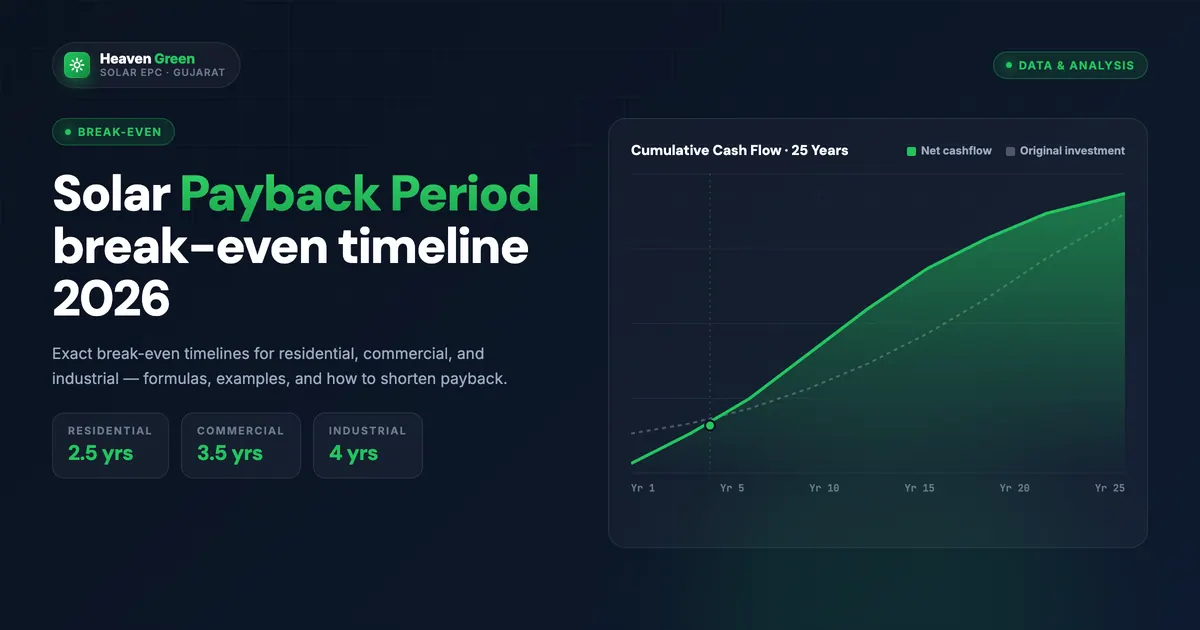
The solar payback period is the length of time required for your solar energy system to generate enough savings to offset its initial purchase and installation costs. For most systems in Gujarat, that number is between 3 and 7 years — after which you get 20+ years of effectively free electricity.
This guide shows you how to calculate your payback, what affects it, and how to make it shorter.
What Is Solar Payback Period and Why Does It Matter?
The payback period is the single most important financial metric when evaluating a solar investment. A shorter payback means:
- Faster return on your capital
- More years of “pure profit” after break-even
- Lower risk if policy or tariff structures change
Typical payback periods in Gujarat (2026):
- Residential: 4–7 years
- Commercial: 3–5 years
- Industrial: 3–4 years
How to Calculate Your Solar Payback Period
The Basic Formula
Payback Period (years) = Total System Cost ÷ Annual SavingsThat’s it at the simplest level. But a more accurate calculation accounts for subsidies and maintenance:
Payback Period = (System Cost − Subsidies) ÷ (Annual Electricity Savings − Annual Maintenance)Worked Example — 5 kW Residential System in Surat
| Factor | Amount |
|---|---|
| Gross system cost | ₹2,50,000 |
| Central subsidy | −₹50,000 |
| Net investment | ₹2,00,000 |
| Annual generation | 7,500 kWh |
| Electricity tariff | ₹6/unit |
| Annual electricity savings | ₹45,000 |
| Annual maintenance | −₹3,000 |
| Net annual savings | ₹42,000 |
| Payback period | 4.76 years |
After year ~5, you’re saving ₹42,000 per year in electricity — pure profit.
Key Factors That Affect Payback Timeline
1. System Size and Electricity Consumption
Higher consumption + well-sized system = faster payback. An undersized system leaves savings on the table; an oversized system generates excess that’s harder to monetise.
2. Local Electricity Rates
| Consumer Type | Typical Rate |
|---|---|
| Residential | ₹3–7 per unit |
| Commercial | ₹6–10 per unit |
| Industrial | ₹8–10 per unit + demand charges |
Commercial and industrial users pay higher rates — which is why their payback is faster.
3. Available Subsidies and Incentives
- PM Surya Ghar Muft Bijli Yojana: ₹30,000/kW for first 2 kW, ₹18,000 for 3rd kW (max ₹78,000)
- PM-KUSUM scheme for agricultural consumers
- Accelerated depreciation — 40% first-year depreciation for commercial/industrial
- Net metering credits for excess generation
4. Component Quality and Efficiency
Premium tier-1 panels cost 10–15% more upfront but generate 5–10% more electricity and last longer. Over 25 years, the higher-quality system typically delivers better ROI.
5. Solar Irradiation by Region
| Gujarat Region | Daily Irradiation |
|---|---|
| North Gujarat | 5.8–6.2 kWh/m²/day |
| Central Gujarat | 5.5–5.9 kWh/m²/day |
| South Gujarat (incl. Surat) | 5.4–5.8 kWh/m²/day |
| Coastal areas | Slightly lower due to cloud cover |
Real-World Payback Examples in Gujarat
Residential — 5 kW Rooftop (Surat)
- Net investment: ₹2,00,000
- Net annual savings: ₹42,000
- Payback: 4.8 years | 25-year ROI: 425%
Commercial — 50 kW Installation (Ahmedabad)
- Net investment: ₹18,00,000
- Annual generation: 75,000 kWh × ₹8/unit = ₹6,00,000
- Net annual savings: ₹5,75,000
- Payback: 3.1 years
Industrial — 200 kW Ground-Mount (Rajkot)
- Net investment: ₹60,00,000
- Annual generation: 3,00,000 kWh × ₹9/unit = ₹27,00,000
- Net annual savings: ₹26,20,000
- Payback: 2.3 years
Industrial projects consistently achieve the fastest payback due to high electricity tariffs, large demand charges, and accelerated depreciation tax benefits.
Proven Strategies to Reduce Your Payback Period
1. Claim every available subsidy. A ₹50,000 subsidy on a ₹2 lakh system shortens payback by over a year.
2. Size your system correctly. Undersized = missed savings. Oversized = unused generation. Match your system to your actual consumption.
3. Install during peak generation months. Pre-monsoon installation means you start generating during Gujarat’s high-irradiance months.
4. Use premium, high-efficiency components. More kWh from the same roof area = faster payback.
5. Optimise panel orientation. South-facing at 20–25° tilt in Gujarat maximises yearly output.
6. Maintain the system properly. 2–4 cleanings per year prevents the 5–15% efficiency loss from dust accumulation.
7. Take advantage of net metering. Every excess unit exported becomes a bill credit.
8. Consider accelerated depreciation (commercial/industrial) — 40% first-year depreciation is a major tax saving.
Common Mistakes That Extend Your Payback
- Using low-quality panels to save upfront cost — cheaper panels degrade faster
- Incorrect system sizing (under or over)
- Poor installation leading to 10–20% generation loss
- Skipping cleaning and maintenance
- Missing subsidy applications or deadlines
- Not claiming accelerated depreciation benefits
- Choosing the lowest-priced EPC over a quality partner
Frequently Asked Questions
What is a “good” payback period? Under 5 years for residential, under 4 years for commercial, under 3 years for industrial. Gujarat installations regularly hit these targets.
Does electricity tariff inflation help my payback? Yes — significantly. Tariffs rise 4–6% annually in India, which means your annual savings grow every year, shortening real-world payback.
What about after the payback period? Every unit you generate after payback is pure profit. On a 25-year system with a 5-year payback, you get 20 years of free electricity — typically totaling ₹10–15 lakh or more.
Can financing change my payback? Cash purchase has the fastest payback. Solar loans extend it by 1–2 years but reduce upfront strain. PPAs/leases give you immediate savings with no capital outlay.
Ready to Calculate Your Exact Payback?
Every installation is different. The only way to get an accurate payback number is a site assessment that accounts for your roof, consumption, and local tariff structure.
Heaven Green Energy has delivered 10,000+ installations across Gujarat — our engineers give you a detailed payback analysis specific to your site, for free.
Call +91 63904 05060 for a free solar payback calculation.