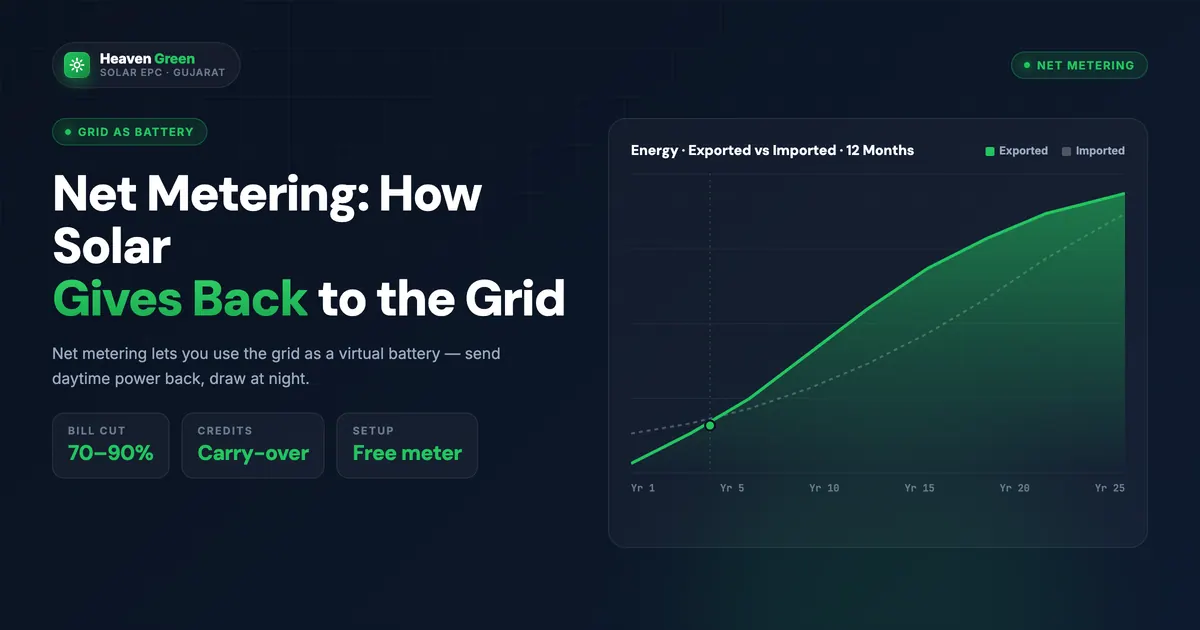
Net Metering: How Your Solar Panels Can Actually Give Back to the Grid (and Your Wallet)
Solar panels are brilliant — but they have one inconvenient habit. They generate the most power right in the middle of the day, when most people are out at work or school. So what happens to all that electricity nobody is using?
Without net metering, it mostly goes to waste. With net metering, it goes to your neighbours — and your bank account.
The Big Problem with Sunlight (and the Easy Solution)
Solar panels generate peak power during midday when occupants are typically away. Without net metering, surplus energy would be wasted or require expensive battery storage systems. The system solves this mismatch by enabling homeowners to bank daytime excess power and draw it back when needed — using the grid itself as a virtual battery.
How Does It Actually Work?
The core technology is a bi-directional meter, which tracks both imported and exported electricity.
Here’s the process, step by step:
- Daytime: Solar panels power the home; excess energy feeds back to the grid — the meter literally runs backward
- Nighttime: Standard grid power consumption occurs, drawing from what you banked earlier
- Monthly billing: Charges reflect only the net difference between exported and imported units
Think of it like a bank account for electricity. You deposit power during the day, and withdraw it at night. At the end of the month, you only pay for what you withdrew more than you deposited.
Why Should You Care? (The Benefits)
- Significant cost reduction — Electricity bills can approach zero with a well-sized system
- Eliminates battery expense — Avoids the most costly component of off-grid systems
- Potential income generation — Some utilities compensate for annual surplus production
- Minimal upkeep — No replacement cycles like battery systems require
Government Subsidy Information
The Indian national rooftop solar programme makes net metering even more attractive with direct subsidies:
| System Size | Subsidy Amount |
|---|---|
| 1 kW | ₹30,000 |
| 2 kW | ₹60,000 |
| 3 kW+ | ₹78,000 |
With these subsidies, systems typically pay for themselves in 6–8 years, after which electricity is essentially free for the remaining 17–19 years of the system’s life.
Implementation Steps
Getting net metering approved involves a straightforward process:
- Permission request with your local electricity utility (DISCOM)
- Site inspection by a utility official
- Equipment installation by an approved installer
- Certification submission to the utility
- Bi-directional meter installation by the utility at your premises
Frequently Asked Questions
Does solar work during a grid outage?
No — and for a very good reason. The system shuts down automatically during power cuts to prevent electrical hazards to utility workers who may be working on the lines. This is a mandatory safety feature, not a flaw.
What equipment do I need?
A grid-tied inverter synchronized with utility frequency is mandatory. Standard inverters won’t function with net metering, so always confirm your equipment is grid-tie compatible before installation.
Are the rules the same everywhere?
No. Rules and compensation rates differ by state and utility provider. Always check with your local DISCOM for the exact terms in your area.
Ready to make your solar panels work for you — and earn from the grid? Contact Heaven Green Energy today for a free site assessment and net metering guidance.
Heaven Green Energy Phone: +91 63904 05060 Email: hevaensolarenergy@gmail.com Hours: Monday–Friday, 9 AM–5 PM