India’s True Solar Power Potential, Now 3343 GW: What It Means for the Next 25 Years
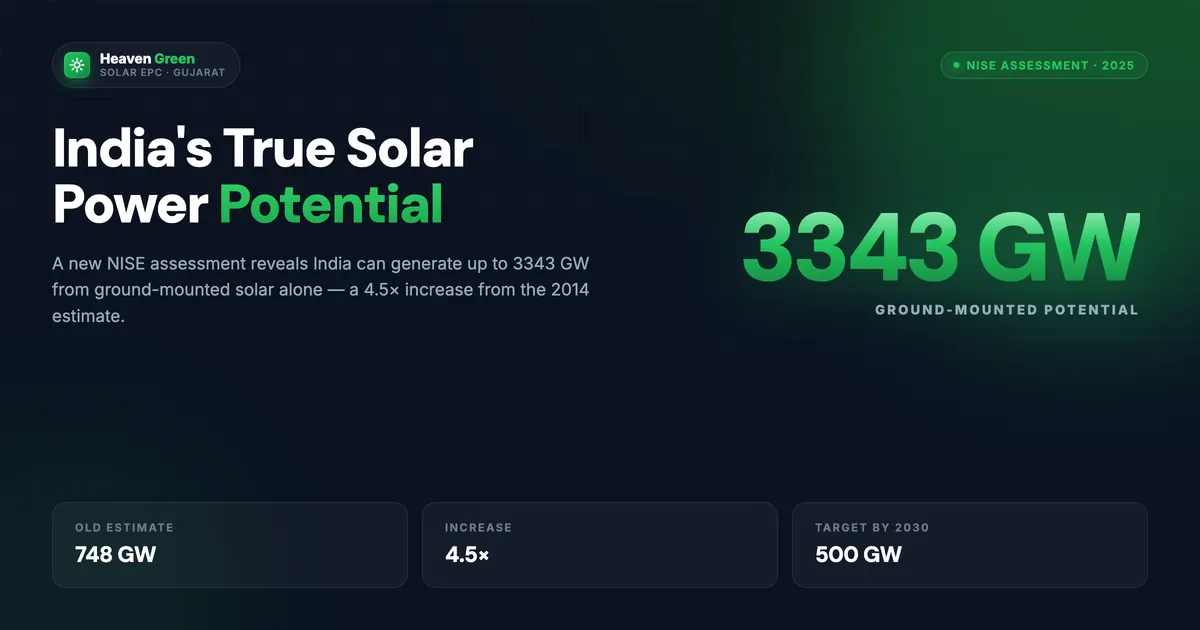
For years, India’s solar potential was quoted at around 748 GW — a number from a 2014 study that shaped policy, investment, and industry expectations for over a decade.
That number has just been revised. Dramatically.
A new national assessment from NISE (National Institute of Solar Energy) under India’s Ministry of New and Renewable Energy reveals that India can generate up to 3,343 GW of solar power from ground-mounted projects alone. That is a 4.5-fold increase from the previous estimate — and it changes the entire strategic picture for India’s energy future.
A New Solar Map of India
The updated potential is not concentrated in the traditionally recognised solar hotspots of Rajasthan and Gujarat. The research highlights that Maharashtra, Madhya Pradesh, Karnataka, Andhra Pradesh, Telangana, and numerous other states all demonstrate strong feasibility zones.
This geographic distribution is significant. It means solar development can become decentralised across India’s states — creating regional energy independence rather than a few mega-concentration zones.
How Was 3343 GW Calculated?
The NISE assessment applies rigorous screening criteria rather than theoretical maximum irradiance:
- Slopes under 10 degrees — excludes steep terrain unsuitable for solar farms
- South-oriented terrain — only land with favourable sun exposure
- Limited wasteland usage — maximum 10% of each state’s wasteland area
- Strong irradiance — minimum 3.5 kWh/m²/day
- Proximity to infrastructure and substations — ensuring grid connectivity is feasible
3,343 GW is not “possible someday” — it is achievable with coordinated planning.
The use of satellite data, GIS mapping, and modern engineering analysis makes this assessment significantly more reliable than the 2014 version.
What 3343 GW Actually Means
Energy Independence
India has set a vision of energy independence by 2047. This capacity comfortably meets India’s projected 2050 electricity demand while eliminating reliance on coal and gas imports. That is not an aspiration — it is a mathematically achievable target.
Job Creation
Solar development at this scale generates employment across:
- Module and equipment manufacturing
- Logistics and transportation
- EPC (Engineering, Procurement, Construction) services
- Operations and maintenance
- Software and monitoring solutions
- Rural community employment through land lease and local workforce
Industrial Competitiveness
Lower energy expenses enable faster scaling for Indian manufacturers competing in global markets — particularly in manufacturing, MSMEs, data centres, and textiles.
Import Reduction
Every megawatt of solar capacity deployed decreases India’s dependence on imported fossil fuels. Over 25 years, this fundamentally rebalances the trade deficit and reduces India’s exposure to global commodity price volatility.
Urban Air Quality
Decreased coal dependency translates directly to cleaner urban environments — a benefit that is difficult to quantify but impossible to overstate for India’s cities.
Benefits Across Indian Society
| Stakeholder | Benefit |
|---|---|
| Residential consumers | Stable electricity supply and lower consumer costs |
| Industry and MSMEs | Declining energy expenses and global competitiveness |
| Farming communities | Alternative income through land leasing and agrivoltaic models |
| Urban residents | Improved air quality as coal capacity is displaced |
| Government | Energy security, reduced import bills, climate commitments met |
Heaven Green Energy’s Role in India’s Solar Future
We are not observers of India’s solar story — we are active participants in building it. Our focus:
- Building optimised, long-duration solar facilities designed for 25-year performance
- Employing technology and AI-driven monitoring for performance enhancement
- Developing solar parks in high-potential regions across Gujarat and beyond
- Supporting industrial and commercial businesses in their renewable energy transition
- Creating durable energy systems that deliver on their specifications
The Conclusion That Matters
The 3,343 GW assessment is a watershed moment. It represents:
- Energy independence — no longer a dream, but a mapped and measurable reality
- Economic growth — through manufacturing, employment, and reduced import dependence
- Environmental benefit — decades of reduced emissions baked into the trajectory
- A stronger, self-reliant India — Atmanirbhar Bharat, powered by sun
India has the potential. The land, the irradiance, the engineering capability, and the policy ambition all exist. What is needed now is execution.
Want to be part of India’s solar story? Heaven Green Energy develops commercial, industrial, and utility-scale solar projects across Surat and Gujarat. Reach out to discuss your project.
Call us: +91 63904 05060 Email: hevaensolarenergy@gmail.com Hours: Monday–Friday, 9 AM–5 PM