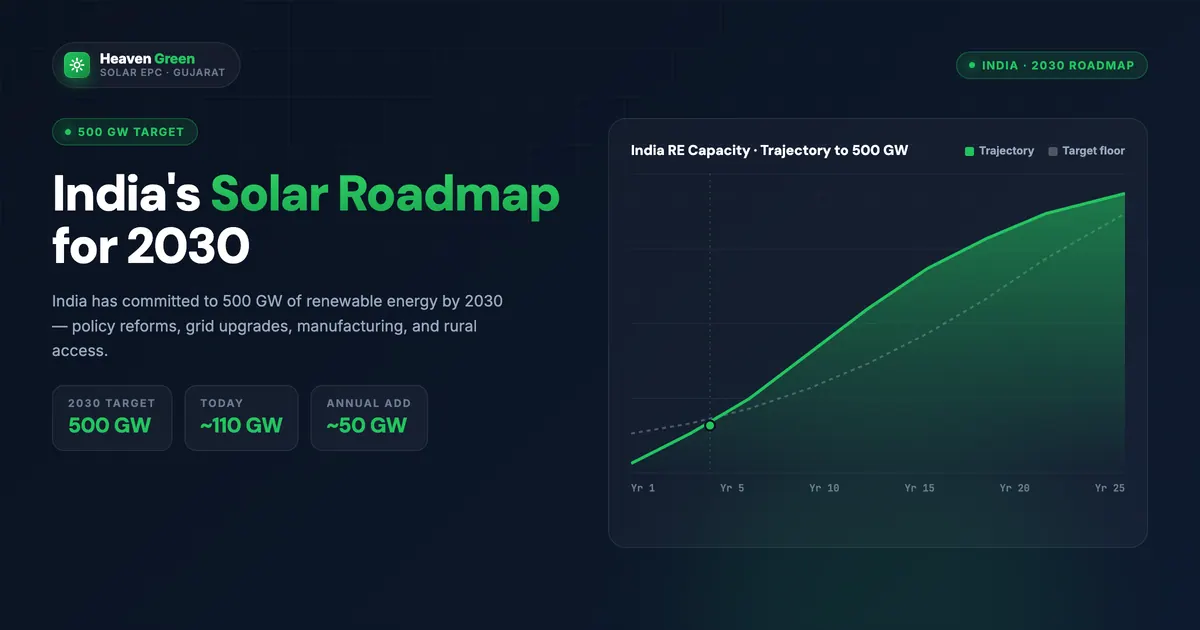
India’s Solar Energy Roadmap for 2030: A Clear, Practical, and Future-Ready Guide
India has entered a transformative decade. Solar energy is no longer an alternative — it is the foundation of the nation’s future power infrastructure.
But most discussions about India’s solar ambitions stop at the headline numbers. 500 GW by 2030. Net zero by 2070. Impressive targets — but how, exactly, do we get there?
This guide addresses the questions that mainstream coverage ignores:
- How will India actually achieve 500 GW renewable energy capacity?
- What structural reforms are needed in grid infrastructure, policy frameworks, and finance?
- What obstacles remain, and what solutions exist?
- What does a realistic, implementable solar roadmap look like for 2030?
1. India’s Renewable Power Potential: A Once-in-a-Century Opportunity
According to NITI Aayog research, India possesses:
- Over 10,000 GW of solar potential
- More than 2,000 GW of wind potential
This renewable capacity far exceeds India’s total electricity requirements — not just for today, but for decades to come.
The transition to solar is not just an environmental commitment. It is a strategic national priority encompassing:
- Energy security and independence
- Reducing fuel import expenditures
- Water resource preservation
- Pollution reduction in cities
- Job creation in clean energy sectors
2. India’s 2030 Solar Targets: What Exactly Are We Aiming For?
India has established three core commitments:
| Target | Detail |
|---|---|
| 500 GW non-fossil energy capacity | By 2030 |
| 50% electricity from renewables | By 2030 |
| 1 billion tonnes CO₂ reduction | Cumulative |
Solar technology will serve as the primary contributor due to India’s substantial solar irradiation and rapidly declining solar costs. However, most public discussions mention targets without explaining the practical mechanisms for achieving them.
3. The Four Pillars of India’s Solar Energy Roadmap
The NITI Aayog roadmap identifies four essential reform areas that must advance simultaneously:
- A stronger national renewable energy policy framework
- Ensuring consistent electricity buyers for solar power
- Streamlining project development timelines and processes
- Upgrading electrical grid infrastructure for solar and wind integration
Each pillar reinforces the others. Progress on one without the others creates bottlenecks that slow the entire transition.
4. Policy Reform: Making Solar the Primary Power Source
The report proposes a fundamental perspective shift: “Why not consider renewable energy as the primary component and construct the system accordingly?”
Key Policy Reforms Required
- A comprehensive national renewable energy statute that creates legal certainty for investors
- Strong Renewable Purchase Obligations (RPOs) enforced across all states — not just the states that choose to enforce them
- A defined financial incentive structure for early-stage adoption to de-risk investment
- National-level coordinated energy planning rather than the current fragmented state-by-state approach
Policy architecture is the essential foundation. Without robust policy structures, ambitious targets remain theoretical figures.
5. Solar Project Development: Faster, Cheaper, Smoother
A significant barrier to India’s solar expansion is the protracted and expensive project development process. Every solar project must navigate:
- Land procurement processes
- Regulatory authorisations and permits
- Grid connection approvals
- Resource measurement assessments
Three Major Improvements Proposed
A. One-Stop Shop for Solar Projects
A unified platform consolidating approvals, contractual processes, transmission information, and standardised procedures. This single reform could cut project development timelines by months and reduce soft costs substantially.
B. States and Centre Joint Committee
Coordinated governance addressing land availability, grid connectivity, and infrastructure obstacles that currently create inter-jurisdictional delays.
C. Low-Cost Financing for Solar Developers
Renewable energy projects demand significant capital. Current financing costs in India range between 12 to 14 percent — far higher than international benchmarks. Reduced interest rates would accelerate deployment across the board.
6. Grid Upgrades: India’s Most Critical Solar Challenge for 2030
This is the most frequently overlooked aspect of solar expansion. Many advocates push for more solar capacity — but few address whether the grid is ready to absorb variable renewable generation.
Five essential grid improvements are required:
A. Upgrade Grid Technology
- Real-time energy monitoring across the network
- Advanced sensor deployment at key nodes
- Enhanced data processing infrastructure for grid operators
B. Improve Forecasting
Refined solar and wind generation forecasting reduces operational uncertainty for grid operators. Better forecasts mean less reserve capacity held idle.
C. Move to 5-Minute Scheduling and Dispatch
India currently operates on 15-minute dispatch intervals. Nations with high renewable penetration use 5-minute scheduling. This single change dramatically improves grid stability as solar share increases.
D. Expand Balancing Areas
Establishing larger balancing regions allows variability in one zone to be offset by generation in another, minimising frequency deviations and reducing operational expenses.
E. Promote Flexible Energy Resources
The grid needs flexibility on both sides of the supply-demand balance:
- Pumped hydroelectric storage — proven, large-scale storage technology
- Battery energy storage systems (BESS) — fast response, increasingly cost-competitive
- Gas-fired power plants — as dispatchable backup, not baseload
- Demand management technologies — shifting industrial loads to match renewable output
Grid modernisation is the genuine foundation of India’s clean energy transformation. Without it, 500 GW of solar capacity creates instability rather than reliability.
7. Manufacturing and Jobs: India’s Solar Economy in 2030
Current manufacturing challenges are real:
- International technology reliance for cells, wafers, and key components
- Competitive pricing pressure from established manufacturing nations
- Substantial capital requirements for factory construction
By 2030, India’s roadmap targets:
- Solar module production capacity at scale
- Cell and wafer manufacturing — moving up the value chain
- Inverter and battery production facilities
- Research and innovation capabilities
- Large-scale technical workforce development
This manufacturing foundation will generate millions of employment opportunities and materially strengthen India’s energy independence.
8. The Future of Energy Access: Solar for Rural India
Approximately one-third of India’s population lacks dependable electricity access. This is not just a social challenge — it is an economic constraint.
Solar mini-grids, household systems, and hybrid configurations will:
- Supply reliable electricity to rural communities
- Enable agricultural modernisation through solar-powered irrigation
- Support small enterprise development
- Decrease costly diesel fuel dependency
Solar is an instrument for inclusive economic development — not just a utility-scale technology for cities and industry.
9. India’s Solar Energy Roadmap for 2030: The Complete Strategy
| Pillar | Action |
|---|---|
| Policy | Strong, unified national solar policy |
| Capacity | Massive scale-up in rooftop and utility solar |
| Manufacturing | Domestic module, cell, and component production |
| Finance | Transparent mechanisms and lower interest rates |
| Grid | Rapid grid modernisation and advanced forecasting |
| Storage | Expansion of energy storage and flexible resources |
| Process | One-stop shop to simplify approvals and cut soft costs |
| Access | Solar access for rural and remote regions |
10. Final Thoughts: India’s Solar Future Is Not Just Possible — It Is Inevitable
The NITI Aayog report’s central insight: “If India builds its system around renewables instead of forcing solar to fit in,” achievement of targets becomes faster, economically efficient, and environmentally sustainable.
Solar energy has transitioned from future possibility to present reality. India has commenced its trajectory toward becoming a global renewable energy authority by 2030.
The question is not whether India will get there. The question is how fast — and who will be ready when it arrives.
Heaven Green Energy is building the solar future in Surat and Gujarat today. Whether you are a homeowner, business, or industrial operation, now is the right time to make the transition.
Call us: +91 63904 05060 Email: hevaensolarenergy@gmail.com Address: 203, 204, Anupam Square, SAT Swaminarayana Temple Rd, Mota Varachha, Surat, Gujarat 394101 Hours: Monday–Friday, 9 AM–5 PM