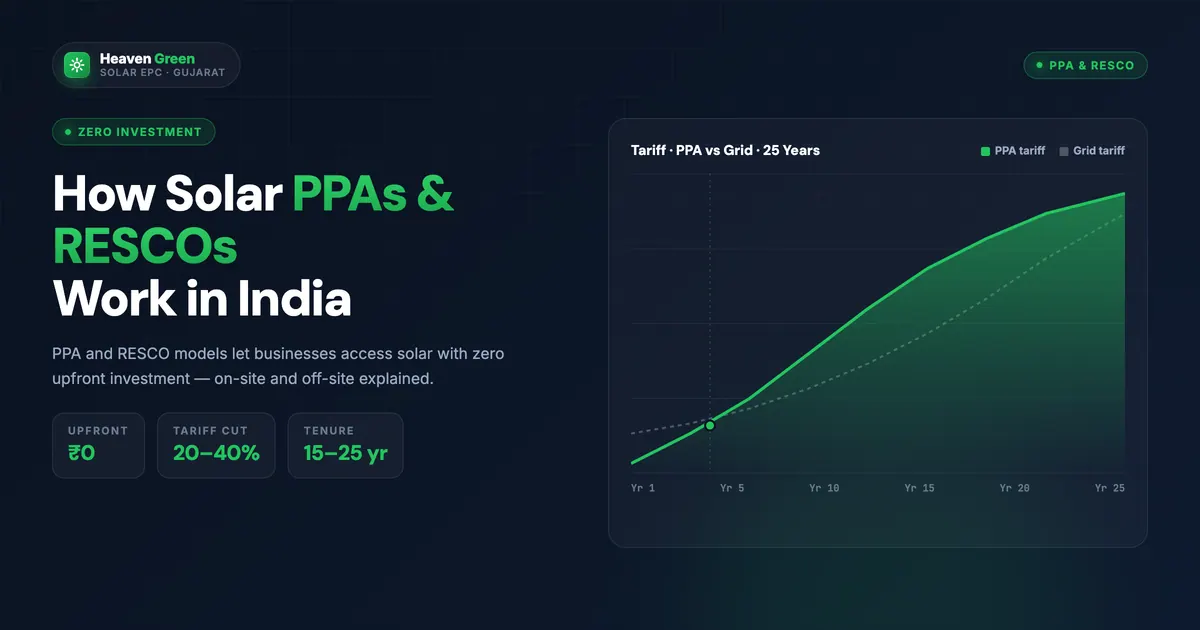
How Solar PPAs and RESCOs Work in India
Solar power is booming in India — but the upfront cost of installing panels can be daunting. What if you could go solar with zero upfront investment?
Under Solar Power Purchase Agreements (PPAs) and the RESCO model, a developer sets up a solar power system at little to no cost for the user. You then pay only for the electricity generated — typically at a rate lower than what your utility charges today.
What Is a Solar PPA?
A Solar Power Purchase Agreement (PPA) is a financial contract between two parties: a power producer (developer) and a power consumer (usually a business or institution).
How It Works
- The developer arranges design, permitting, financing, and installation at minimal cost to you
- Once operational, the developer sells the electricity to you at an agreed rate per kWh
- That rate is typically lower than your local utility’s grid tariff
- PPAs are long-term agreements, usually ranging from 10 to 25 years
- The developer owns and operates the solar system and is responsible for all maintenance
What Happens at the End of the Contract?
At contract conclusion, options typically include:
- Extending the contract at a renegotiated rate
- Purchasing the system from the developer
- Allowing the developer to remove the system per agreement terms
Understanding the RESCO Model
RESCO stands for Renewable Energy Service Company.
Under this model, a third-party company owns and operates the solar power project, selling the energy to the consumer. It is also called the OPEX model because you incur only an operating expense (periodic payment for electricity) rather than a capital expense.
The RESCO model offers a zero-investment approach for the consumer: you get a solar plant installed on your roof or premises, and you pay only for the energy it produces.
What the RESCO Is Responsible For
The RESCO develops, installs, finances, operates, and owns the solar project — even if it is physically located on your roof or land. Since the RESCO owns the equipment, it handles all operations and maintenance throughout the project’s life.
The BOOT Structure
Many RESCO contracts use a BOOT (Build, Own, Operate, Transfer) structure. This means the RESCO builds, owns, and operates the plant for the duration of the contract, then transfers ownership to you at the end.
Government Alignment
RESCO projects frequently align with government initiatives. The Indian government and state agencies have promoted rooftop solar through RESCO models, especially on government buildings and public institutions. Government entities often issue tenders inviting developers to install solar under long-term PPAs, sometimes with additional subsidies.
How Solar PPAs Work: On-Site vs. Off-Site
On-Site (Rooftop or Premise) PPA
The solar system is installed at your location — on the roof of a factory, campus of an office, or unused land at an institution.
The power is generated and consumed in the same location (behind the meter).
How It Operates Day to Day
- The RESCO sets up panels, inverters, and all equipment on your roof or campus
- During daylight hours, your operations use solar power first; any shortfall is automatically drawn from the grid
- If your system produces more than you need, surplus can flow back to the grid if you have a net metering arrangement
- The RESCO remotely monitors performance and handles maintenance tasks including panel cleaning and fault repairs
How Billing Works
- A separate meter records generated and consumed solar energy
- Every month, the RESCO bills you for solar units consumed at the agreed PPA rate
- You still receive your normal DISCOM electricity bill for any grid units used — but that bill is significantly reduced
Off-Site (Open Access) PPA
When on-site installation is not feasible due to space or scale, businesses can access solar through open access.
The solar plant is located elsewhere — a sunny rural plot or large solar farm — and power is transmitted through the public grid to your facility.
Who Can Use Open Access?
Under the Electricity Act, 2003, large power consumers (typically those with over 1 MW of connected load) can buy electricity directly from generators through open access. If your factory has a sanctioned load above 1 MW, you can source power from a solar farm hundreds of kilometres away.
Tariff and Savings
The tariff for open access solar is usually significantly lower than commercial DISCOM tariffs, and the savings can be substantial. Many industries use open access PPAs to slash energy costs and meet sustainability targets.
Additional Charges to Factor In
Because power travels through the public grid, additional charges apply:
- Transmission charges
- Wheeling charges (for using distribution lines)
- Cross-subsidy surcharges (in some states)
Even with these charges, the all-in cost of open access solar often remains cheaper than buying solely from the grid. The government has also been working to reduce open-access charges to encourage renewable energy adoption.
Financial Benefits for Businesses
Key Advantages
- Lower Electricity Bills — Solar tariffs under PPAs are typically 20–50% cheaper than grid tariffs
- Zero Capital Investment — Businesses avoid capital costs and loans; the RESCO handles all expenses
- Stable, Predictable Pricing — PPAs offer fixed or slightly escalating tariffs for 15–25 years, protecting against grid rate increases
- Hassle-Free Maintenance — RESCO developers maintain the system, often with 24/7 monitoring and performance guarantees
- Green Compliance — Helps meet ESG and sustainability targets with verifiable renewable energy use
Key Considerations
- Long-Term Commitment — You must commit to buying solar power for 10–25 years
- Credit Assessment — RESCOs prefer financially stable clients; startups may need to provide guarantees
- No Asset Ownership — The developer claims tax depreciation benefits; you save through lower tariff
- Contract Flexibility — Electricity markets evolve; understand exit clauses and escalation terms before signing
Opportunities for Landowners
If you own land in a location with good solar potential, a RESCO arrangement offers a completely passive income stream.
Benefits for Landowners
- Earn Steady Rent — Lease your land or roof to a RESCO developer and earn a fixed annual income while they set up and operate the plant
- No Effort, No Investment — Developers manage everything from permits to operations
- Long-Term Security — Lease terms often last 25–30 years with annual rent escalation clauses
- Increased Property Value — Your land becomes income-generating and grid-connected
- Regulatory Support — Developers typically handle land conversion, approvals, and compliance
- Community Benefits — Large solar projects can bring local jobs and infrastructure improvements
- Dual Option — If you need power too, you can be both the landlord and the power buyer
Frequently Asked Questions
What happens at night or when there is no sunlight?
At night or during low-radiation periods, your power needs are automatically met by the grid. Under both on-site and off-site PPA models, the grid acts as a seamless backup ensuring uninterrupted power supply.
Will I still get my regular electricity bill?
Yes, but it will be significantly reduced. You will receive two bills: one from the RESCO developer for solar power consumed, and one from the local DISCOM for any grid electricity still used.
Is there a minimum electricity usage requirement?
Yes. Most PPAs require you to commit to a minimum offtake (energy purchase) per year. This helps the RESCO recover its investment and operate sustainably.
What if my business shuts down before the contract ends?
Early termination may involve penalties. PPAs often include buyout clauses allowing you to exit by paying the developer the remaining dues or a negotiated amount. Forecast your long-term energy needs carefully before signing.
Conclusion
Solar PPAs and RESCO models have revolutionised how India is adopting clean energy by removing the biggest barrier — high upfront cost — and replacing it with a simple pay-as-you-go model.
For businesses, this means access to cheaper electricity and a greener footprint without tying up capital. For landowners, it opens a new avenue for generating steady passive income. These arrangements are tried, tested, and well-supported by policy.
Explore Solar PPA Options with Heaven Green Energy
Heaven Green Energy works with businesses and landowners across India to structure solar PPA and RESCO arrangements that deliver real, measurable value from day one. We handle the engineering, paperwork, and financing — you just enjoy lower energy costs.
Contact our team today: +91 63904 05060
Surat: +91 63904 05060 | Ahmedabad: +91 87996 96345