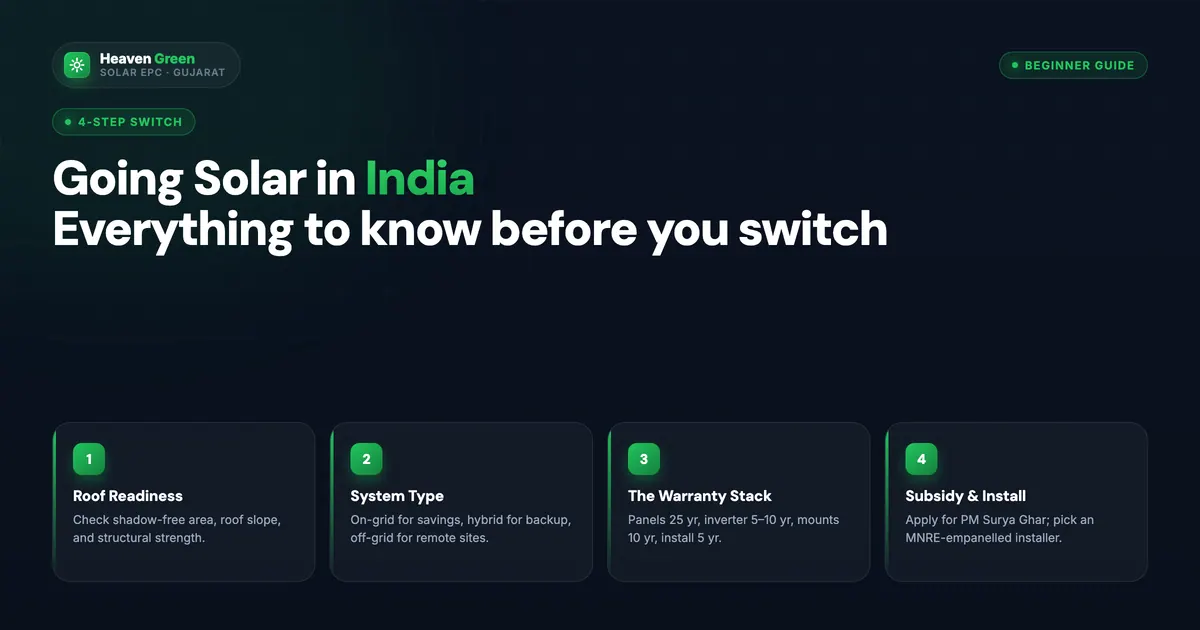
Going Solar in India: Everything You Need to Know Before You Switch
Solar energy adoption in India has accelerated dramatically. The sector expanded from 1.2 GW in 2012 to over 40 GW in recent years, following the launch of the National Solar Mission in 2010. Costs have fallen, subsidies have expanded, and rooftop solar has moved from an early-adopter curiosity to a mainstream financial decision for millions of Indian families and businesses.
But going solar is not like buying a TV or an air conditioner. Unlike a car, which you might trade in after five years, solar panels are a 25-year commitment. Early mistakes — wrong system type, poor installer, missed warranty details — result in prolonged dissatisfaction with no easy exit.
This guide is your practical checklist for navigating the process correctly. It covers pricing concerns, technical complexity, and every key decision you need to make before signing anything.
Phase 1: Is Your Roof Actually Ready?
Before thinking about panels, inverters, or subsidies, your roof needs to pass three critical assessments.
1. Weight Capacity
Standard solar panel setups add approximately 10–20 kg per square meter to your roof structure. RCC (Reinforced Concrete) roofs in good condition typically accommodate this without issue. However:
- Older buildings — particularly those 20–30 years old — may have weakened slabs
- Lightweight industrial roofing (tin sheeting, asbestos) requires different mounting approaches
- A structural expert evaluation is recommended before installation on any roof with uncertain load history
Skipping this step risks damaging the building itself, voiding your home insurance, and creating serious safety hazards.
2. Shadow Analysis
Panels should generally face south to capture the most sun across the day. But the specific placement matters enormously:
- Nearby buildings, water tanks, mobile towers, or trees create shadows that reduce generation significantly
- Even partial shading on one panel in a string can affect the entire string’s output
- A proper shadow analysis (ideally a 3D simulation) maps shading throughout the year — not just on a clear summer afternoon
Ask your installer specifically how they conduct shadow analysis. “We’ll avoid that water tank” is not an answer — a simulation showing annual generation loss is.
3. Storm Resistance
Your solar mounting structure must withstand wind loads from monsoons and cyclones. Gujarat and coastal states experience significant seasonal wind events.
- Mounting structures should be engineered for local wind zone requirements (IS 875 classification)
- Fastenings must be rated for the specific roof type
- Check whether your home insurance covers the solar system against natural disasters — if not, consider adding this coverage before commissioning
Phase 2: Choosing Your Partners and Technology
Choosing a Solar Developer
The solar installer you choose is not just a contractor — it is a 25-year relationship. Long after installation day, you will need:
- Performance monitoring support
- Warranty claim assistance
- Periodic maintenance and inspections
- Inverter replacement (likely once during the system’s life)
- Help with DISCOM documentation if you move or expand the system
Do not choose based on price alone. Company longevity, service infrastructure, and warranty accountability matter far more than saving ₹10,000 on the quote.
What to evaluate:
- How long has the company been operating? (10+ years is reassuring)
- Do they have verifiable references from customers with systems similar to yours?
- Do they employ in-house engineers, or subcontract all technical work?
- Do they have a local service presence — or will service calls require technicians from another city?
Installation Warranty: Developers typically provide 5–10 years of workmanship coverage, addressing installation quality defects. This is separate from — and in addition to — manufacturer equipment warranties.
Grid-Tied vs Off-Grid Systems
This is one of the most important decisions you will make.
Grid-Tied Solar (Net Metering)
The most popular and economically sound option for most Indian households and businesses.
How it works:
- Your solar panels generate power during the day
- Excess power you do not immediately consume flows to the utility grid
- You receive billing credits for that exported power
- At night or on cloudy days, you draw from the grid as normal
Key advantages:
- Lower system cost — no batteries required
- Grid serves as your “backup” at no additional cost
- Strong financial returns through bill reduction and export credits
Key limitation:
- The system shuts down automatically during power outages. This is a mandatory safety feature (anti-islanding protection) to protect utility workers repairing lines. If backup power during outages is a priority, you need a hybrid system with batteries.
Off-Grid Solar (with Battery Storage)
Provides complete energy independence and backup power during outages.
Advantages:
- Total independence from the grid
- Uninterrupted power during outages
Serious considerations:
- Batteries are expensive — adding significant upfront cost
- Batteries require periodic replacement (typically every 8–12 years), which impacts long-term ROI
- Battery replacement costs must be factored into your financial calculations — some systems that look profitable on paper become marginal when battery lifecycle costs are included
For most urban and semi-urban Indian households with a reliable grid: on-grid with net metering is the correct choice. Off-grid only makes clear sense in areas with genuinely unreliable or absent grid power.
Phase 3: Understanding the Fine Print
The Warranty “Layer Cake”
Solar systems comprise multiple components from different manufacturers, each with distinct and separate guarantees. Understanding this structure is essential — most customers do not, and it creates unpleasant surprises later.
Solar Panels
- Manufacturing defect coverage: 10 years (covers physical defects, delamination, cell failures)
- Performance guarantee: 25 years (guarantees the panel will still produce a specified percentage of its rated output — typically 80% — after 25 years)
These are two different warranties from the panel manufacturer. Both matter. Read both.
Inverters
The inverter is often called the “brain” of the solar system — it converts DC power from your panels into AC power your home can use.
- Standard warranty: 5–10 years
- Unlike panels, inverters contain electronic components that degrade faster
- Plan for at least one inverter replacement during your solar system’s 25-year life
This is not a flaw — it is a known characteristic of current inverter technology. Premium inverters with extended warranties (some now offer 12 years) reduce this uncertainty.
Installation (Workmanship)
- Developer-provided coverage: 5–10 years
- Covers installation quality defects: roof leaks from improper mounting, electrical faults from poor connections, structural failures
This is the warranty that protects you from the consequences of poor engineering. If your installer offers less than 5 years of workmanship warranty, that is a warning sign.
Summary Warranty Table
| Component | Defect Coverage | Performance Coverage |
|---|---|---|
| Solar panels | 10 years | 25 years |
| Inverter | 5–10 years | N/A |
| Installation (workmanship) | 5–10 years | N/A |
Insurance Considerations
- Ensure the installer carries liability insurance during installation — covering accidents that occur while crews work on your roof
- After commissioning, verify whether your home or business insurance policy covers the solar system
- Standard home insurance often requires an endorsement for permanently installed equipment
- For larger commercial or industrial systems, standalone solar plant insurance is available and advisable
Government Subsidies in 2026
The Indian government provides significant financial support for rooftop solar. The current scheme structure:
- Up to 3 kWp: 40% subsidy credited directly to your bank account
- 3 kWp to 10 kWp: 20% subsidy on the additional capacity above 3 kWp
Example — 5 kW system: 40% on first 3 kW + 20% on next 2 kW = significant reduction in your net cost.
Critical subsidy access requirement: To receive the subsidy, you must use a developer on your DISCOM’s empaneled (approved) list. The government only releases subsidies for installations completed by authorized companies. Verify your installer’s empanelment status through your local electricity board’s website before signing any contract.
Installing with an unempaneled contractor — even if they promise to “sort out” the subsidy later — is the most common way customers lose their subsidy entitlement entirely.
Phase 4: Maintenance is Not Optional
Solar panels are durable — but not maintenance-free. The distinction matters.
Panels have no moving parts, and they will not stop working if left alone. But operational efficiency degrades meaningfully without upkeep.
What Affects Performance Without Maintenance
Dust accumulation is the primary performance thief in India’s climate. A thin layer of dust across your panels can reduce generation by 15–25% within weeks. In cities with industrial activity, near main roads, or in semi-arid regions, accumulation is faster.
Bird droppings create even more concentrated shading effects than general dust, because they block specific cells completely rather than reducing irradiance uniformly across the panel.
Warranty Implications of Neglect
This is critically important and often overlooked:
A lack of maintenance can sometimes void your performance warranty.
Many panel manufacturers include maintenance requirements in their warranty terms. If a warranty claim investigation reveals that panels were not regularly cleaned and the performance shortfall is attributable to soiling rather than product defect, the claim may be denied.
Retain records of all cleaning and service visits throughout your system’s life.
Maintenance Recommendations
- Cleaning frequency: Every 15–20 days during summer; monthly in other seasons (adjust for your location and local dust levels)
- Never use high-pressure water or abrasive materials — this damages anti-reflective coatings
- Clean during early morning or evening — never on hot panels in direct sun
- Annual professional inspection of electrical connections, inverter performance, and structural integrity
Annual Maintenance Contracts (AMC) are worth evaluating seriously. A good AMC covers scheduled cleaning, performance monitoring, inverter checks, and priority breakdown response — for a predictable annual cost that is a small fraction of the value protected.
Conclusion: The Smartest Investment You Can Make
Switching to rooftop solar is one of the best ways to secure a lifetime of nearly free electricity. It is a smart move for your wallet and for the planet — provided you do your homework first.
The difference between a solar system that delivers 25 years of strong returns and one that creates 25 years of frustration often comes down to three decisions:
- Whether your roof was properly assessed before installation
- Whether you chose an installer with genuine engineering capability and service infrastructure
- Whether you maintain the system consistently throughout its life
Get those three things right, and solar energy will be one of the best financial decisions you ever make.
Ready to Switch? Start with Heaven Green Energy
Heaven Green Energy is a leading Solar EPC provider with over 10,000 successful projects completed across Gujarat, specializing in residential, commercial, and industrial installations. We are MNRE empaneled, authorized Adani Solar distributors, and provide end-to-end support from site assessment through commissioning and long-term AMC.
Our team handles subsidy applications, DISCOM documentation, and net metering activation — so you can focus on enjoying the savings.
Call us today: +91 63904 05060 Email: hevaensolarenergy@gmail.com Offices: Surat | Ahmedabad | Junagadh