Connecting Solar to the Grid Is Harder Than You Think
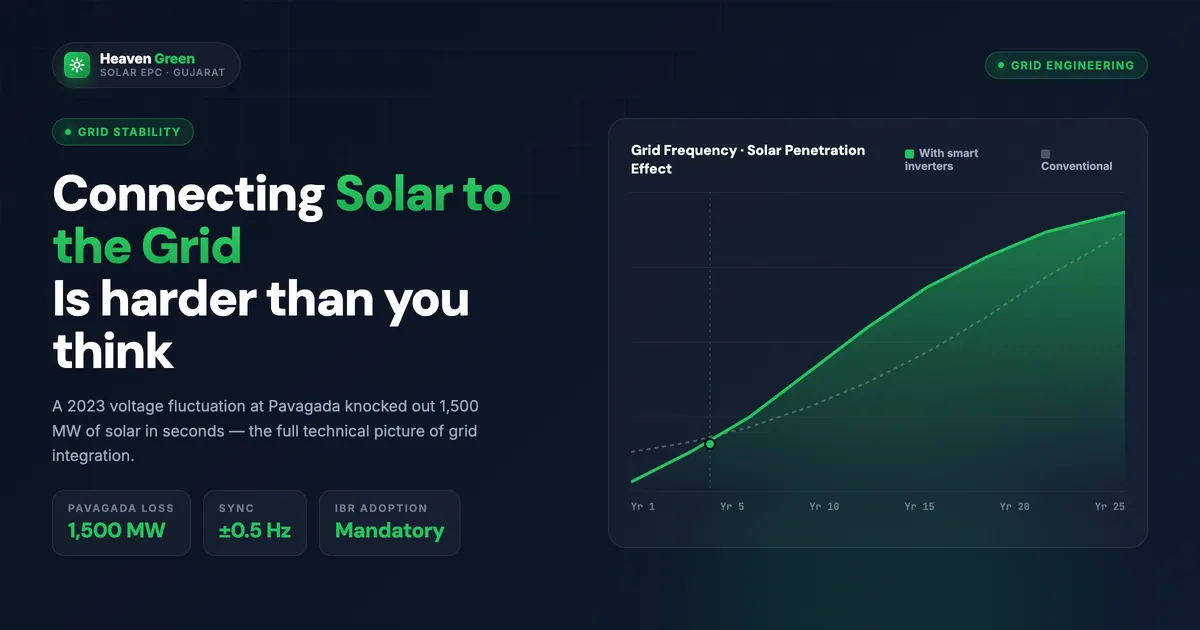
In July 2023, a voltage fluctuation at Pavagada Solar Park in Karnataka triggered cascading disconnections of over 1,500 megawatts of solar generation — nearly instantly. The event caused a frequency dip in the Southern grid to around 49.85 hertz, exposing just how fragile the interface between large-scale solar and the grid can be.
Solar panels generate clean electricity. But connecting that electricity to a grid that was designed around rotating machines is a multi-layered engineering challenge that most industry conversations simply gloss over.
Understanding Inverter-Based Resources and the Grid
Traditional power plants — coal, gas, hydro, nuclear — use rotating turbines that generate AC electricity directly. Solar panels and battery systems produce DC, requiring conversion through inverters.
The collective term for solar, wind, and batteries is Inverter-Based Resources (IBRs). As IBRs grow to dominate India’s grid, the engineering challenges multiply.
Why AC Matters
India’s 50 Hz grid uses AC because it can be stepped up or down in voltage efficiently using transformers, enabling long-distance transmission. Solar panels generate DC. Inverters bridge this gap by converting DC to grid-compatible AC — matching frequency, voltage, and phase precisely.
Get this wrong, and the inverter trips offline. Do it at scale across thousands of installations, and you have the Pavagada scenario.
The Evolution of the Inverter
Early inverters used electromechanical switching and lacked precision. Modern solid-state inverters use Pulse Width Modulation (PWM) to simulate clean sine waves from DC input. The quality of this simulation matters — affordable inverters may produce imperfect waveforms that affect grid synchronisation and introduce harmonics.
This is one reason why inverter quality is not a place to economise on large solar projects.
Grid-Following Inverters
Most Indian rooftop and commercial solar systems use grid-following inverters. These:
- Detect the grid’s voltage waveform
- Lock onto it using Phase-Locked Loops (PLLs)
- Follow the grid’s lead on frequency and voltage
This design explains a common question: why does solar not work during a power cut? Grid-following inverters shut down automatically during grid failures — because there is no signal to follow. This is a safety feature, not a design flaw.
Maximum Power Point Tracking (MPPT)
Even with perfect synchronisation, getting the most out of solar panels requires continuous optimisation. MPPT algorithms dynamically adjust the electrical load presented to panels to extract maximum power under varying:
- Sunlight intensity
- Temperature
- Panel orientation
- Partial shading conditions
MPPT is particularly critical in large solar parks, where conditions vary across thousands of panels simultaneously.
The Frequency Stability Problem
India’s grid is maintained near 50 Hz. Variations outside a narrow band can damage equipment and, at extremes, cause grid collapse.
Traditional power plants provide frequency stability through rotational inertia — the physical momentum of spinning turbines. When demand exceeds supply, turbines slow slightly, absorbing the imbalance while automatic control systems respond. Inverter-based resources have no such physical inertia.
As renewable penetration increases, grids become more vulnerable to frequency instability. This is not a flaw of solar — it is a characteristic of IBRs that requires engineering solutions.
How India Is Responding
With India’s renewable capacity exceeding 125 GW (including over 85 GW solar), grid operators now require large solar plants to provide primary frequency response. Advanced inverters can provide synthetic inertia — algorithmically simulating the stabilising effect of rotating turbines.
This capability is increasingly mandated by the CEA (Central Electricity Authority) for utility-scale projects above certain thresholds.
Operating Reserves and Market Economics
Grid stability requires operating reserves — generation capacity held back from full output, ready to respond within seconds if frequency dips. For solar plants competing on the Indian Energy Exchange (IEX), this creates a direct tension between maximising revenue and providing the grid services POSOCO mandates.
Navigating this balance is a growing part of commercial solar plant operations.
Fault Management and Ride-Through
Grid disturbances — short circuits, line trips, transformer faults — can trigger rapid voltage changes. Without protective specifications, these events cause cascading disconnections like Pavagada. India’s CEA grid standards now require:
- Low-Voltage Ride-Through (LVRT) — inverters must remain online during brief voltage sags rather than tripping immediately
- Frequency Ride-Through — inverters must tolerate frequency deviations within specified limits
These requirements add cost to inverter specifications but prevent the catastrophic chain reactions that can destabilise an entire regional grid.
The Future: Grid-Forming Inverters
The next evolution in solar grid integration is the grid-forming inverter — a fundamentally different approach that can:
- Operate in islanded mode independently of the main grid
- Support black start capabilities (restarting a grid section after total blackout)
- Actively provide voltage and frequency stabilisation rather than just following the grid
Grid-forming inverters are being piloted in smart grids and microgrids across India’s Northeast and Ladakh regions — environments where grid reliability is critical and conventional infrastructure is limited.
They are central to India’s Mission 500 GW by 2030.
What This Means in Practice
| Challenge | Current Solution | Future Direction |
|---|---|---|
| DC to AC conversion | PWM inverters | Higher efficiency wide-bandgap semiconductors |
| Grid synchronisation | Phase-Locked Loops | Improved PLL algorithms |
| Frequency stability | Synthetic inertia | Grid-forming inverters |
| Fault ride-through | CEA-mandated LVRT | Enhanced ride-through specifications |
| Power optimisation | MPPT algorithms | AI-driven dynamic optimisation |
Conclusion
The Pavagada incident in 2023 was a wake-up call. Solar grid integration involves multi-layered engineering challenges spanning synchronisation, power optimisation, frequency stability, and fault management. The panel is the easy part.
Building a future grid that is clean, stable, and resilient requires continued R&D investment, updated regulatory frameworks, and engineers who understand that solar does not simply plug into the grid — it must be intelligently integrated with it.
Success requires continued R&D investment and regulatory foresight to build a future grid that is clean, stable, and resilient.
Heaven Green Energy designs solar power systems with full grid integration engineering — from inverter selection to protection coordination. Whether you are planning a rooftop system or a large commercial solar plant, we get the engineering right.
Call us: +91 63904 05060 Email: hevaensolarenergy@gmail.com Hours: Monday–Friday, 9 AM–5 PM